
Antiparasitic agents
a technology of acetonitrile and pentafluorothiobenzamidoacetonitrile, which is applied in the field of antiparasitic agents, can solve the problems that the mechanism by which these agents act has not yet been fully elucidated
- Summary
- Abstract
- Description
- Claims
- Application Information
AI Technical Summary
Problems solved by technology
Method used
Image

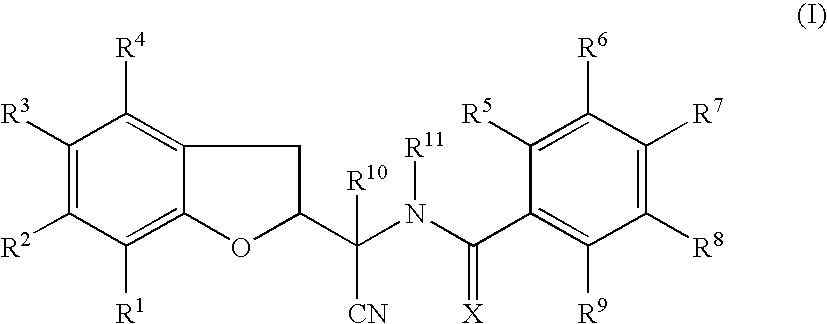
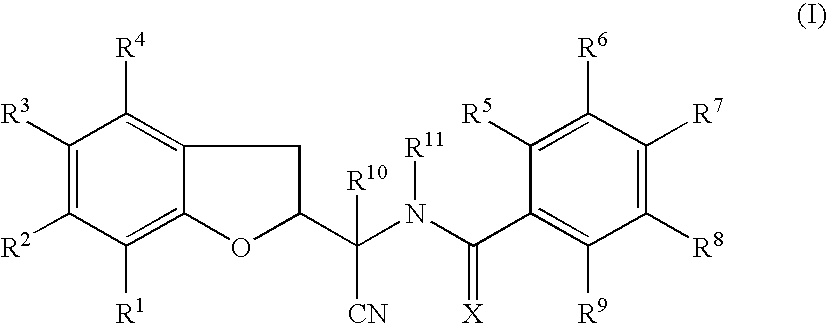
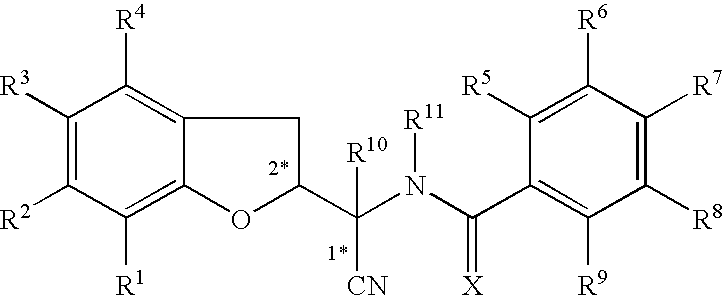
Examples
example 1
N-[1-Cyano-1-(5-cyano-2,3-dihydro-1-benzofuran-2-yl)ethyl]-4-(trifluoromethoxy)benzamide
[0202]
[0203]To a solution of the compound of Preparation 1 (14.4 g, 67.5 mmol) and N,N-diisopropylethylamine (14.0 ml, 81.0 mmol) in tetrahydrofuran (100 ml), at 0° C., was added dropwise 4-(trifluoromethoxy)benzoyl chloride (10.8 ml, 70.9 mmol) in tetrahydrofuran (5 ml). The reaction mixture was stirred at room temperature for 18 h and then concentrated in vacuo. To the residue was added ethyl acetate (200 ml) and the solution was washed with hydrochloric acid (0.1M, 80 ml), saturated aqueous sodium hydrogen carbonate solution (100 ml) and brine (50 ml), dried (MgSO4) and concentrated in vacuo. A portion of the residue (approximately 5 g) was purified by column chromatography (silica), eluting with 1% methanol in dichloromethane. The appropriate fractions were combined and concentrated give the compound of Example 1a (1.4 g) as a mixture of 4 diastereoisomers.
[0204]The compound of Example 1a (ap...
example 1a
[0206]1H-NMR (CDCl3): 1.76-1.78 and 1.90-1.92 (3H), 3.39-3.46 (1H), 3.46-3.60 (1H), 5.20-5.24 and 5.59-5.62 (1H), 6.37-6.39 and 6.52-6.54 (1H), 6.86-6.91 (1H), 7.30-7.34 (2H), 7.48-7.51 (2H), 7.80-7.85 (2H)
example 1b
[0207]1H-NMR (CDCl3): 1.72-1.75 (3H), 3.35-3.40 (1H), 3.46-3.51 (1H), 5.58-5.61 (1H), 6.32-6.35 (1H), 6.90-6.92 (1H), 7.30-7.33 (2H), 7.49-7.51 (2H), 7.81-7.83 (2H)
PUM
| Property | Measurement | Unit |
|---|---|---|
| temperature | aaaaa | aaaaa |
| temperature | aaaaa | aaaaa |
| temperature | aaaaa | aaaaa |
Abstract
Description
Claims
Application Information
 Login to View More