
LED chain failure detection
a technology of led chain and failure detection, applied in the direction of electric variable regulation, process and machine control, instruments, etc., can solve the problems of affecting the overall system efficiency, affecting the relative power savings of a cluster with a minimal amount of leds, and affecting the current of a large amoun
- Summary
- Abstract
- Description
- Claims
- Application Information
AI Technical Summary
Benefits of technology
Problems solved by technology
Method used
Image

Examples
Embodiment Construction
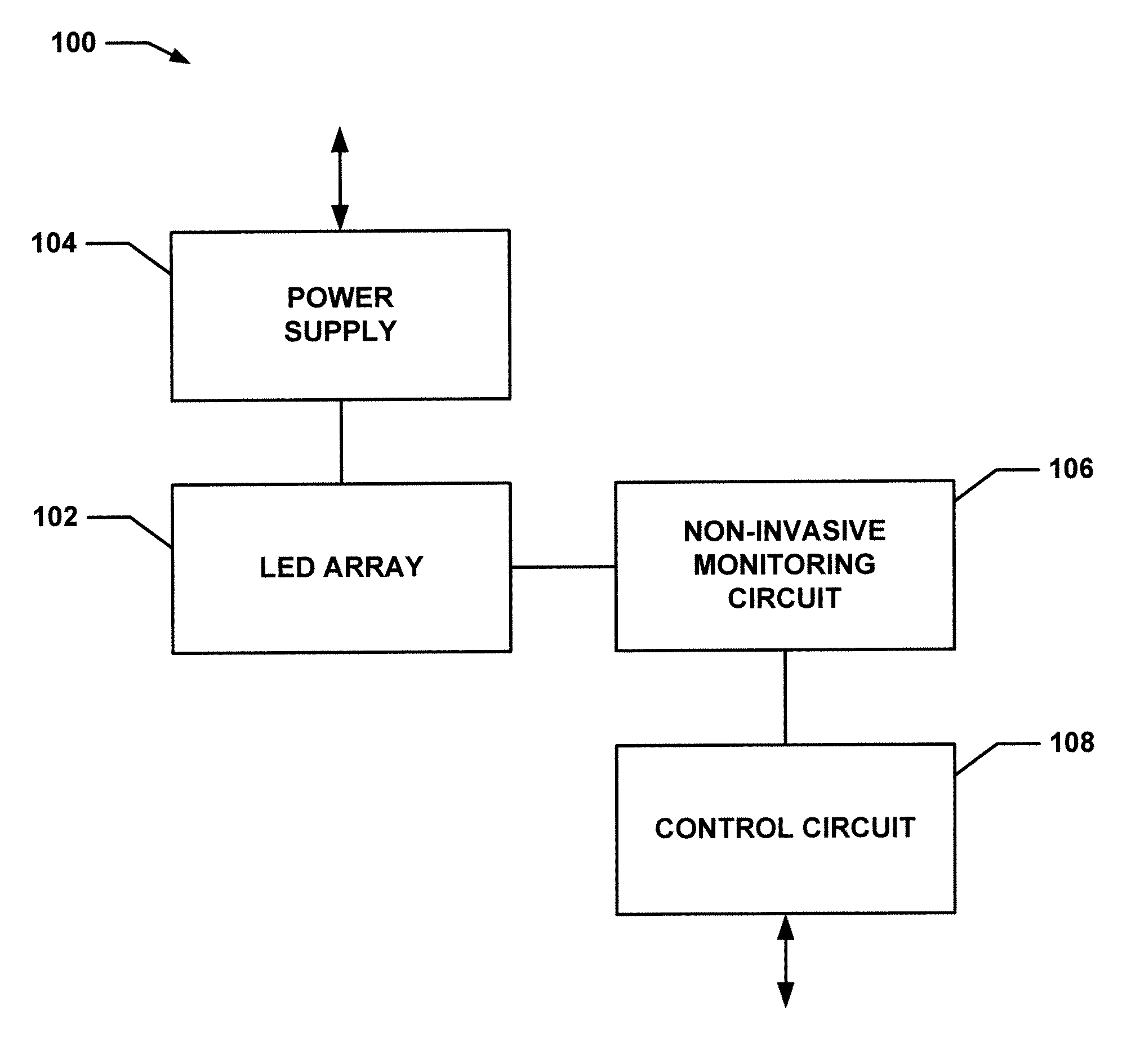
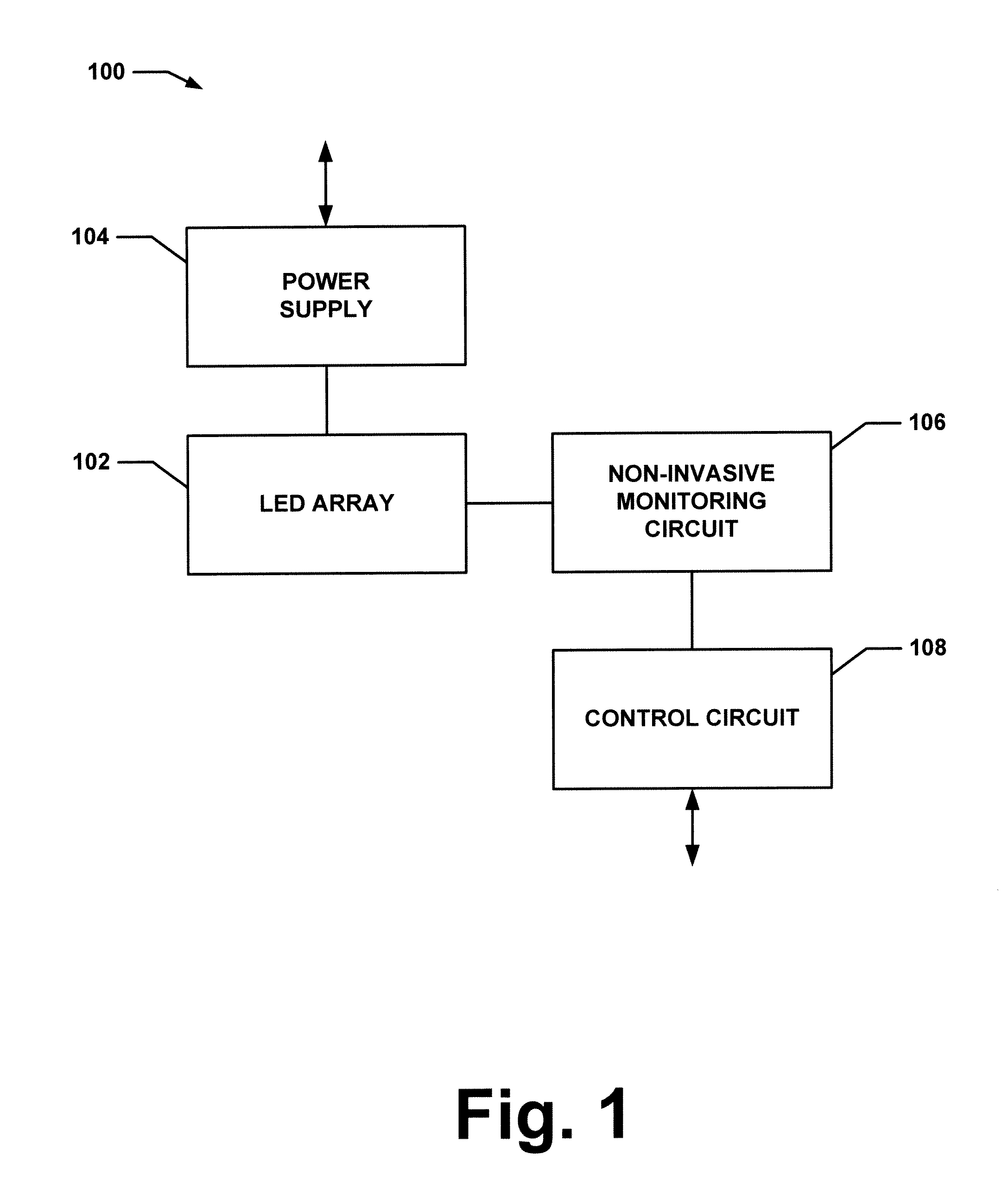
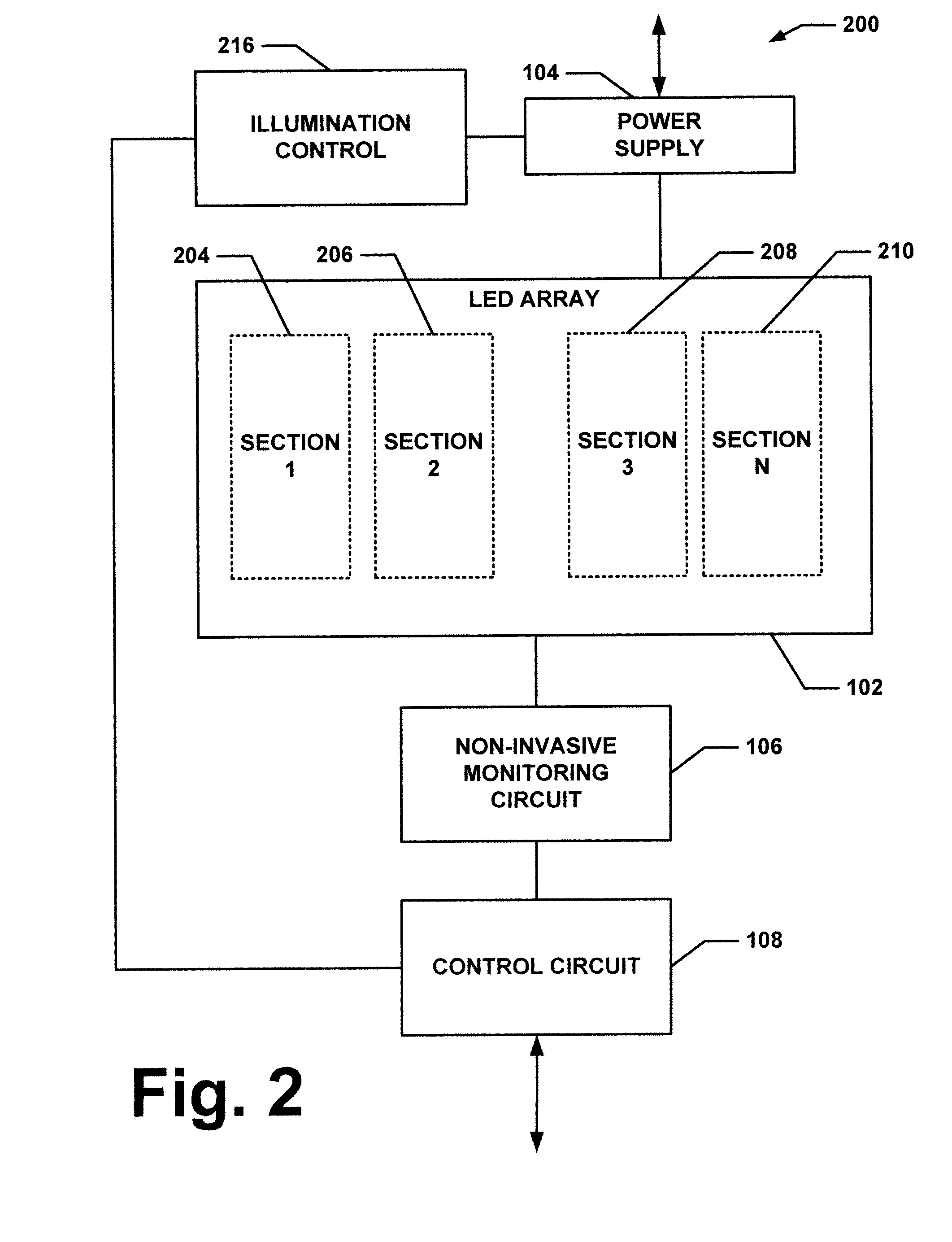
[0013]FIG. 1 illustrates a lighting system 100 that includes an LED array 102 that is energized via a power supply 104. The LED array 102 interfaces with a non-invasive monitoring circuit (NIMC) 106 that monitors one or more aspects of the LED array (e.g., light output, current draw, etc.). A control circuit 108 is coupled to the NIMC 106 to compare values read by the NIMC 106 to one or more predetermined parameters. If the values from the NIMC 106 are outside such predetermined thresholds, the control circuit 108 can provide an output (e.g., to a disparate system, to maintenance personnel, etc.) to provide such indication.
[0014]The LED array 102 can include a number of disparate configurations. In one example, the LED array 102 includes a plurality of LEDs connected in series. Power is delivered across the serially connected LEDs via the power supply 104. In a second example, the LED array 102 includes a plurality of serially connected LEDs wherein each serial connection is coupled...
PUM
 Login to View More
 Abstract
Description
Claims
Application Information
 Login to View More