[0008]The characteristic features according to the invention provide the
advantage that the shielding or attenuating of electromagnetic fields between the first and the second area by electromagnetically shielding components is overcome, so that
wireless communication is no longer restricted to the first area. Hence,
RF communication means like NFC devices can be arranged in both the first and the second area. Further, electromagnetic signals arriving in the second area are received by an antenna in the first area. Even in the case where a PCB of the communication device causes
electromagnetic shielding, it is still possible to position RF communication means on both sides of a PCB of the device, since the
magnetic flux of electromagnetic signals is guided between the first and the second area. Compared with prior art devices RF communication capability of electronic circuits located in the second area is dramatically increased. It should be observed that the term “shielding component” as used throughout this text is to be understood in a sense that it does not necessarily cause complete shielding of electromagnetic fields, but attenuates a
magnetic field to some extent. It should further be noted that the ferrite is not necessarily arranged in the first area as a whole. The ferrite may rather be part of the second area too.
[0009]It is advantageous when said ferrite is arranged to bridge the first area with the second area and / or when said ferrite penetrates said shielding components. These measures provide the
advantage that the
magnetic flux is guided with high
coupling efficiency between the first and second areas. For instance, when the shielding component is a multi-layer PCB comprising at least one grounding layer, a through hole can be provided in the PCB through which the ferrite projects.
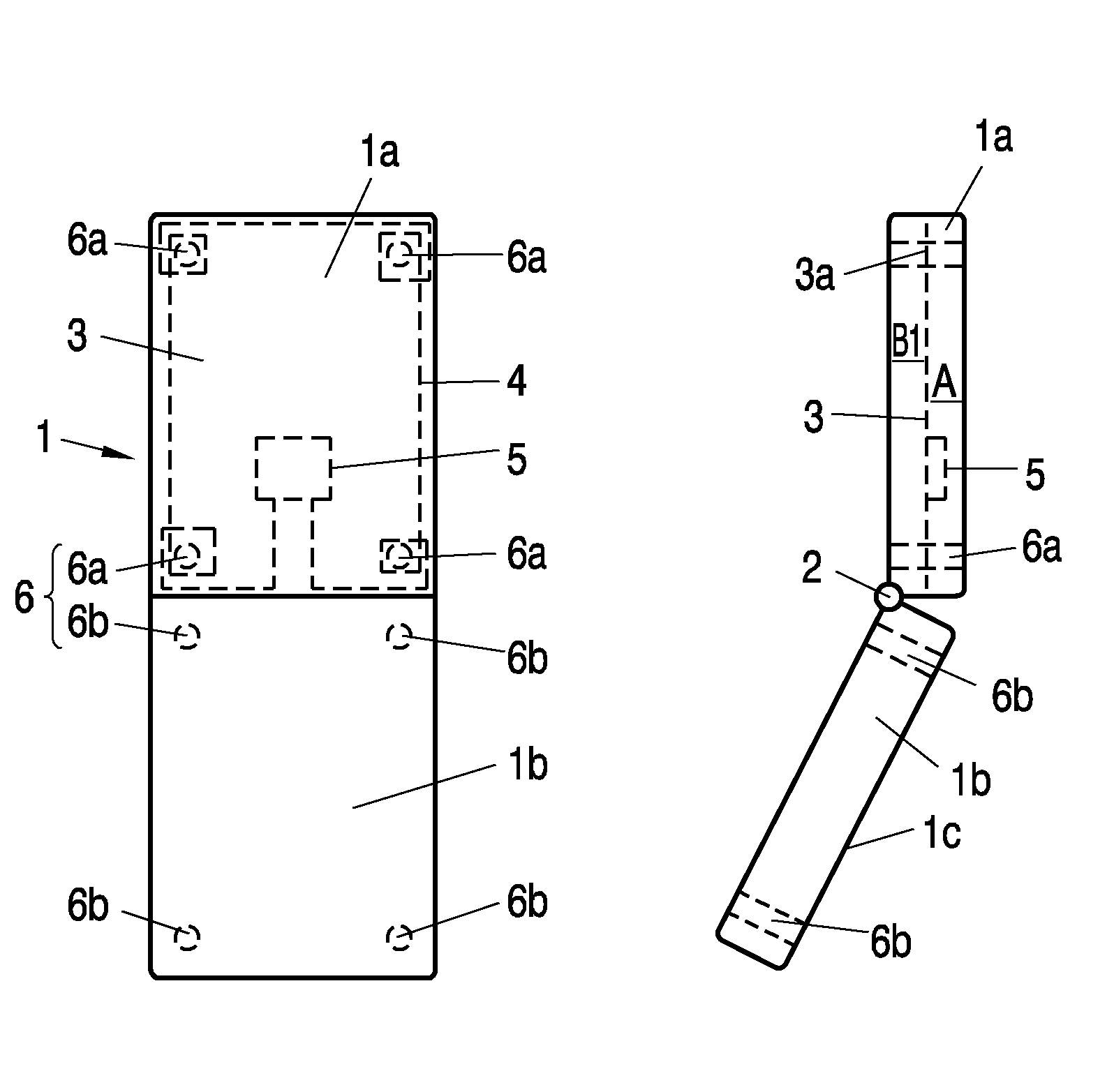
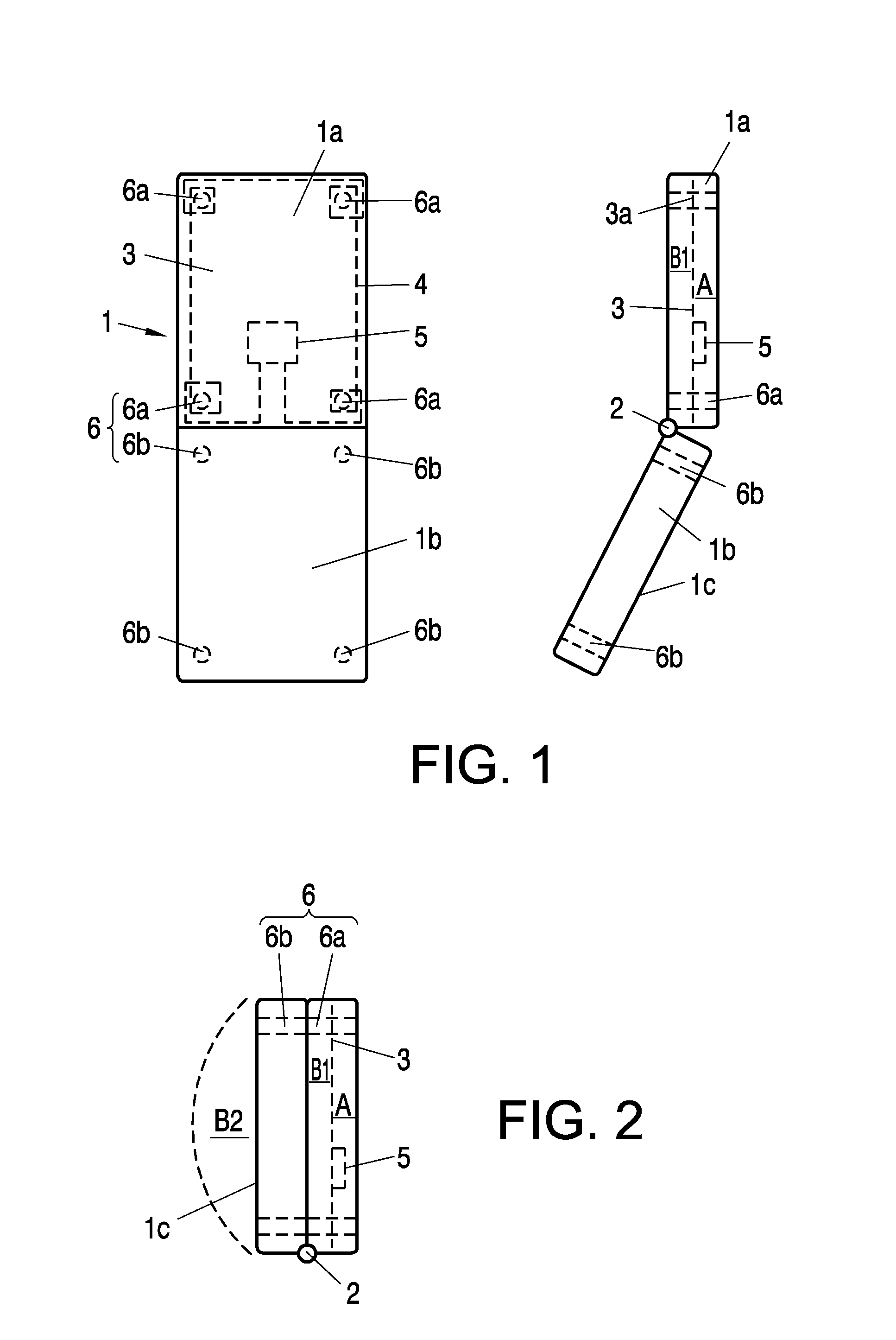
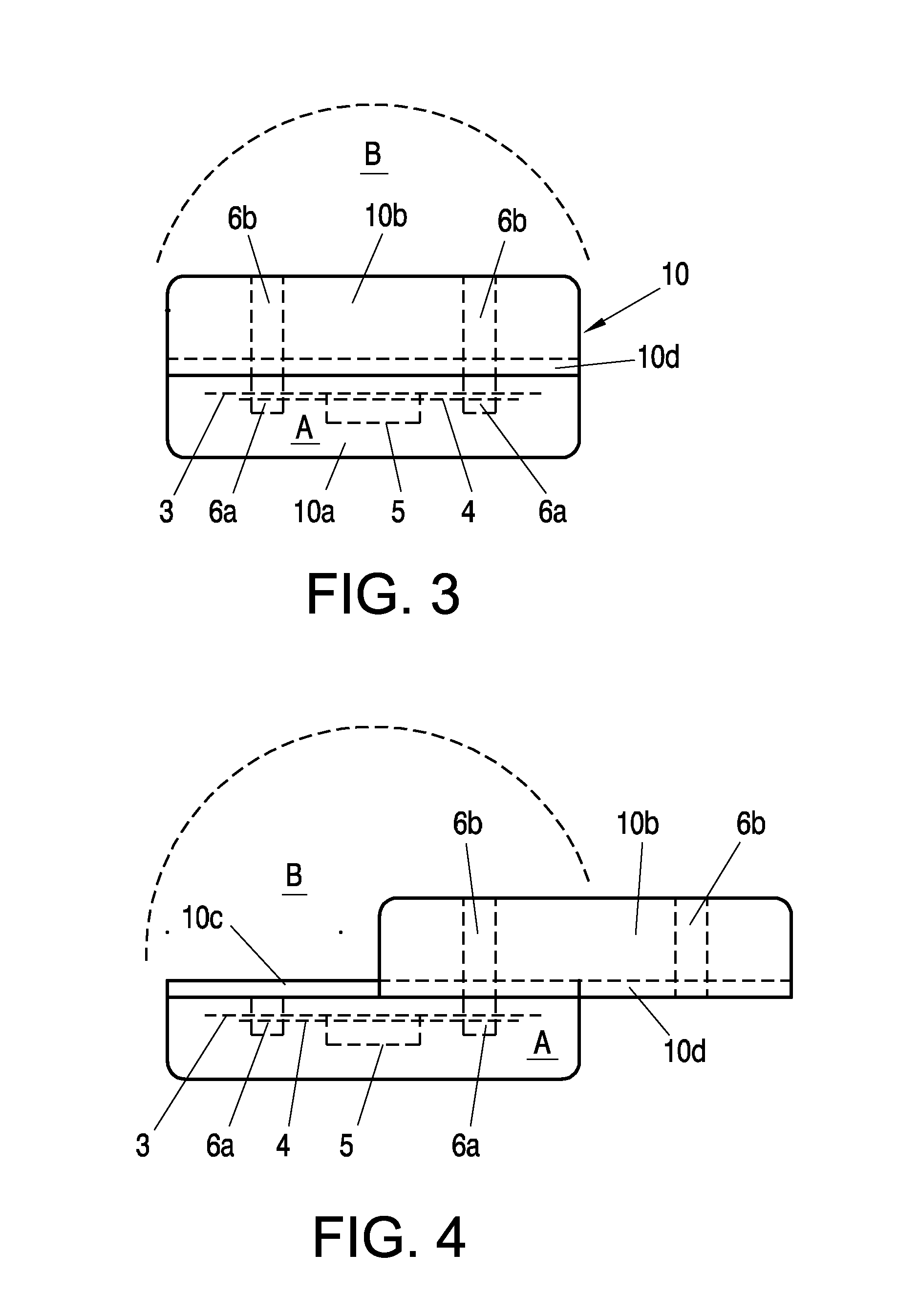
[0010]It is further advantageous, when said mobile communication device comprises a first device portion and a second device portion, which are displaceable in respect of each other between a first and a second operating position, wherein the ferrite is split into a first ferrite part being arranged in the first device portion and a second ferrite part being arranged in the second device portion, wherein in the first operating position said first and second ferrite parts are adjacent to each other and in the second operating position said first and second ferrite parts are interspaced. Hence reception and transmission of electromagnetic fields can be ensured in all areas of the mobile communication device even when the mobile communication device comprises two or more portions that are displaceable with respect to each other. Further, by splitting the ferrite into ferrite parts, a very compact but flexible structural shape of the communication device can be achieved.
[0011]It is further advantageous, when said first device portion and said second device portion are connected by means of a hinge, or by means of a slide. Thus a predefined first and second operating position is given, so that wireless communication works in both areas of the communication device irrespective of whether the device is opened or closed.
[0012]Yet another preferred embodiment of the invention is a mobile communication device, wherein the ferrite is a ferrite rod split into first and second ferrite parts transverse to its longitudinal axis, and the first and second ferrite parts are arranged in the first device portion and second device portion in such a manner that in the first operation position they are arranged coaxially. Therefore the
advantage that the ferrite parts complement each other to a ferrite rod that guides a magnetic flux with high efficiency is provided, since the respective axes of the ferrite parts coincide and the adjacent faces of the ferrite parts are abutting so that magnetic losses are minimized.
[0017]These measures provide the advantage that the production process of such a device can be highly automated and is applicable to PCB mounting processes. Further, a single antenna can generate a magnetic flux in a plurality of ferrites. By directing the
electrical conductor of the antenna as proposed in the aforesaid manner, losses of magnetic flux are kept very low and the
electromagnetic field is concentrated in the regions where the ferrites are positioned.


 Login to View More
  Login to View More