Neurorestoration With R(+) Pramipexole

a technology of pramipexole and neuroneural stimulation, which is applied in the direction of anti-noxious agents, drug compositions, biocides, etc., can solve the problems of autosomal genetic variant relevance, decline of function, and few therapies

a technology of pramipexole and neuroneural stimulation, which is applied in the direction of anti-noxious agents, drug compositions, biocides, etc., can solve the problems of autosomal genetic variant relevance, decline of function, and few therapies

US20080234338A1Inactive Publication Date: 2008-09-25UNIV OF VIRGINIA ALUMNI PATENTS FOUND

Image

Smart Image Click on the blue labels to locate them in the text.
Viewing Examples
Smart Image
  • Neurorestoration With R(+) Pramipexole
  • Neurorestoration With R(+) Pramipexole
  • Neurorestoration With R(+) Pramipexole

Examples

Experimental program
Comparison scheme
Effect test

example 1

Clinical Studies of R(+) Pramipexole

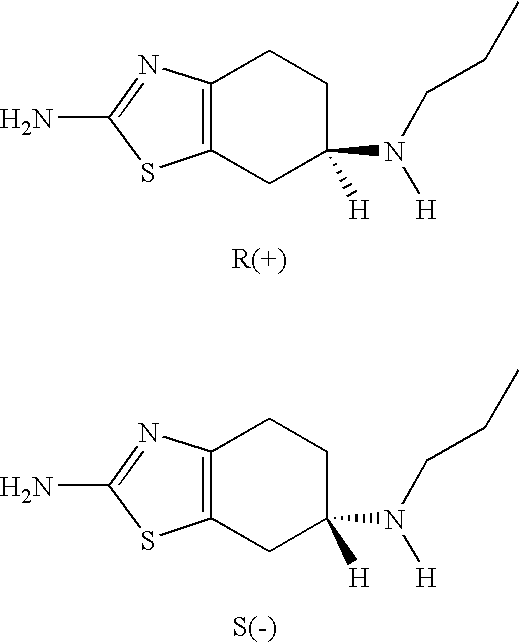
[0076]Phase I clinical studies with R(+) pramipexole were conducted in patients with amyotrophic lateral sclerosis (ALS), a fatal adult neurodegenerative disease arising from the loss of motor nerve cells. During the studies, it was found that the approximately half the patients treated with 30 mg / day of R(+) pramipexole for up to 8 weeks reported improvements in motor function. These reports included such things as regaining the ability to speak coherently, the ability to climb stairs again, and improved motor skills in their extremities, i.e. hands and / or fingers. This data indicates that rather than simply slowing the loss of function, R(+) pramipexole improves and restores function in an otherwise rapidly progressive neurodegenerative disease.

the structure of the environmentally friendly knitted fabric provided by the present invention; figure 2 Flow chart of the yarn wrapping machine for environmentally friendly knitted fabrics and storage devices; image 3 Is the parameter map of the yarn covering machine
Login to View More

PUM

PropertyMeasurementUnit
enantiomeric excessaaaaaaaaaa
Login to View More

Abstract

Formulations and methods of use thereof for restoring neuronal tissue function in children and adults afflicted with chronic neurodegenerative diseases, such as neurodegenerative movement disorders and ataxias, seizure disorders, motor neuron diseases, and inflammatory demyelinating disorders. Examples of disorders include Alzheimer's disease (AD), Parkinson's disease (PD), and amyotrophic lateral sclerosis (ALS). The method involves administering a pharmaceutical composition containing an effective amount of a tetrahydrobenzathiazole, preferably a formulation consisting substantially of the R(+) enantiomer of pramipexole. R(+) pramipexole is generally administered in doses ranging from 0.1-300 mg / kg / daily, preferably 0.5-50 mg / kg / daily, and most preferably 1-10 mg / kg / daily for oral administration. Daily total doses administered orally are typically between 10 mg and 500 mg. Alternatively, R(+) pramipexole can be administered parenterally to humans with acute brain injury in single doses between 10 mg and 100 mg, and / or by continuous intravenous infusions between 10 mg / day and 500 mg / day.

Description

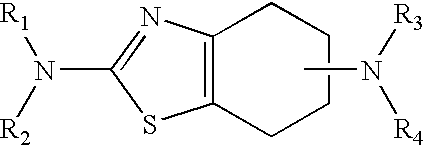
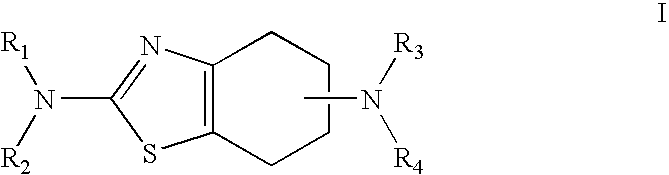
CROSS-REFERENCE TO RELATED APPLICATIONS[0001]This application is a filing under 35 U.S.C. ยง 371 of PCT / US2006 / 031831 filed with the U.S. Receiving Office on Aug. 15, 2006, which claims the benefit of U.S.S.N. 60 / 708,213, filed in the United States Patent and Trademark Office on Aug. 15, 2005, all of which are incorporated by reference in their entirety.[0002]The United States government may have certain rights in this invention by virtue of National Institutes of Health Grant Nos. NS35325, AG14373, NS39788, and NS39005 to James Bennett.FIELD OF THE INVENTION[0003]The present invention relates to the use of pramipexole (2-amino-4,5,6,7-tetrahydro-6-propylaminobenzathiazole), and analogs and derivatives thereof, to restore neuronal, muscular (cardiac and striated) and / or retinal tissue function. More particularly, the invention is directed to the use of the substantially pure stereoisomer R-(+)-2-amino-4,5,6,7-tetrahydro-6-propylaminobenzathiazole, and pharmacologically acceptable sal...

Claims

the structure of the environmentally friendly knitted fabric provided by the present invention; figure 2 Flow chart of the yarn wrapping machine for environmentally friendly knitted fabrics and storage devices; image 3 Is the parameter map of the yarn covering machine
Login to View More

Application Information

Patent Timeline
25 Sep 2008
Publication
US20080234338A1
IPC
A61K31/428; A61P25/28
CPC
A61K31/428; A61P21/00; A61P25/00; A61P25/16; A61P25/28; A61P27/02; A61P39/06; A61P9/00
Inventors
BENNETT JR., JAMES P.