

Method and system for tracking and positioning continuous cast slabs
a technology of continuous cast and tracking system, applied in the direction of manufacturing tools, mould control devices,foundry moulding apparatus, etc., can solve the problems of strands that may tend to wander, distort, twist, etc., and achieve the effect of reducing the thickness of strands
- Summary
- Abstract
- Description
- Claims
- Application Information
AI Technical Summary
Benefits of technology
Problems solved by technology
Method used
Image

Examples
Embodiment Construction
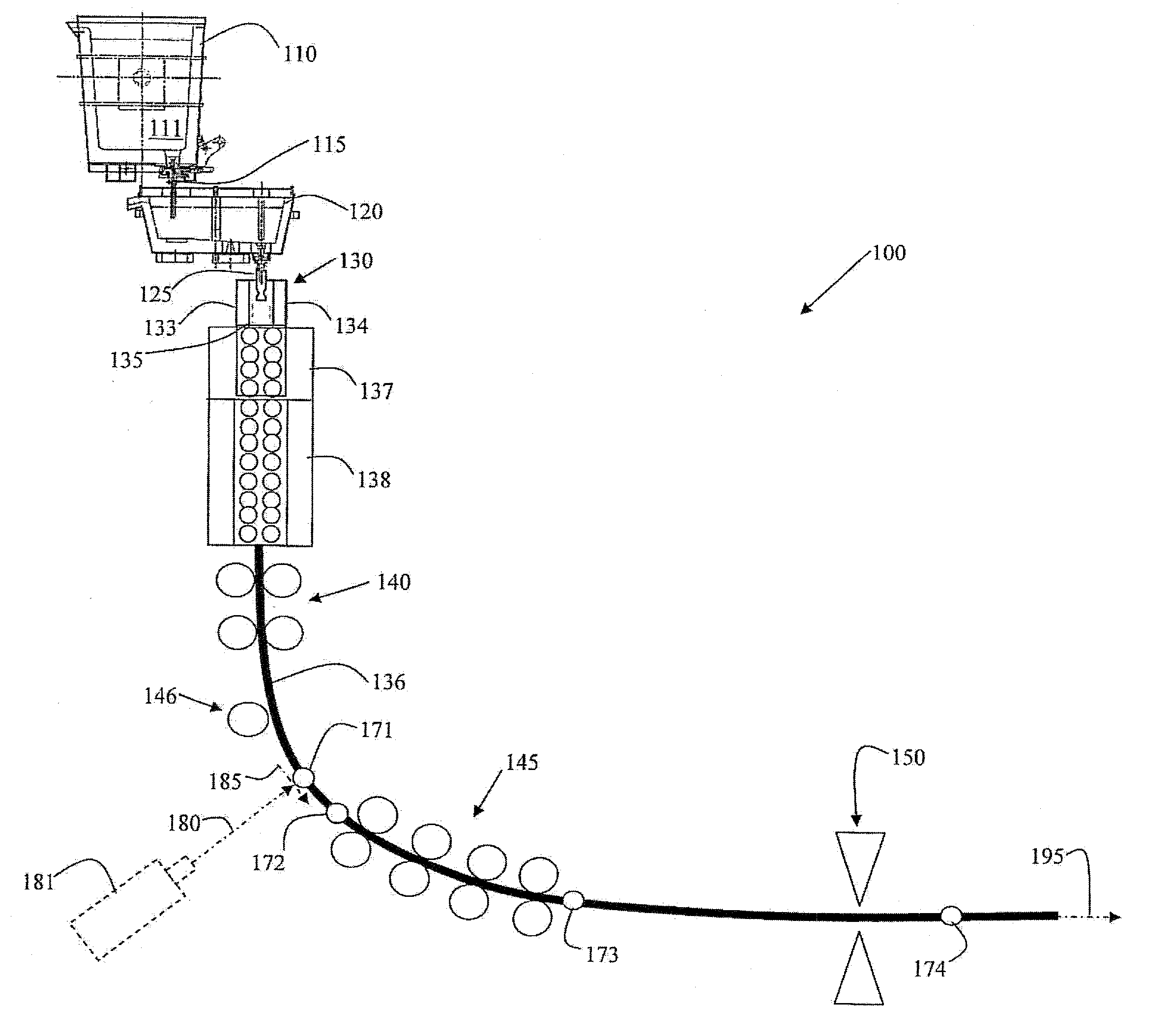
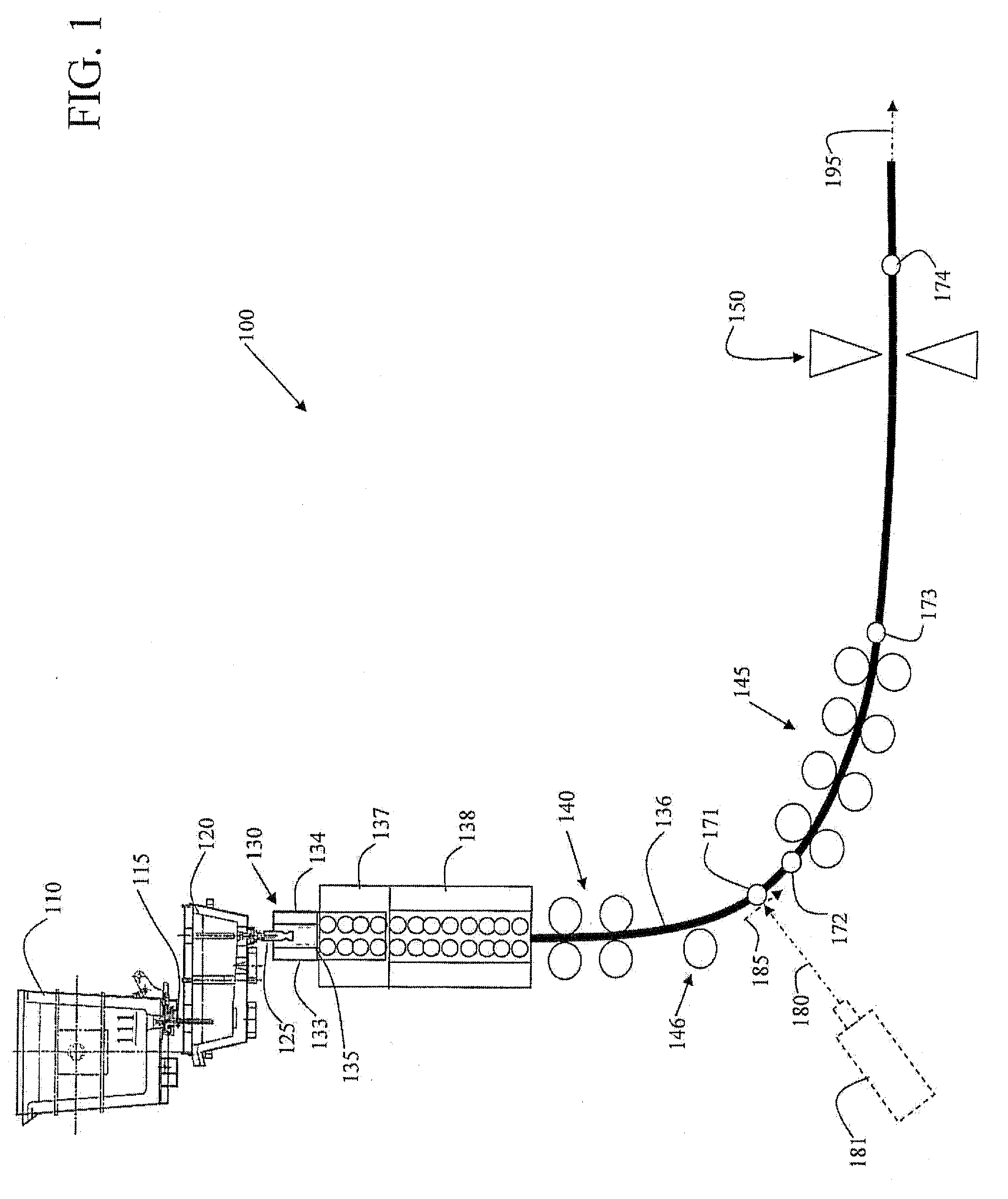
[0057]FIG. 1 is a schematic illustration of an embodiment of a continuous metal slab casting plant 100. The steel slab casting plant 100 includes a ladle 110 to provide molten steel 111 to a tundish 120 through a shroud 115. The tundish 120 directs the molten melt 111 to the casting mold 130 through a submerged entry nozzle (SEN) 125 connected to a bottom of the tundish 120. The casting mold 130 includes at least two opposing mold faces 133 and 134, which may be fixed or moveable. The SEN 125 delivers the molten melt into the casting mold 130 below the surface (“meniscus”) of the molten metal in the casting mold 130.
[0058]The width of the cast strand 136 leaving the casting mold 130 is substantially determined by the configuration of the caster mold faces at the mold exit at 135. The casting mold 130 has two opposing broad mold faces 133 and 134 and two opposing narrow mold faces (not shown) to form a substantially rectangular configuration, or some other desired configuration for t...
PUM
| Property | Measurement | Unit |
|---|---|---|
| elevation | aaaaa | aaaaa |
| drive speed | aaaaa | aaaaa |
| roll force | aaaaa | aaaaa |
Abstract
Description
Claims
Application Information
 Login to View More