[0005]Advantageously, embodiments of the present invention provide techniques for applying circumferential lesions to the
pulmonary vein (PV) ostia to cause conduction block at the junction of the PV and
left atrium as well as other blocking lesions. Such techniques are well suited for use with patients presenting with paroxysmal (focal)
atrial fibrillation. Exemplary embodiments involve the administration of precisely controlled ablative energy to create reproducible, uniform transmural lesions during
cardiac surgery. Such techniques enable rapid and effective ablative lesions in a variety of clinical situations, including endocardial and epicardial ablations. By forming the transmural ablations, surgeons are able to achieve conduction block in the patient.
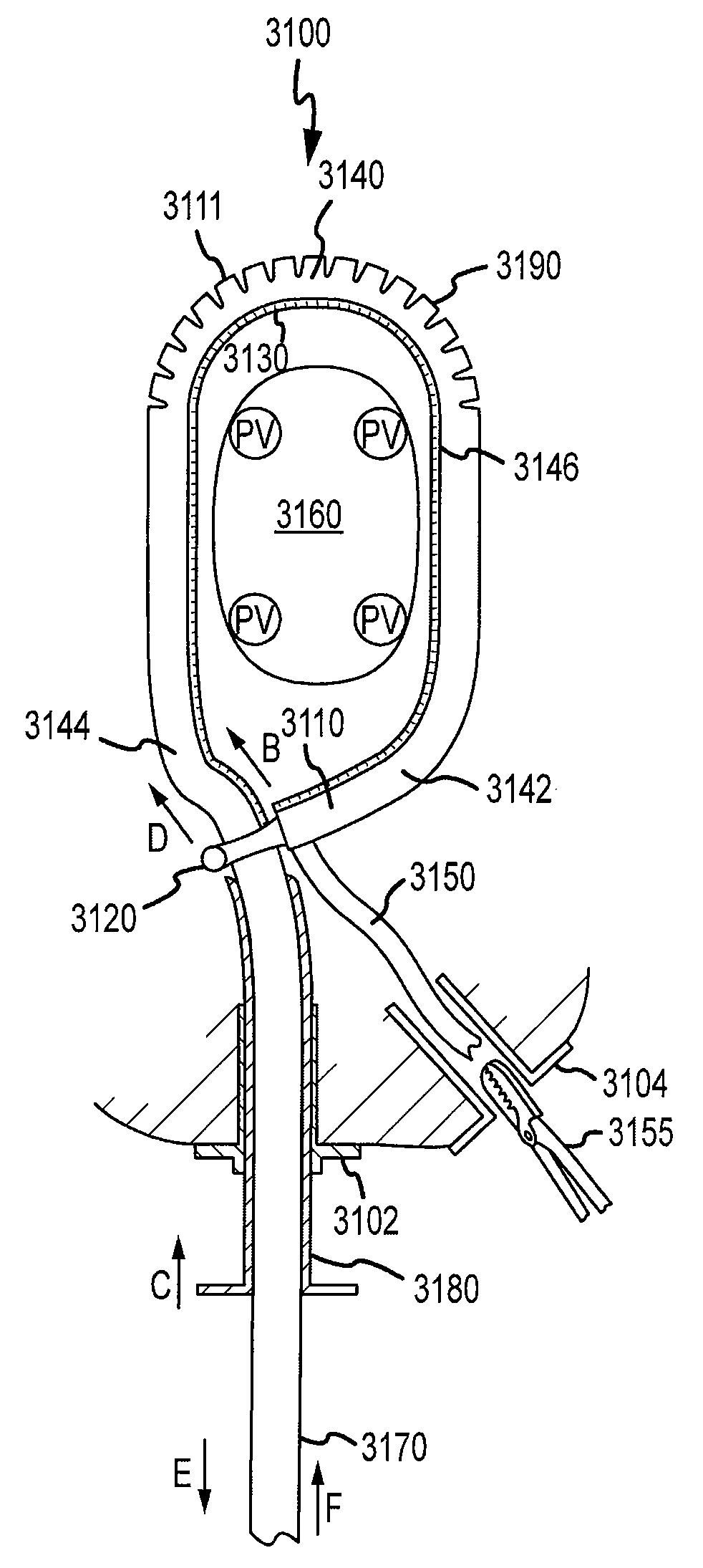
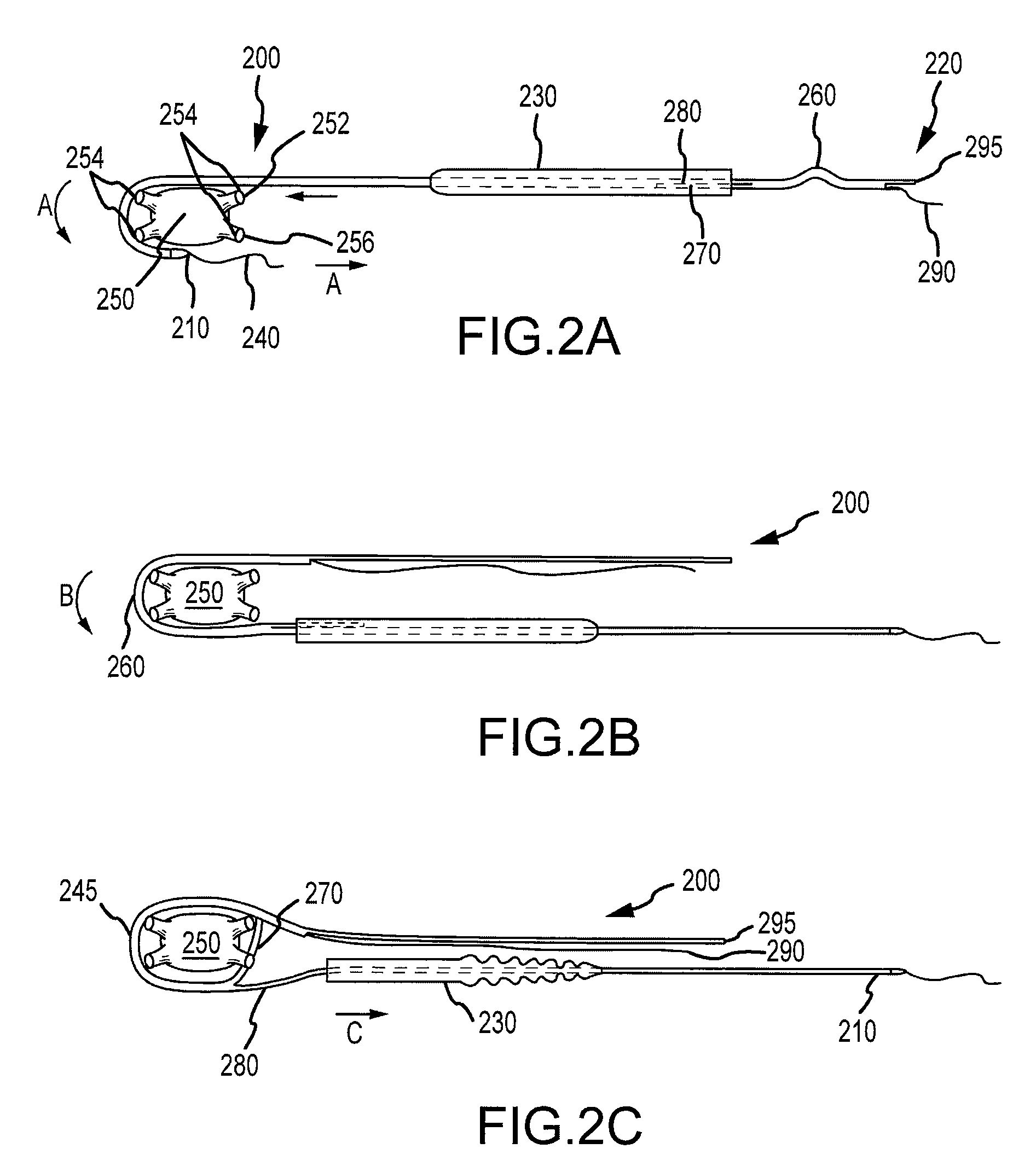
[0006]Embodiments of the present invention include introducer systems and instruments equipped with magnetic elements that facilitate one-sided port introduction and can reduce procedure times significantly, in many cases to less than one hour. Embodiments also provide systems with flexible suction probes or stabilizer mechanisms that can be used in conjunction with cinching mechanisms or delivery tubes, which are well suited for use on any patient tissue or
anatomy of any size or shape. Cinching mechanism facilitate length adjustability for variable atria
lesion sizes and box
lesion sizes, for example. Hence, it is possible to form a complete box lesion with a single
device placement with minimal or no gaps. In some embodiments, techniques involve unilateral 10 mm
port access. Systems and methods disclosed herein are also well suited for creating Cox Maze lesions. For example, a single device can be used to create a transmural box lesion and a connecting lesion. In some embodiments, a surgeon or operator can use a cinching mechanism such as a delivery or push tube as a placement wand. Suction stabilizer mechanisms can be operatively associated with cinching mechanisms such as delivery tubes to facilitate length adjustability of a stabilizer mechanism, an
ablation mechanism, or both. Improved
coupling techniques for introducers and introducer retrievers can vastly improve introducer search times, which often can occupy more than half of the entire
procedure time. Introducers, stabilizer and ablation assemblies, and other components of the treatment systems described herein can have curved configurations, such as
helical curves, for improved routing into the oblique sinus from a transverse sinus, for example. Embodiments also provide
single step continuity, whereby a cinching delivery mechanism can easily be used to snare a distal tape to form a continuous box lesion without the need for repositioning or additional instruments. Advantageously, embodiments of the present invention can be used to create complete lesion sets and reliably produce transmural lesions on a
beating heart.


 Login to View More
  Login to View More