
Method and System for Filtering Elongated Features
a technology of feature and filtering method, applied in image enhancement, instruments, computing, etc., can solve the problems of high computational cost of neither the design of a steerable filter kernel nor the linear combination, and achieve the effect of more efficien
- Summary
- Abstract
- Description
- Claims
- Application Information
AI Technical Summary
Benefits of technology
Problems solved by technology
Method used
Image

Examples
second embodiment
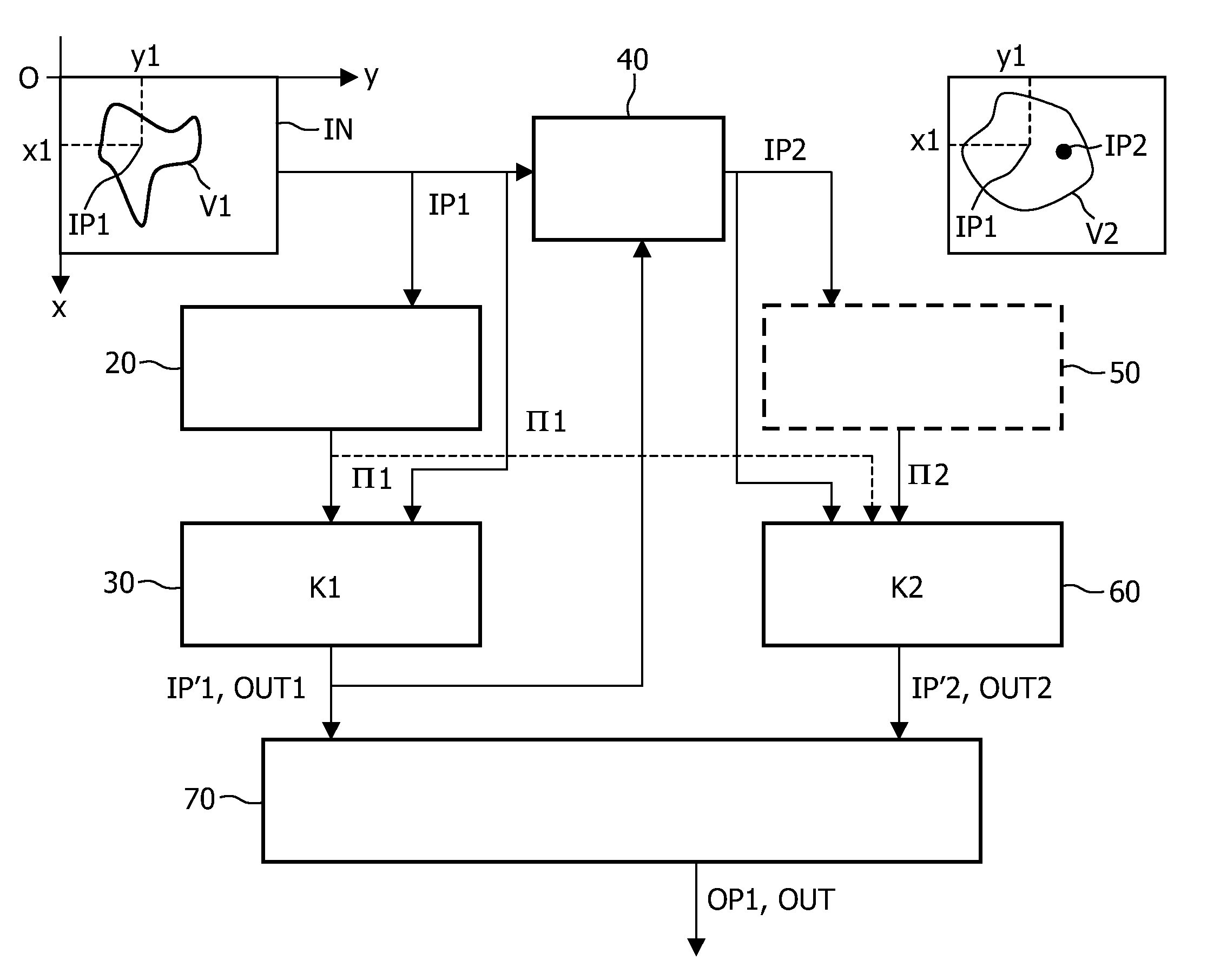
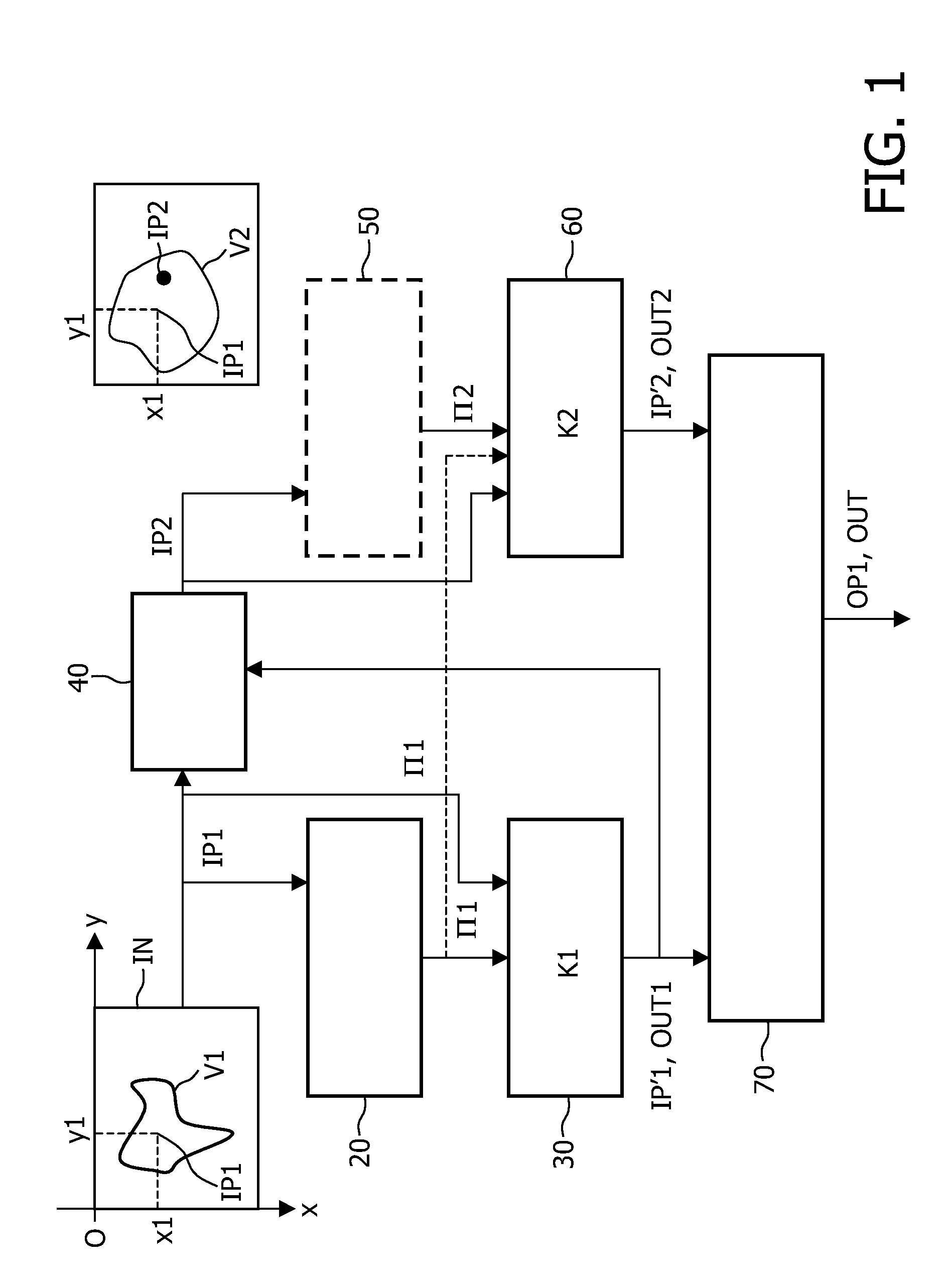
[0057]Referring to FIG. 4B and in accordance with the invention, the method further comprises a step analysing intensity levels of the input image in a second vicinity V2 of the second image point for calculating the second direction of filtering θ2 at said second image point IP2. As already mentioned above, this analysis is performed by using known image processing techniques, for instance by applying a gradient operator to the input image.
[0058]Therefore, the contribution of the second steerable filter kernel K2 to the linear combination has the effect of extending the first steerable filter kernel K1 in the direction of a curved feature CF present in the image at the second image point. A consequence is that a curved elongated filter K is designed, which fits better with the local intensity of the image and brings improved feature enhancement results on elongated curved features CF.
[0059]Referring to FIG. 4C and in accordance with a third embodiment of the invention, the step of ...
fourth embodiment
[0062]Referring to FIG. 5B and in accordance with the invention the second and third output image points IP2, IP3 are located on a curve C comprising the first output image point IP1. Such a curve is either a circle, which is defined by a curvature radius or a parabolic curve or any kind of curve, which is defined on the basis of analysis parameters calculated on the image such as the curvature of the elongated features. Advantageously, the curve has a shape which is related to the elongated features present in the image. Therefore, the defined curve can be used as a guide for designing of a curved elongated filter K which fits better with complex elongated structures of the input image.
[0063]Preferably, the third image point IP3 is selected in such a way that said third image point IP3 is symmetric on the curve C to the second image point IP2 with respect to the first image point. An advantage is that the elongation of the first steerable kernel is the same on both sides of the fir...
PUM
 Login to View More
 Abstract
Description
Claims
Application Information
 Login to View More