

Erase method in thin film nonvolatile memory
a non-volatile memory, erase method technology, applied in static storage, digital storage, instruments, etc., can solve the problems of reducing the efficiency of boosting, memory cell by memory cell erase operation is very slow for practical use, and the non-volatile memory cell erase operation has arisen. , to achieve the effect of optimizing scalability and fast eras
- Summary
- Abstract
- Description
- Claims
- Application Information
AI Technical Summary
Benefits of technology
Problems solved by technology
Method used
Image



Examples
Embodiment Construction
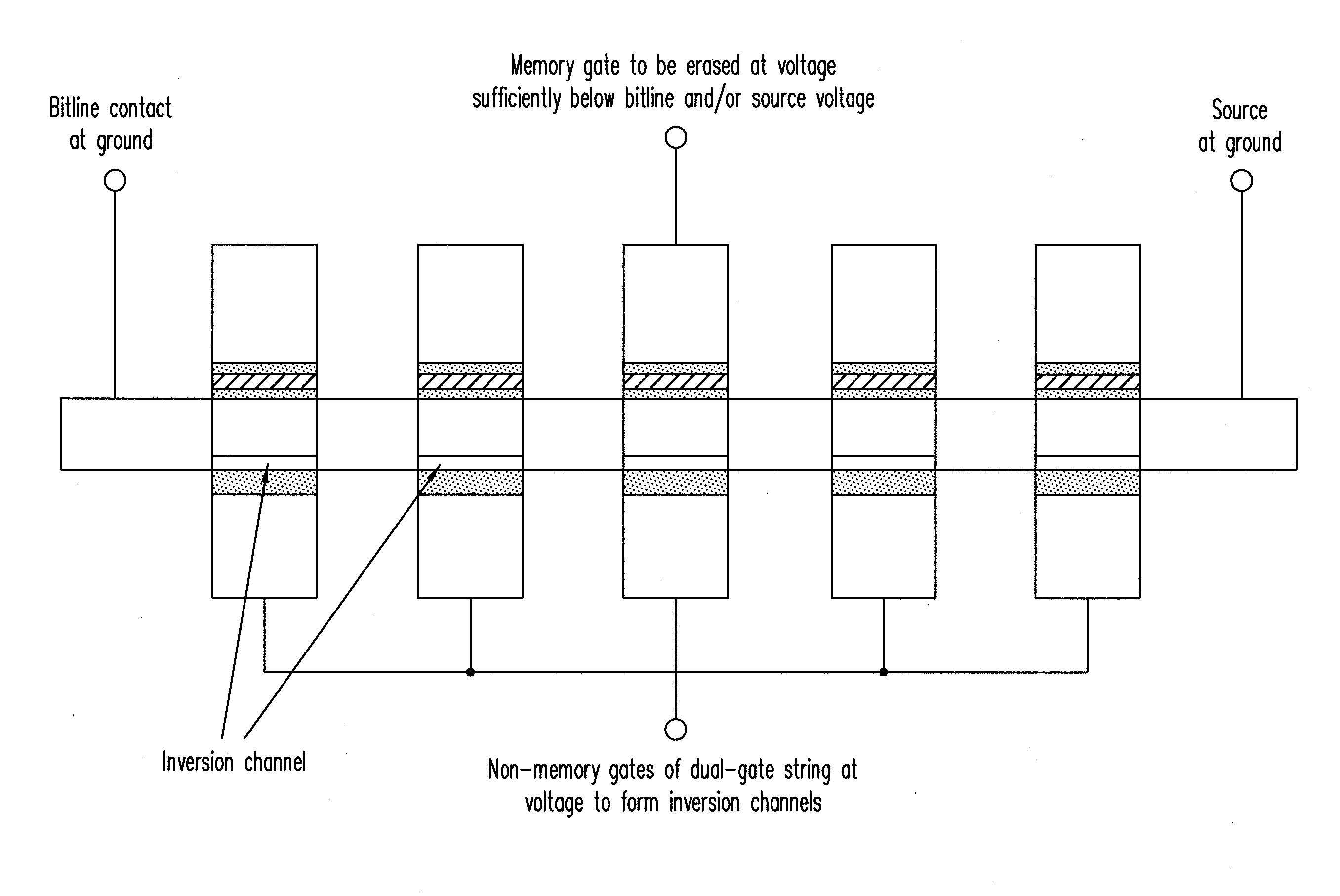
[0027]FIG. 1 is a cross-section of dual-gate memory cell 100 formed by a memory device and a non-memory device (also, referred to as an “access device”). As shown in FIG. 1, the access device includes gate dielectric 106 and gate electrode 102 and the memory device includes gate dielectric stack 108 and gate electrode 109. The memory and access devices share source and drain regions 110 and active region 107. Although shown having the memory device formed above the access device, these device may be formed in the reverse order—i.e., with the memory device formed underneath the access device. FIG. 2 is a graphical representation 200 of a dual-gate device, indicating gate electrode 201 of the memory device, and gate electrode 202 of the access device, with source and drain connections 203 and 204.
[0028]FIG. 3 shows memory strings 501 and 502 each formed out of serially connected dual-gate memory cells provided between dual-gate select devices provided at the ends of the memory string....
PUM
 Login to View More
 Abstract
Description
Claims
Application Information
 Login to View More