
Lubricating grease and lubricating grease-enclosed roller bearing
a technology of lubricating grease and roller bearing, which is applied in the direction of liquid degasification, mechanical equipment, separation processes, etc., can solve the problems of steel wear, decomposition of base oil, occurrence of defects, etc., and achieve superior durability and durability
- Summary
- Abstract
- Description
- Claims
- Application Information
AI Technical Summary
Benefits of technology
Problems solved by technology
Method used
Image

Examples
reference example 1
Preparation of Grease 1
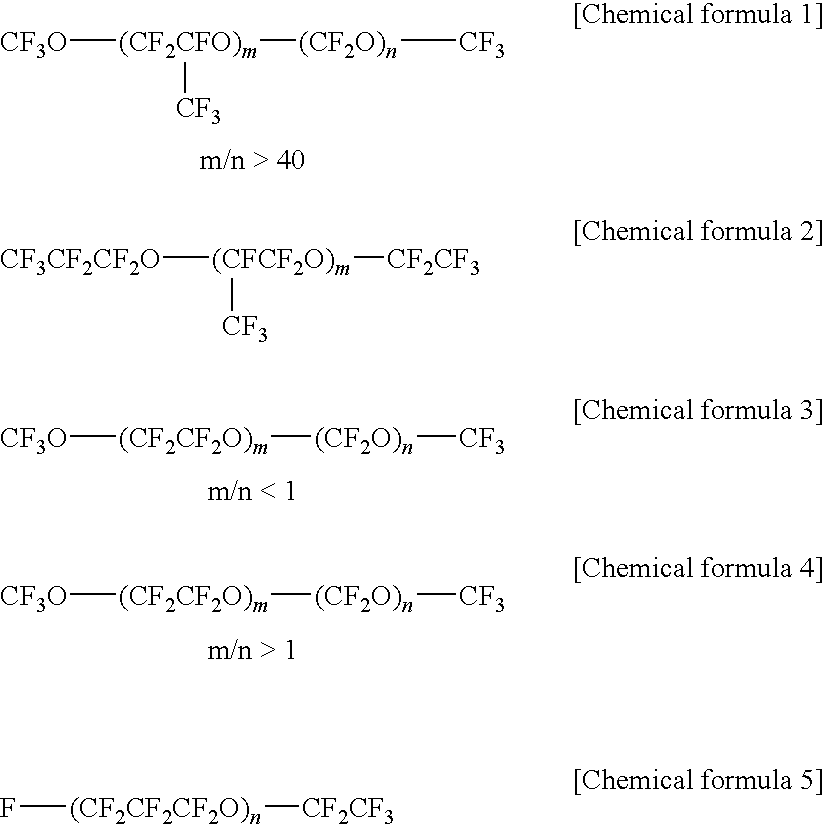
[0126]33 wt % of fluorocarbon resin powder (commercial name: Vydax produced by DuPont) was added to 67 wt % of PFPE oil (commercial name: Krytox 143AC produced by DuPont, kinematic viscosity: 191 mm2 at 40° C.) for the total wt % of grease. After being stirred, it was supplied to a roll mill to obtain a semisolid grease 1 containing the fluorocarbon resin powder as its thickener and the PFPE oil as its base oil.
reference example 2
Diurea Compound
[0127]After one mol of diphenylmethane diisocyanate and two mols of octylamine were dissolved in hexane, stirring of the solution was continued at 40° C. for 30 minutes with the solution circulating to allow a reaction therebetween. Thereby a diurea compound was deposited in the hexane. After the hexane was evaporated, it was crushed in a mortar to obtain diurea compound powder.
reference example 3
Mixture of Diurea Compound and Ester Oil
[0128]One mol of diphenylmethane diisocyanate was dissolved in a half amount of 88 wt % of aromatic ester oil (kinematic viscosity: 91 mm2 at 40° C.) for the total wt % of grease. Two mols of monoamine was dissolved in the remaining half amount of the aromatic ester oil. Thereafter the solution of the aromatic ester oil in which the monoamine was dissolved was added to the solution of the aromatic ester oil in which the diphenylmethane diisocyanate was dissolved, while being stirred. The monoamine and the diphenylmethane diisocyanate were allowed to react with each other, while stirring was continued at 100 to 120° C. for 30 minutes. As a result, 12 wt % of a diurea compound was deposited in the aromatic ester oil serving as the base oil. Thereafter the solution was supplied to the roll mill to obtain a semisolid substance which is the mixture of the diurea compound and the ester oil.
PUM
| Property | Measurement | Unit |
|---|---|---|
| thickness | aaaaa | aaaaa |
| temperatures | aaaaa | aaaaa |
| temperature | aaaaa | aaaaa |
Abstract
Description
Claims
Application Information
 Login to View More