
Method for evaluating internal short-circuit of battery, device for evaluating internal short-circuit of battery, battery, battery pack and their manufacturing methods
a battery and internal short circuit technology, applied in the direction of cell components, sustainable manufacturing/processing, instruments, etc., can solve the problems of inability to accurately evaluate the safety of the tendency of internal short circuit to occur, and the overheating of the battery, so as to improve the safety level of the battery and accurately evaluate the battery under internal short circuit conditions.
- Summary
- Abstract
- Description
- Claims
- Application Information
AI Technical Summary
Benefits of technology
Problems solved by technology
Method used
Image

Examples
example 1
Production of Battery
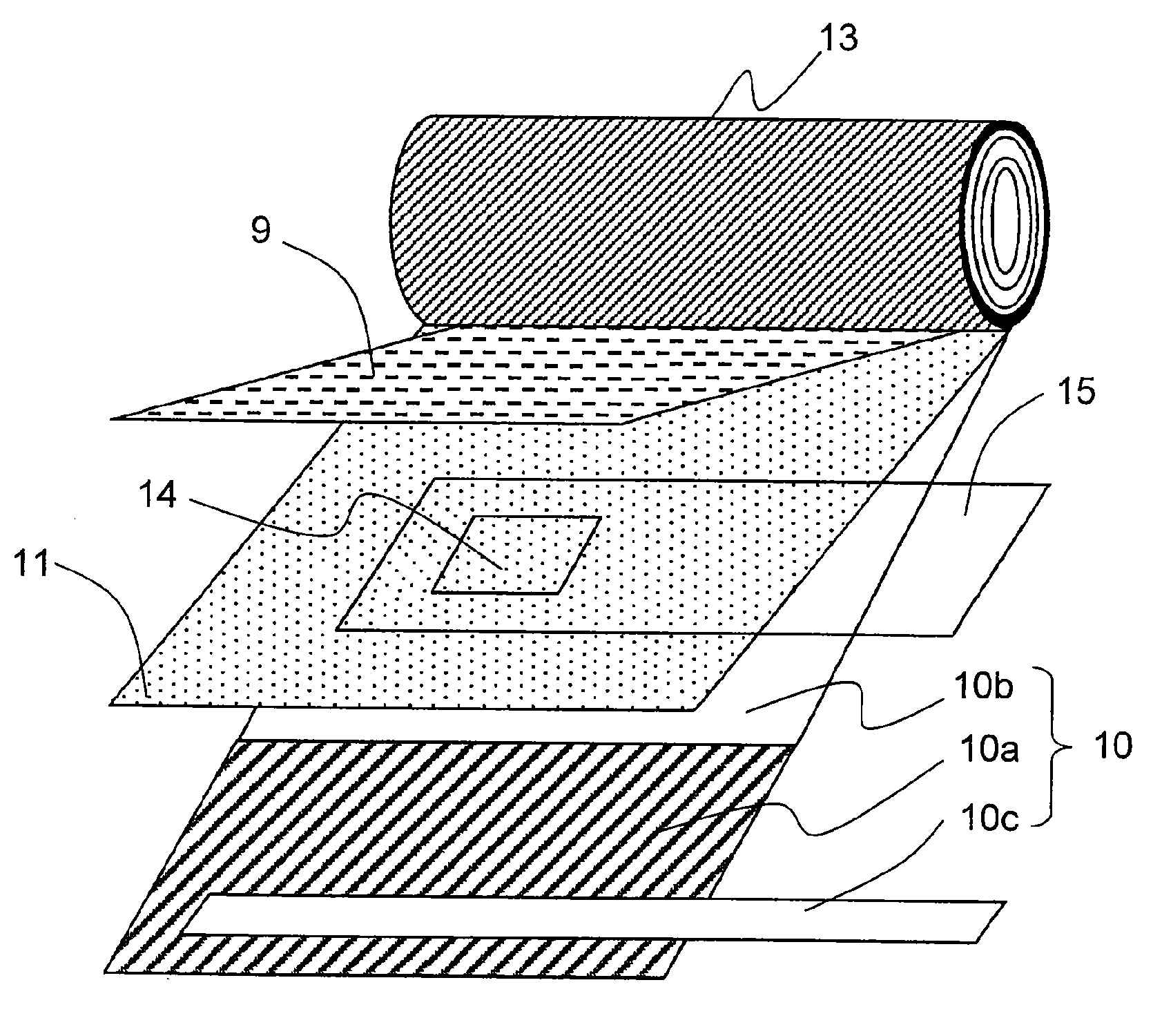
[0153]A cylindrical lithium secondary battery was produced in the following manner as a battery to be subjected to a safety evaluation under an internal short-circuit condition.
(1) Preparation of Positive Electrode
[0154]A positive electrode mixture paste was prepared by stirring 3 kg of nickel manganese cobalt lithium oxide (LiNi1 / 3Mn1 / 3Co1 / 3O2) powder (median diameter 15 μm) serving as a positive electrode active material, 1 kg of N-methyl-2-pyrrolidone (hereinafter “NMP”) solution (trade name: #1320, available from Kureha Corporation) containing 12% by weight of polyvinylidene fluoride (hereinafter “PVDF”) serving as a binder, 90 g of acetylene black serving as a conductive agent, and a suitable amount of NMP dispersion medium with a double-arm kneader. The positive electrode mixture paste was applied onto both sides of a belt-like positive electrode current-collecting terminal made of a 20-μm-thick aluminum foil. The applied positive electrode mixture paste w...
example 2
[0165]A battery was produced in the same manner as in Example 1, except that the outermost part of the positive electrode current-collecting terminal of the battery was provided with an exposed part having a length of about one turn, and evaluated in the same manner.
example 3
[0168]Except that the height of the foreign object inserted in the electrode group was changed to 50 μm, a battery A was produced and evaluated in the same manner as in Example 2.
PUM
| Property | Measurement | Unit |
|---|---|---|
| pressure | aaaaa | aaaaa |
| shape memory | aaaaa | aaaaa |
| temperature | aaaaa | aaaaa |
Abstract
Description
Claims
Application Information
 Login to View More