
Method and apparatus for detecting slow motion
a technology of slow motion and detection method, applied in the direction of instruments, television systems, color signal processing circuits, etc., can solve the problems of not providing “quick and easy” browsing through recordings, not being able to provide means for summarizing or shortening sports broadcasts, and not being able to use existing, conventional recorders, etc., to achieve accurate and simple detection technique, easy and accurate detection
- Summary
- Abstract
- Description
- Claims
- Application Information
AI Technical Summary
Benefits of technology
Problems solved by technology
Method used
Image

Examples
first embodiment
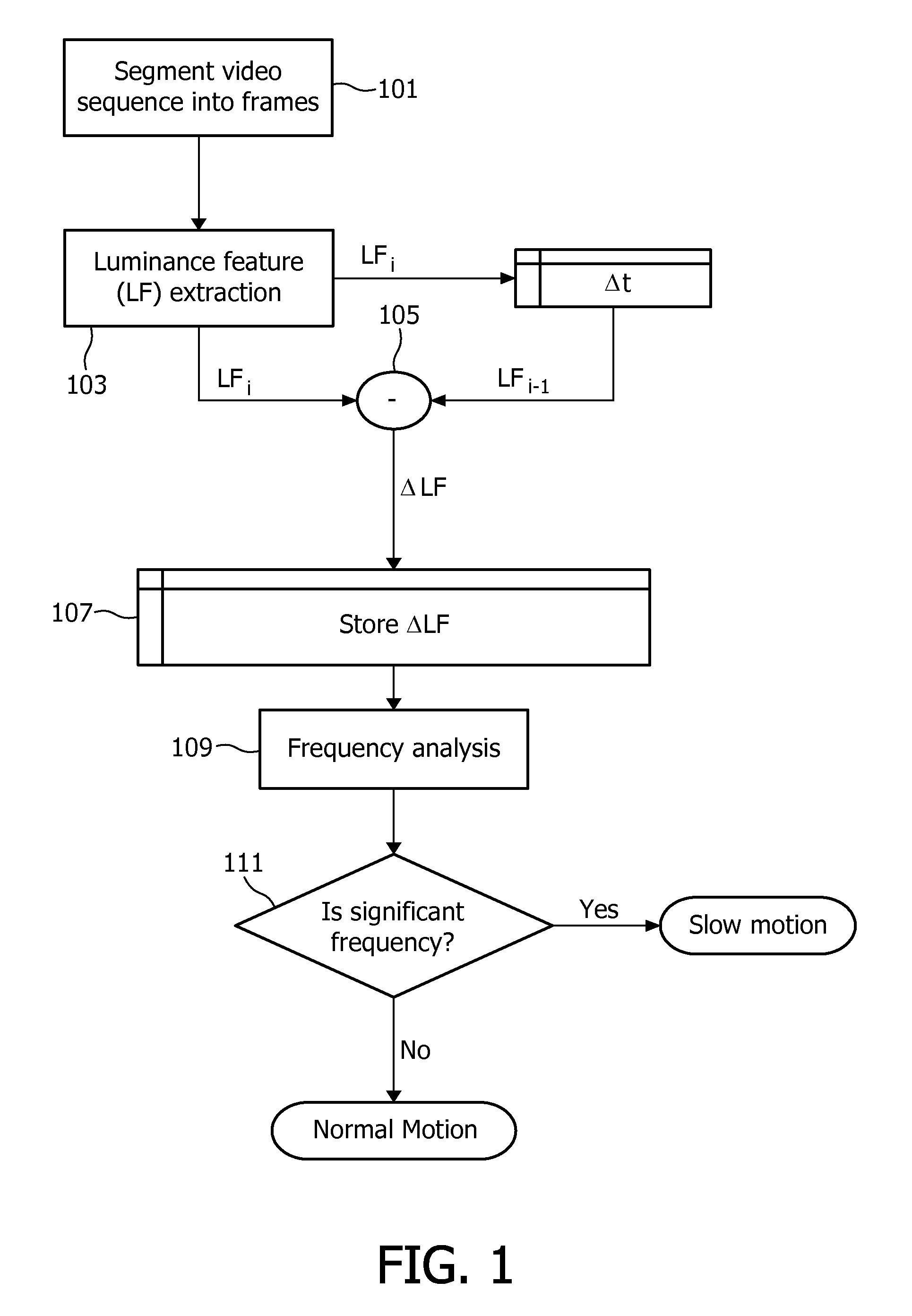
[0019]With reference to FIG. 1, the present invention will be described in detail. In step 101, a video sequence comprising a plurality of frames is input. For each frame i a luminosity feature LFi (the average luminance over the frame or, alternatively, at least a part of a luminance histogram) is extracted, step 103. Subsequent luminosity features are subtracted, ΔLF=LFi−LFi−1, step 105. The result ΔLF is stored in a FIFO buffer, step 107. A frequency analysis (for example Fourier decomposition) is performed, step 109, on the ΔLF samples saved in the buffer to give the frequency spectrum of the sample ΔLF. If the spectrum has a dominant frequency (i.e. a peak in the spectrogram that is significantly higher than the rest) then slow motion is detected, step 111.
[0020]The system of the present invention is based on detecting a physical effect known as temporal aliasing. Two examples of temporal aliasing are as follows:
[0021]The sun moves east to west in the sky, with 24 hours between...
second embodiment
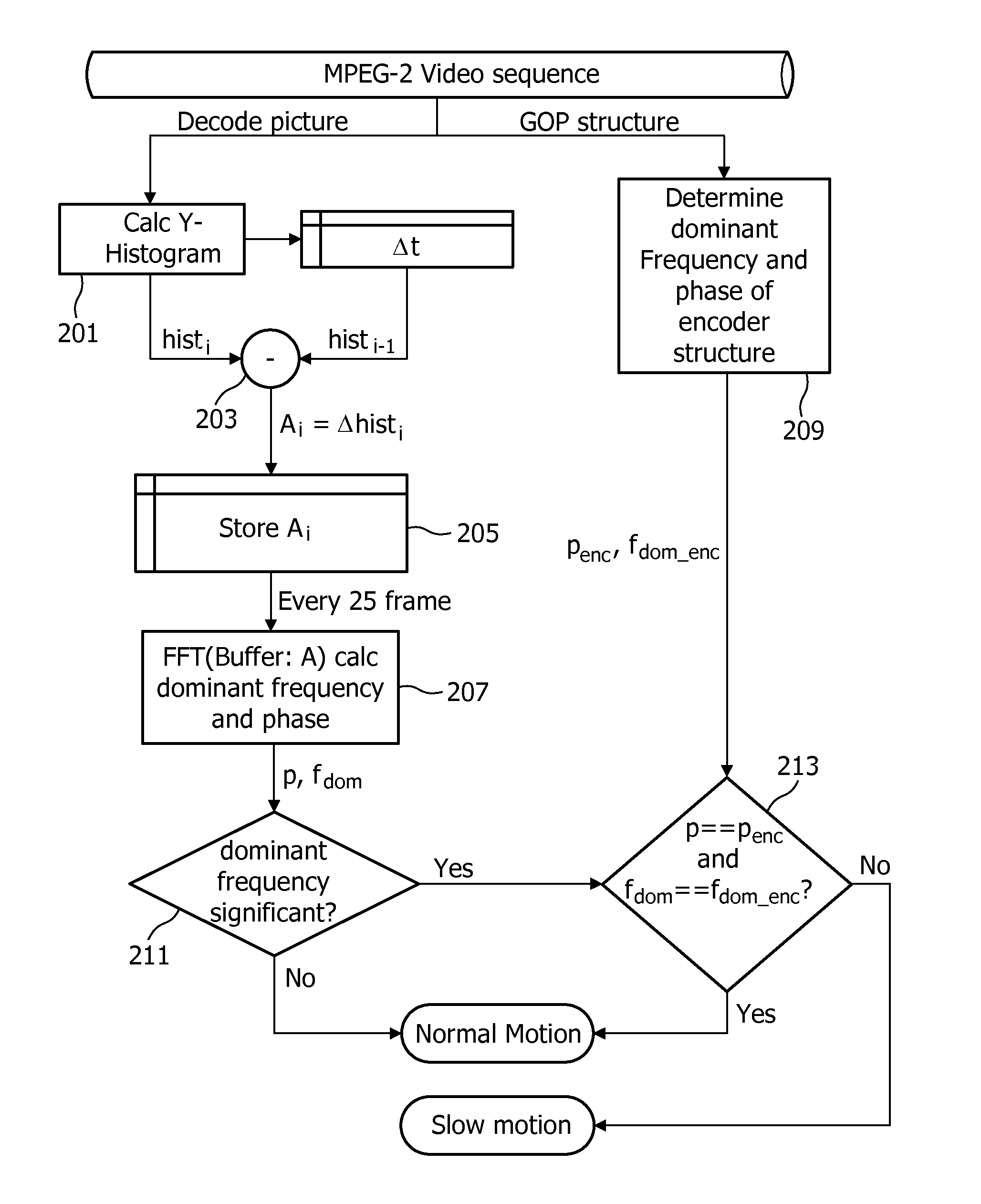
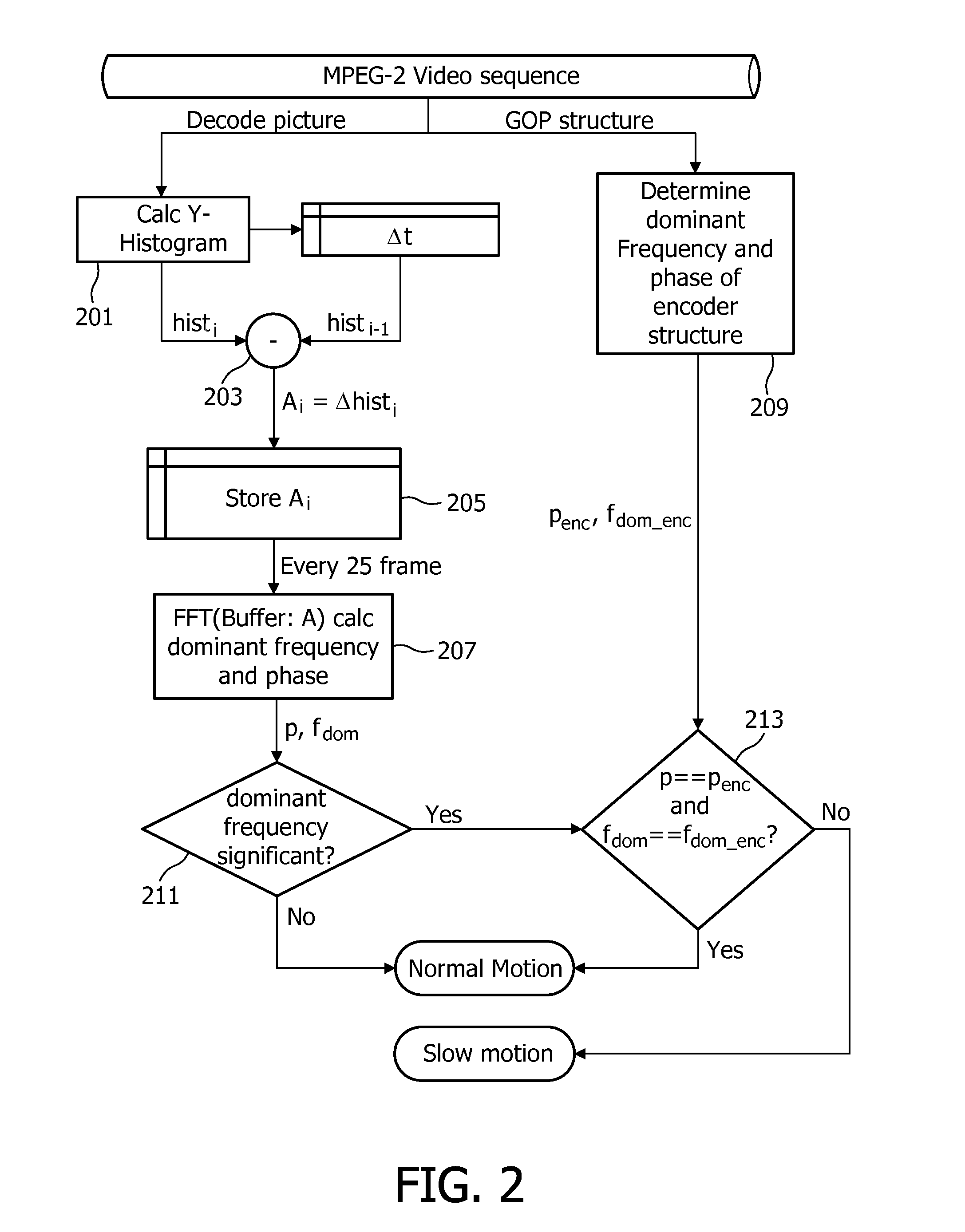
[0028]With reference to FIG. 2, the second embodiment, which takes into account the particularities of MPEG encoding, will be described in detail. Broadcasts are typically encoded using the MPEG-2 video compression standard. However, the encoder may disturb the input in such a way that an erroneous dominant frequency occurs. To illustrate this problem, consider, for example, a GOP-structure of IBPBPBPBPB of a video sequence. The average luminance increases for each I and P frames and decreases for each B frame. The resulting pattern is:
IBPBPBPBPB
[0029]The encoder noise produces flickering in the average luminance with a frequency that is dependant on the GOP-structure. This can generate false positive slow motion detections. The method of the second embodiment excludes these false positives.
[0030]As shown in FIG. 2, the input MPEG-2 video sequence is segmented into a plurality of frames and decoded. A Y-histogram of the decoded input sequence is calculated for each frame, step 201....
PUM
 Login to View More
 Abstract
Description
Claims
Application Information
 Login to View More