
Cold spray impact deposition system and coating process
a deposition system and spray spray technology, applied in the direction of liquid surface applicators, thin material processing, coatings, etc., can solve the problems of turbid flow of particulates, inefficient gas usage, and limited utility of each of these conventional techniques
- Summary
- Abstract
- Description
- Claims
- Application Information
AI Technical Summary
Benefits of technology
Problems solved by technology
Method used
Image

Examples
example 1
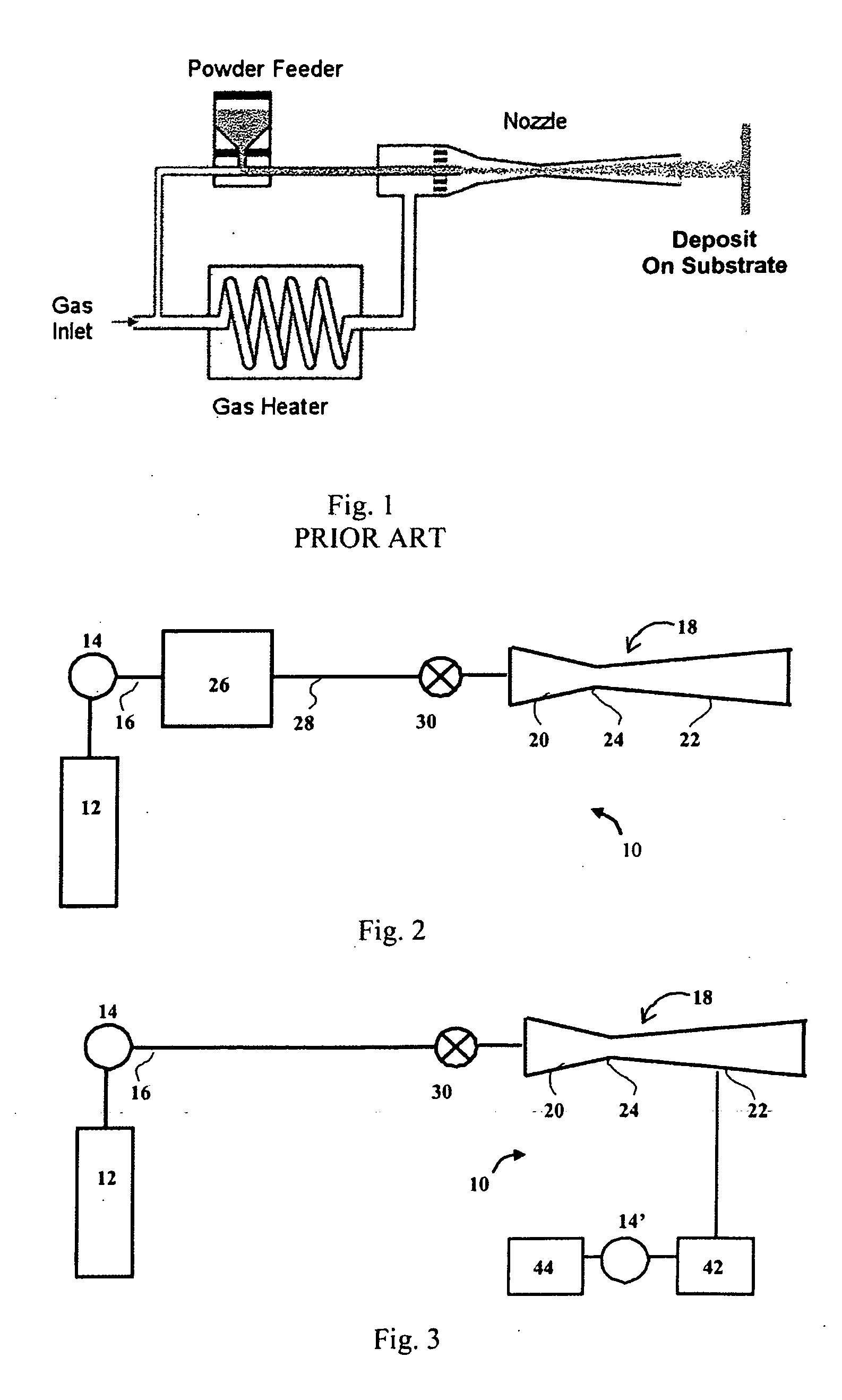
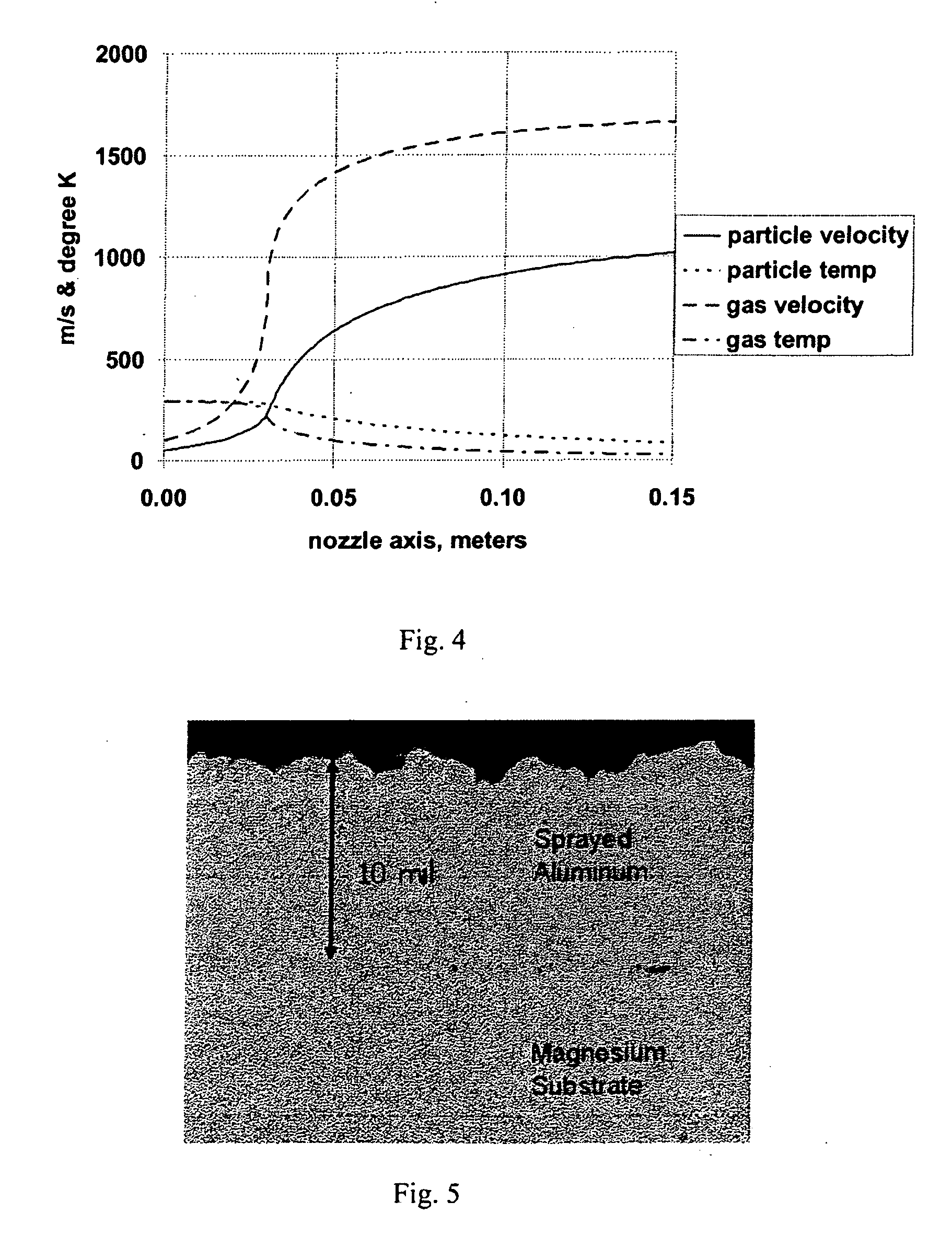
[0024]Using apparatus 10 of FIG. 2, pure helium gas in a K-type cylinder at an initial temperature of 20° Celsius and pressure of 2.8 MPa in the conduit 16 flows at 34 m3 / hour entrains spherical 20 micron-aluminum particles at a rate of 3 grams / minute exit the nozzle with sufficient velocity to achieve good impact plastic deformation on a magnesium substrate positioned 10 centimeters incident to the nozzle. The aluminum particles had a mean x-y-z axially averaged linear dimension of 20 micron. These depositions have also been successfully reproduced with aluminum (AlClad) and steel substrates. The calculated velocities and temperatures for the gas and the aluminum particles as a function of distance traveled through a nozzle is depicted in FIG. 4 for a nozzle having a converging portion with a 6.35 mm circular inlet that extends for 7.62 mm and then tapers over 6.35 mm to a minimal constriction of 1.0 mm and thereafter expanding smoothly to a terminal nozzle diverging circular cross...
example 2
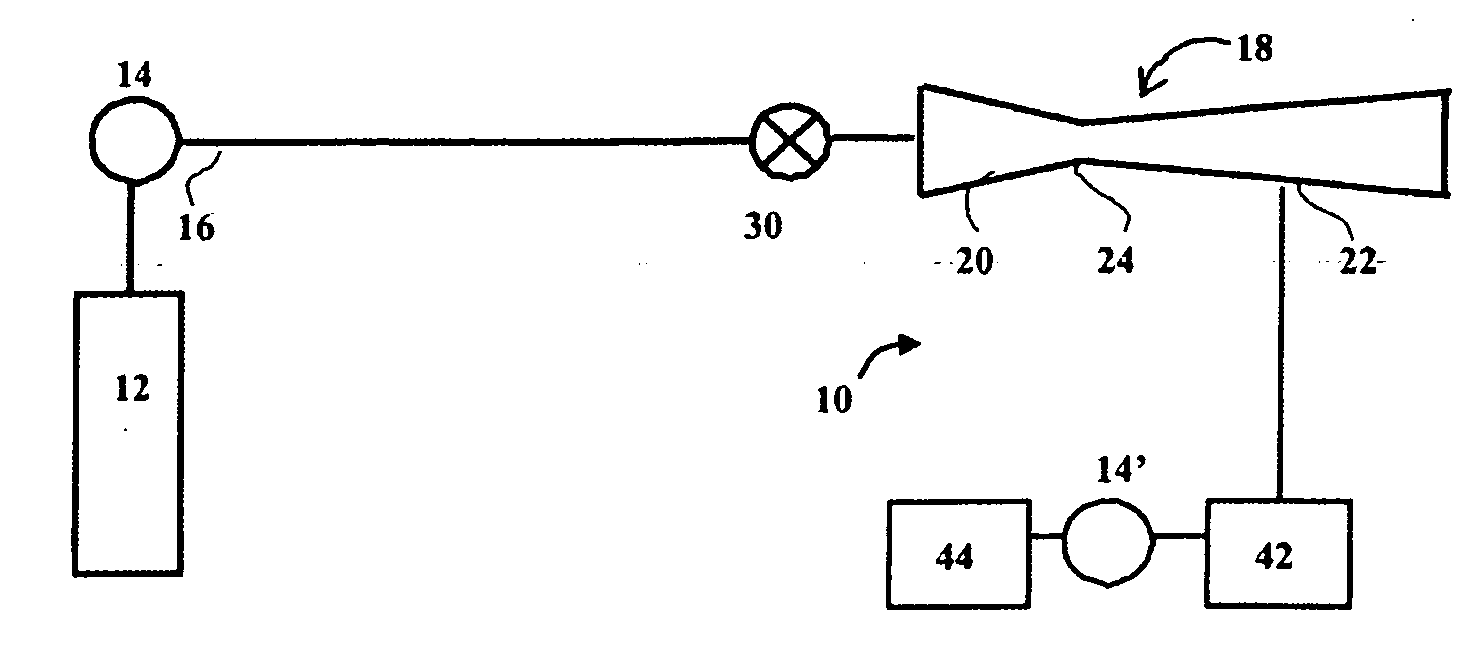
[0025]Using the apparatus of FIG. 3 with the same helium gas conditions and 20 micron spherical aluminum particles also fed at a rate of 3 grams per minute, with the exception that the 20 micron aluminum particles are now fed into the low pressure, divergent section, the calculated velocities and temperatures for the gas and the particles as a function of distance traveled through the nozzle is depicted in FIG. 6. The aluminum particles are noted to exit the nozzle at 900 meters per second and yield a coating similar to that depicted in FIG. 5 with respect to Example 1.
PUM
| Property | Measurement | Unit |
|---|---|---|
| Length | aaaaa | aaaaa |
| Length | aaaaa | aaaaa |
| Length | aaaaa | aaaaa |
Abstract
Description
Claims
Application Information
 Login to View More