System for distributing broadband wireless signals indoors

a wireless signal and indoor technology, applied in the field of telecommunications, can solve the problems of not being able to adapt to changes in communications standards, devices cannot guarantee coverage in any enclosure, and cannot be remotely supervised and controlled

US20110158173A1Inactive Publication Date: 2011-06-30TELEFONICA SA
22 Cites 9 Cited by

Patent Information

Authority / Receiving Office
US · United States
Patent Type
Applications(United States)
Current Assignee / Owner
Publication Date
2011-06-30
Estimated Expiration
Not applicable · inactive patent

Smart Images

  • Figure 1
    Figure 1
  • Figure 2
    Figure 2
  • Figure 3
    Figure 3
Patent Text Reader

Abstract

system for distributing broadband wireless signals indoors includes a radio access node, connected to a telecommunication access network via an access interface, where said radio access node comprises a broadband-signal-transmitting / -receiving module configured to transmit and receive broadband wireless signals via a broadband radio interface; at least one client device comprising a broadband-signal-transmitting / -receiving module configured to transmit and receive broadband wireless signals to / from said radio access node via said broadband radio interface. It also comprises a control channel configured to exchange control signals between said radio access node and said at least one client device over a control radio interface, each of said radio access nodes and at least one client device comprising a control-signal-transmitting / receiving module configured to establish said control channel for transmitting and receiving wireless signals over said control radio interface.
Need to check novelty before this filing date? Find Prior Art

Description

FIELD OF THE INVENTION

[0001] The present invention is applied to the field of telecommunications and, more specifically, to the construction and roll-out of communications networks inside buildings and their connection with other telecommunications networks.BACKGROUND OF THE INVENTION

[0002] The technique conventionally used to provide radio interfaces inside buildings consists of the installation of as many devices and interfaces as are necessary. These devices must be configured by the user and cannot be updated to changes in the communications standard they use. Furthermore, these devices do not guarantee coverage in any enclosure and cannot be remotely supervised and controlled from the operator's network, so that they require local configuration thereof by the user.

[0003] Some examples of devices which have said drawbacks are:

[0004] A device which permits access to the telecommunications network by copper pair and ADSL interface, and that inside the home supports the IEEE 802.11x (W...

Examples

Embodiment Construction

[0040]Throughout this specification, the term “comprises” and its derivatives must not be interpreted in an excluding or limiting sense, i.e. it should not be interpreted in the sense of excluding the possibility that the element or concept referred to includes additional elements or stages.

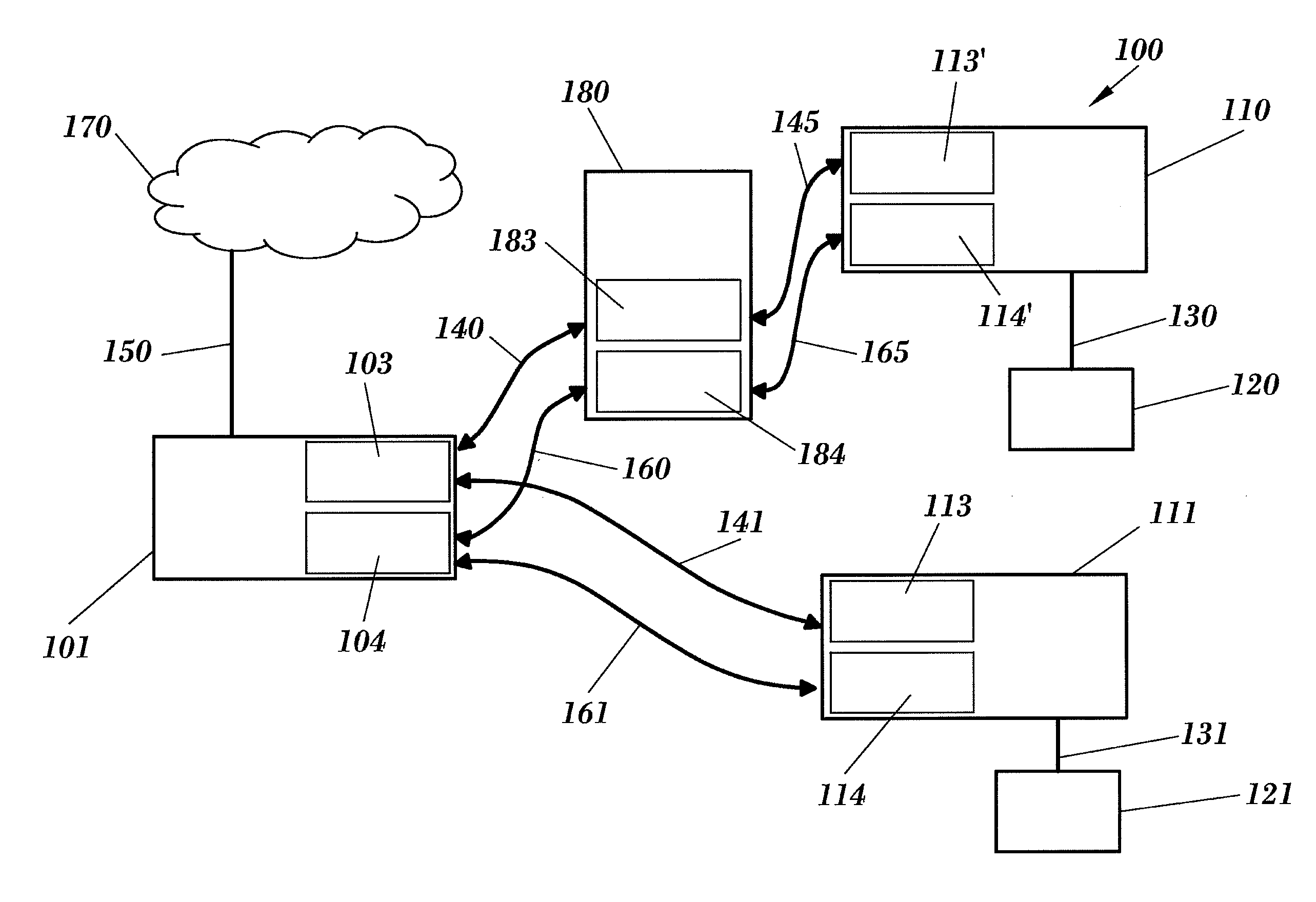
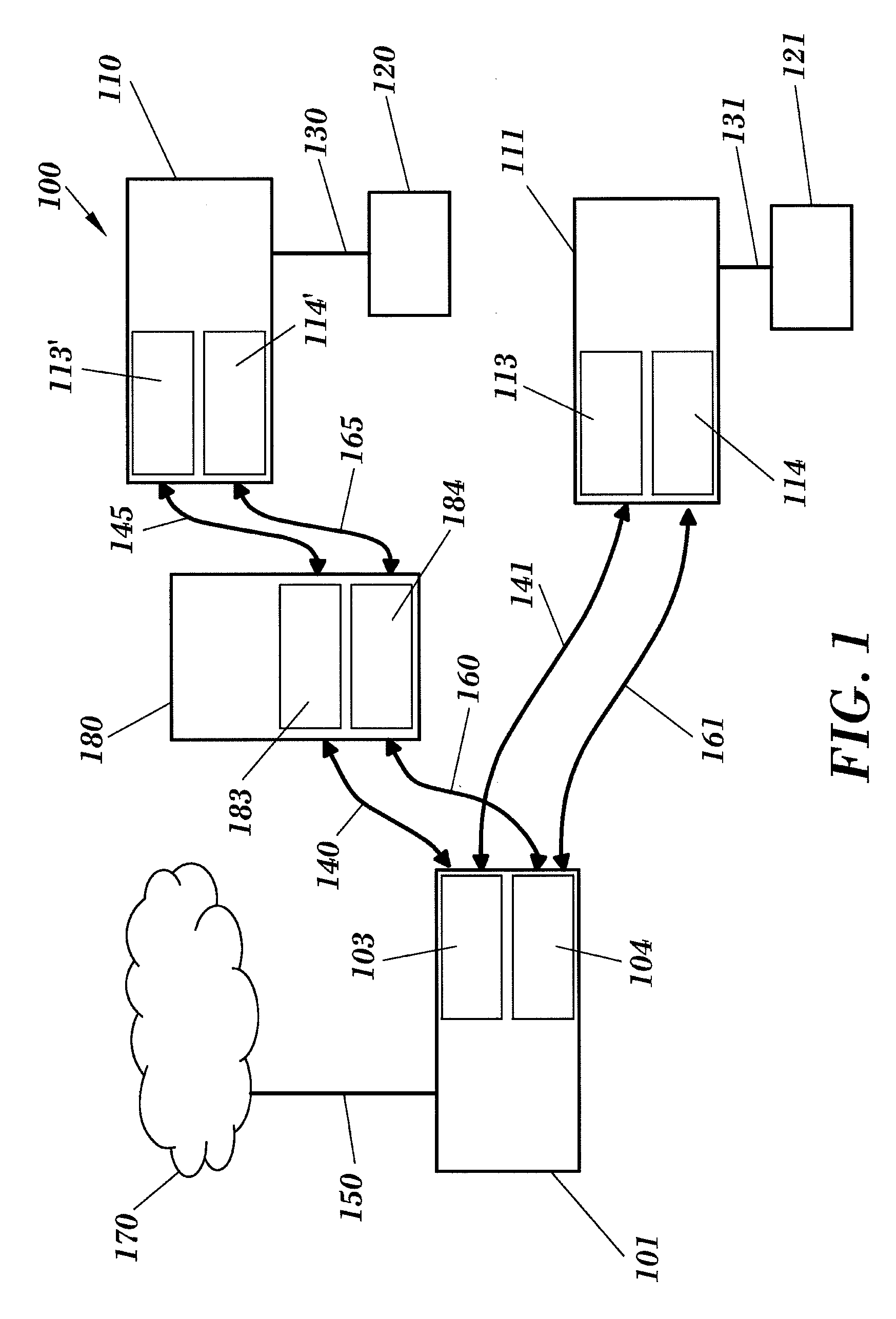
[0041]FIG. 1 illustrates a diagram of a possible embodiment of the system for distributing broadband wireless signals 100 of the invention. The system 100 is especially designed to be used inside buildings and to support multiple radio communication interfaces inside a building. The system 100 comprises the following elements:

[0042]A radio access point or node, also called radio gateway 101. In this radio access node 101 reside the rerouting functions between the radio interfaces within a building and of gateway between the wireless network inside the building and an access network (generally a fixed network, for example copper pair or fibre optic to the home), in addition to the management funct...