
Floating vessel for servicing air diffusers
a technology for air diffusers and floating vessels, which is applied in the field of floating vessels, can solve the problems of unstable and uneven work platforms for workers, extreme unsafe methods of working on submerged diffusers, etc., and achieve the effect of increasing friction characteristics and offering further stability to the vessel
- Summary
- Abstract
- Description
- Claims
- Application Information
AI Technical Summary
Benefits of technology
Problems solved by technology
Method used
Image

Examples
Embodiment Construction
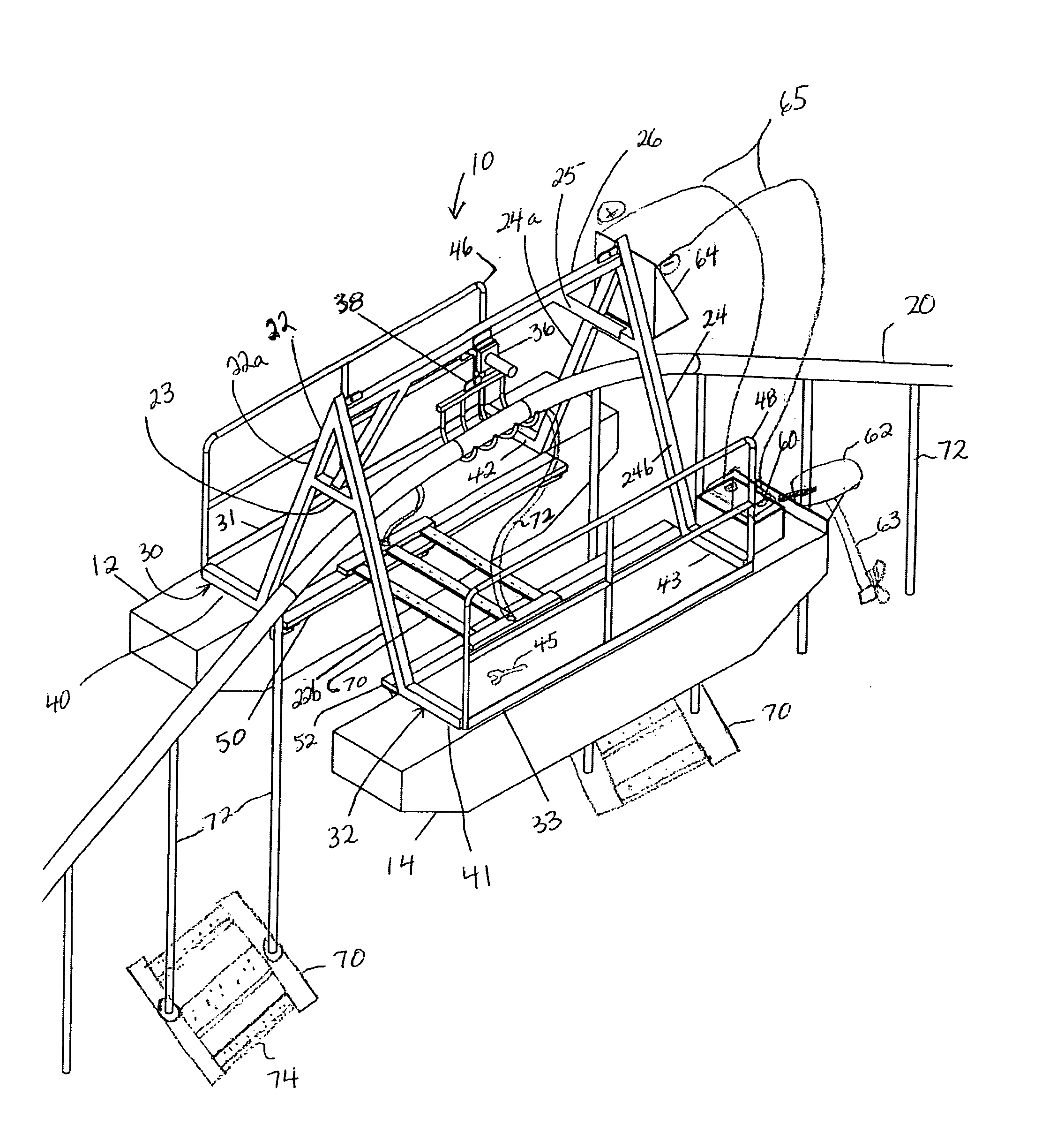
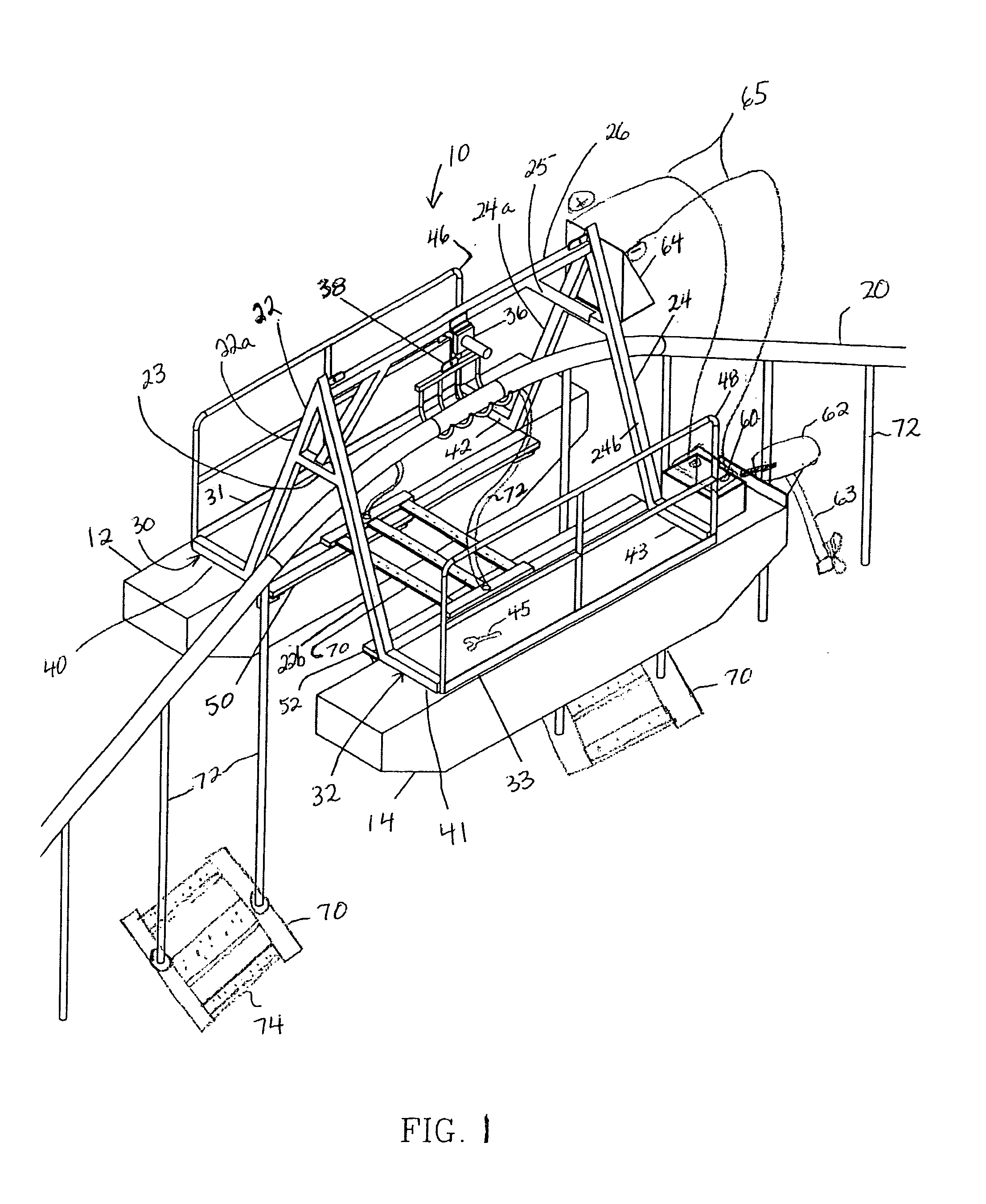
[0017]Turning now to the drawings in more detail, numeral 10 designates the floating vessel according to the present invention. The vessel 10 has a generally catamaran-type structure. The vessel 10 comprises a pair of spaced apart buoyant hulls 12 and 14. The hulls 12, 14 can be barges or any other buoyant bodies. The hulls 12 and 14 can be elongated pontoons having a generally square cross section in the center and slope-ended forward and aft portions. The pontoons 12 and 14 (sloped for ease of movement in the wastewater) can be constructed of ⅛″ thick aluminum plate but could also be constructed of a thicker plate if so desired for added strength and longevity.
[0018]A frame assembly 16 spans between the hulls 12, 14. The frame 16 extends upwardly in a generally A-shape that provides space under the frame and in between the hulls for enabling air diffusers to be positioned in between the hulls and under the frame 16. The space in between the hulls 12, 14 and under the frame 16 can ...
PUM
 Login to View More
 Abstract
Description
Claims
Application Information
 Login to View More