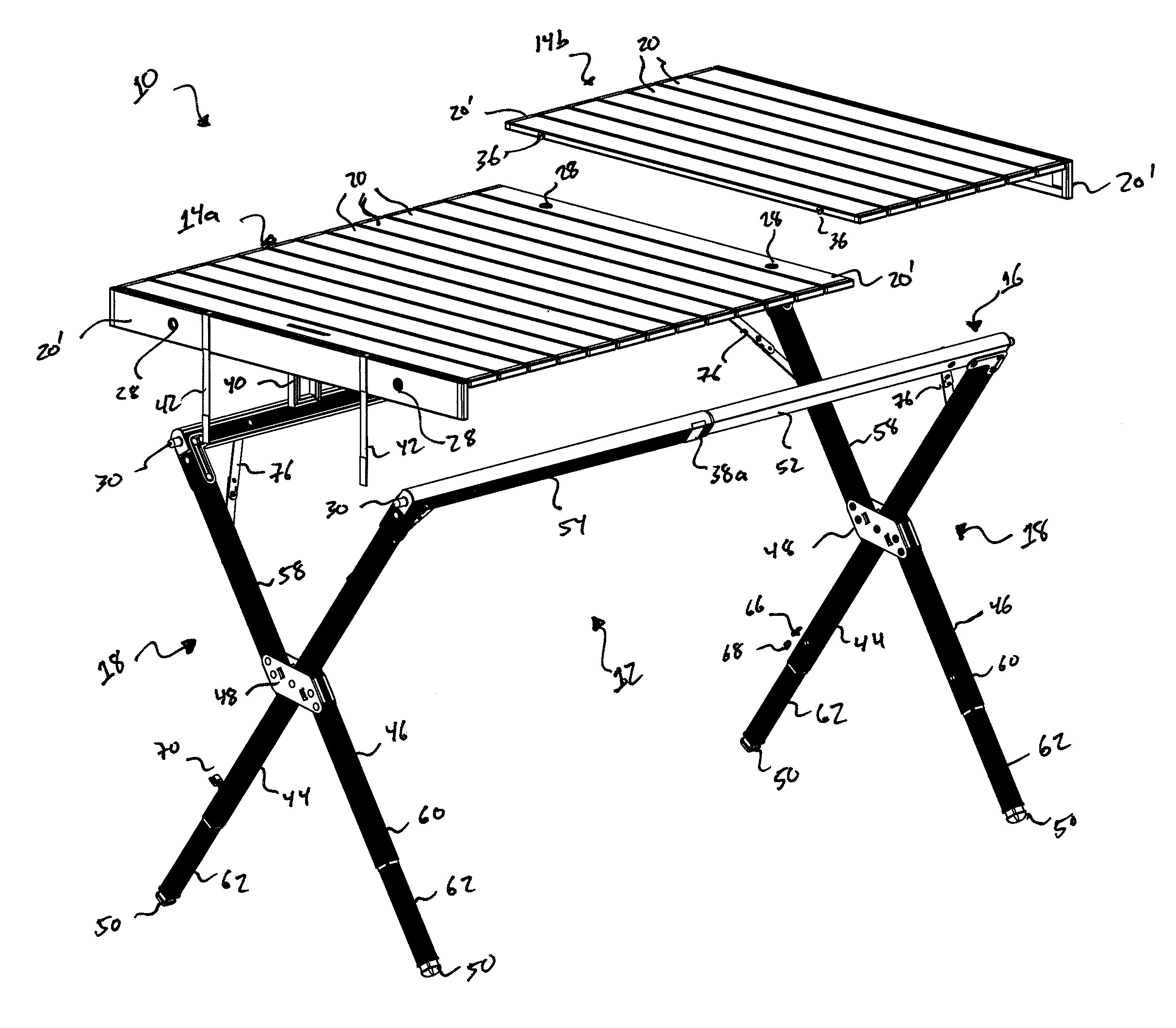
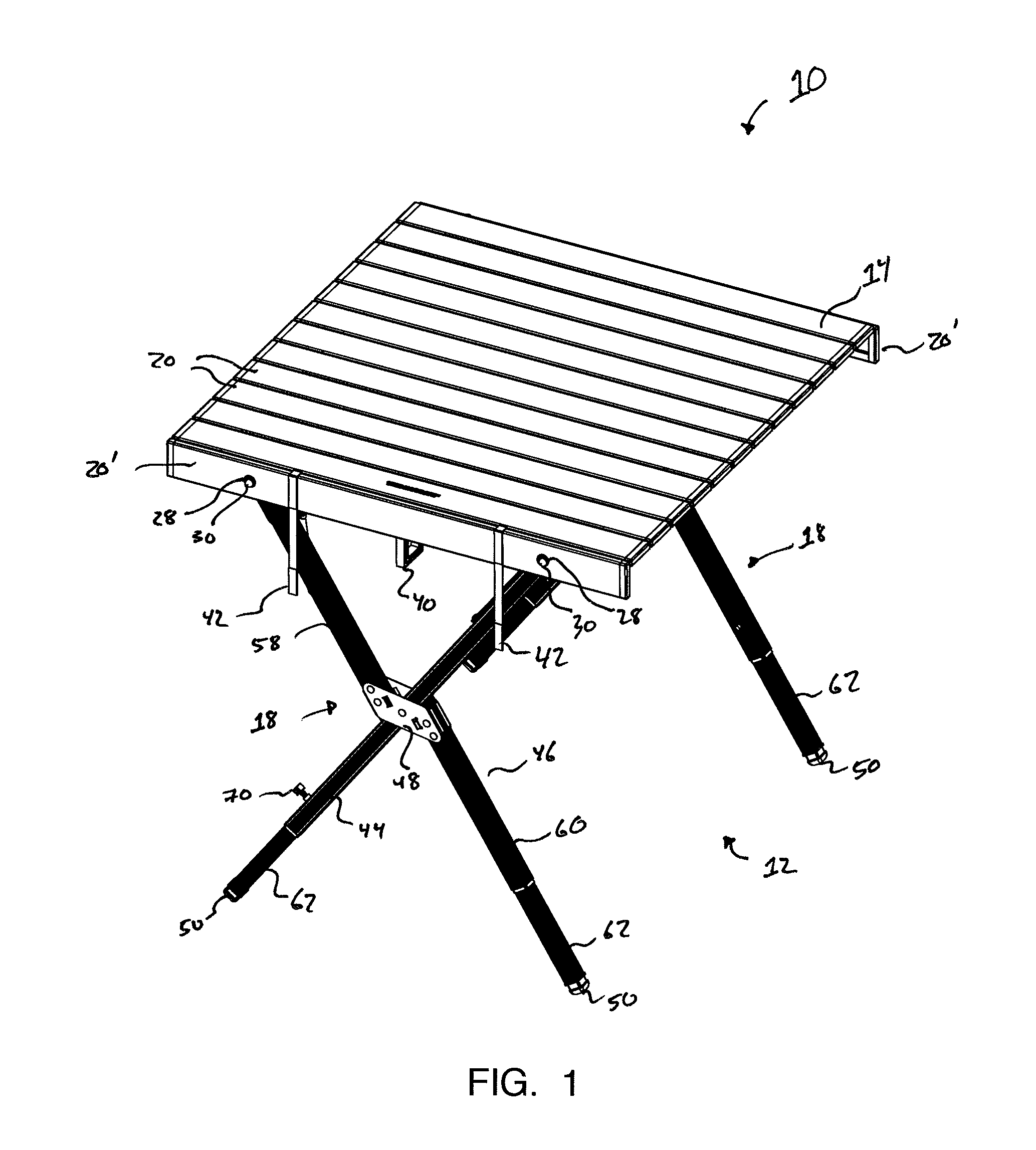
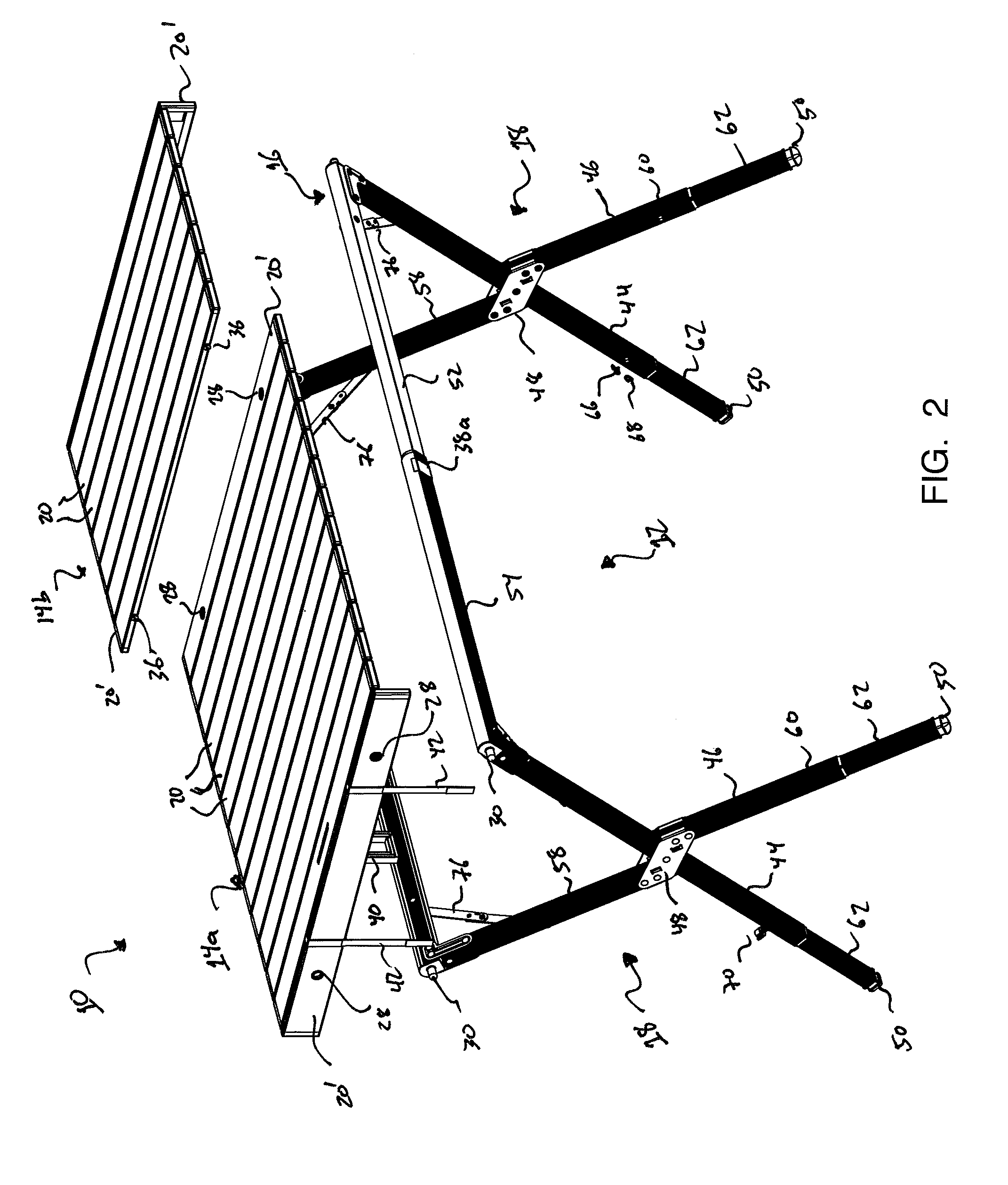
[0008]In accordance with an embodiment of the present invention, there is provided a collapsible table comprising a tabletop, a table frame, and a plurality of folding legs pivotally attached to the table frame. Preferably, the tabletop can be independently collapsed to a compressed condition, for example, by folding or rolling. Similarly, the table frame and the folding legs can be collapsed into a condition where all of the frame members and legs are generally parallelly disposed so as to minimize the amount of space taken up by the collapsed table frame and legs. The collapsed tabletop and the collapsed table frame and legs can be further bundled or packed together for transport and / or storage. Preferably, the bundled table can be easily stored in a travel bag so as to keep all parts of the table together for easy set-up.
[0010]In a preferred design of the present invention, the table frame comprises a pair of telescoping rails that can be adjusted to increase the length of the table frame as desired. In a more preferred design of the present invention, the pair of telescoping rails comprises an outer rail member and an inner rail member telescopically disposed therein. In such an embodiment, the outer rail member defines an interior cavity for receiving the inner rail member wherein the interior cavity is not blocked by any structural components so that the inner rail member can
telescope within substantially the entire length of the rail member to reduce the collapsed size of the table frame for storage and transport.
[0012]In another aspect of the present invention, means are provided for locking the table frame and legs in the set-up condition of the table. For example, linking members may be provided between each of the legs and the table frame so as to lock the table in the set-up position during use and prevent buckling of any of the legs or the table frame when a load is applied to the tabletop. In a preferred design of the present invention, the locking means are affixed between each leg and the table frame so as to minimize the complexity of setting up and breaking down the table frame. That is, the locking means stay attached to both the frame and an associated leg even when the leg is moving in relation to the frame, or when the frame is being adjusted to increase or decrease the table size. In this regard, the locking means preferably have an over-the-center linkage design conventionally used with folding tables that can be folded with movement of a leg to permit collapsing of the leg, and that can be locked in place when the leg is fully extended relative to the table frame in the set-up condition of the table.
[0013]In an alternative embodiment of the present invention, the locking means may be disengaged from the table frame, the legs or both when the table is to be collapsed. Accordingly, the locking means are used when the table is in its set-up condition, but removed, in whole or in part, when the table is being broken down so as not to interfere with the collapsing of the table. Additionally, such locking means are easily
usable with the table frame even when expanded to larger table sizes.
[0014]In another aspect of the present invention, the legs are extendable to different lengths. In this manner, the size of the legs can be reduced during break down of the table, which in turn reduces the size of the collapsed table structure, thereby taking up less space when the table is collapsed and bundled. Preferably, the
reduced size of the legs corresponds to the smallest length of the adjustable table frame. In a preferred embodiment of the present invention, the
reduced size of the legs corresponds to smallest length of the inner rail member completely telescoped within the outer rail member. In a more preferable embodiment of the present invention, the
reduced size of the legs corresponds to the width of the tabletop.
[0017]Unlike the prior art collapsible table designs, the table structure of the present invention can be expanded to different sizes for use without compromising the size of the collapsed and bundled table. In addition, the table structure of the present invention can be expanded to multiple table sizes without affecting the stability of the set-up table. Still further, the table structure of the present invention utilizes a unitary table frame design that can be collapsed and bundled to a minimally-sized bundle without any components interfering with or affecting the collapsing process, or without any extra separate frame components that must be accounted for during set up, break down, storage and transportation of the table.



 Login to View More
  Login to View More