
System for controlling rotary electric machines to reduce current ripple on a direct current bus
a technology of rotary electric machines and direct current, which is applied in the direction of electronic commutators, motor/generator/converter stoppers, dynamo-electric converter control, etc., can solve the problems of increasing the cost and weight of the vehicle, reducing fuel economy, and prone to error in the control of the rotary machine (e.g., the rotational speed or commanded torque of the electric motor). the effect of reducing the ripple current and reducing the direct current rippl
- Summary
- Abstract
- Description
- Claims
- Application Information
AI Technical Summary
Benefits of technology
Problems solved by technology
Method used
Image

Examples
Embodiment Construction
[0009]Ripple refers to variation in the otherwise direct current (DC) or voltage of the direct current bus. Ripple may be modeled as an alternating current signal component (e.g., a generally saw-tooth waveform) of lower magnitude that is combined with the direct current component of greater magnitude to form an aggregate signal on the direct current bus. The peak-to-peak magnitude of the ripple or the root-mean-square magnitude of the ripple may be expressed as a percentage of the direct current component or of the aggregate signal on the direct current bus.
[0010]A capacitor or capacitor bank may be associated with a ripple rating, which is the maximum current that can be applied to the capacitor at a corresponding frequency (e.g., switching frequency of an inverter) of the ripple current.
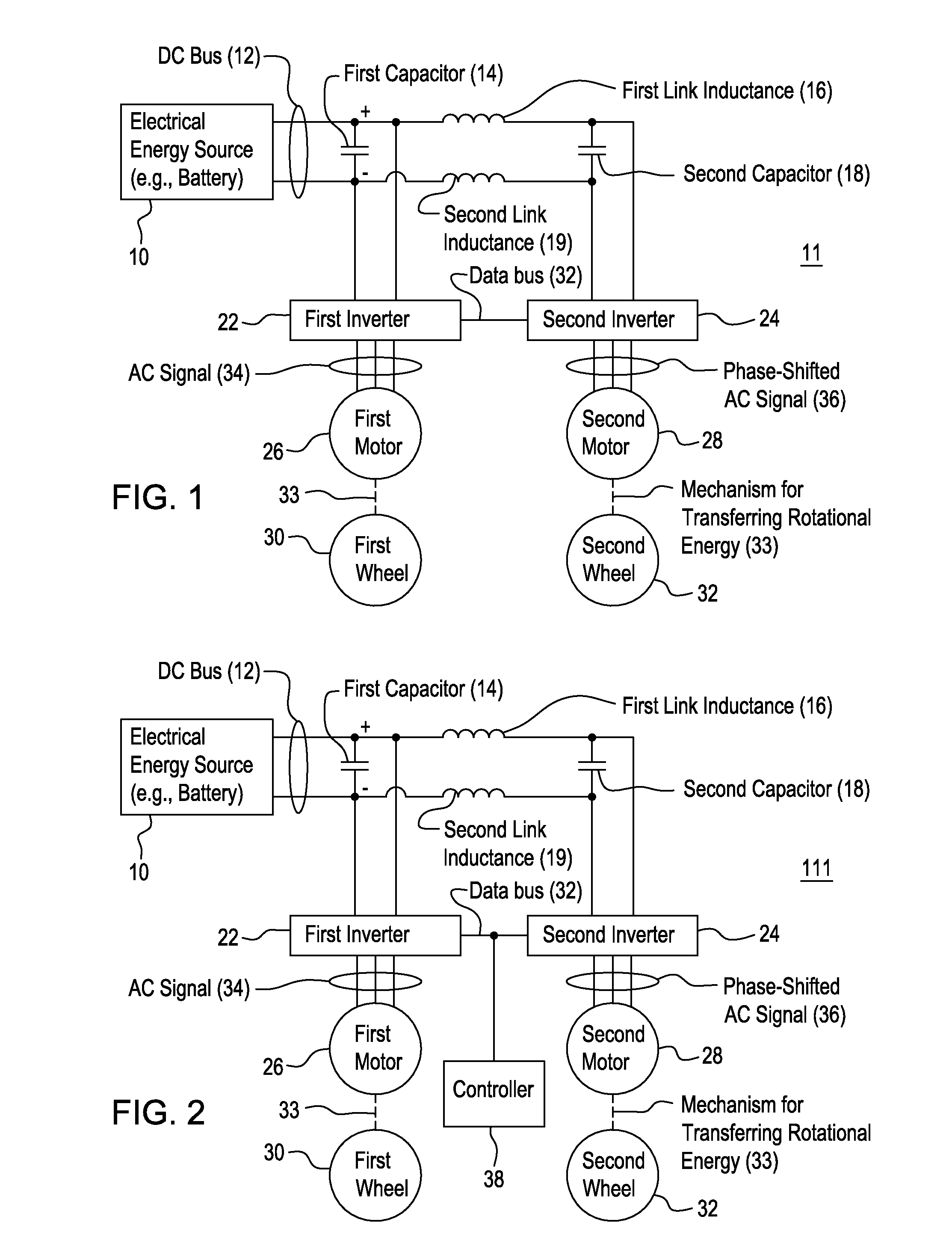
[0011]In accordance with one embodiment, FIG. 1 shows a system 11 that is capable of controlling the propulsion of a vehicle with reduced current ripple or ripple current on the direct current (DC...
PUM
 Login to View More
 Abstract
Description
Claims
Application Information
 Login to View More