

Field sequential color encoding for displays
a color display and field sequence technology, applied in the field of field sequence color display systems, can solve the problems of increasing the gap between response requirements and minimal performance to deploy motional color breakup mitigation strategies, and prior art has fallen short in respect, so as to reduce motional color breakup, reduce the demands on pixel response speeds, and enhance the effect of perceived mitigation of motional artifacts
- Summary
- Abstract
- Description
- Claims
- Application Information
AI Technical Summary
Benefits of technology
Problems solved by technology
Method used
Image



Examples
first embodiment
[0043]In a first embodiment, modulating an intensity of the illumination means of the system in tightly-coordinated conjunction with the temporal modulation of the pixel actuation sequence permits either (a) truncation of the aggregate pulse defining any given primary color full-length frame (all bits accounted for), such that by asynchronous distribution the entire series of tristimulus pulses would be thereby truncated to mitigate motional artifacts, or (b) said sequence permits distribution of the time gained (by using such synchronized intensity modulation within the illumination system as a surrogate for temporal duration for the most significant bits) amongst all bit durations comprising the total gray scale makeup of the full primary frame so as to relax the transient response requirements upon the pixels at the heart of the display architecture. Further, a combination of these two desirable effects (temporal truncation and reduced demands upon pixel speed) is also possible u...
second embodiment
[0048]the present disclosure provides a method to create hard-wired front-loaded bit weighting to enhance perceived mitigation of motional artifacts using virtual aggregate pulse width truncation. As illustrated in FIG. 3F, the temporal rearrangement of the various bit weights comprising the total aggregate color gray scale to be produced by a given pixel during a full frame can be conducted along lines geared toward favoring the front-loading of the most significant bits 101a, 101b, and 101c corresponding to each of the primary colored lights a, b, c, as compared to the embodiment previously described with respect to FIG. 3D wherein the most significant bits 101a, 101b, and 101c are distributed in separate first, second, and third primary pulse durations 100a, 100b, and 100c respectively. Combining bit-rearranging with non-contiguous primary processing, as illustrated in FIG. 3F, may position the same bit weights for each of the three primary colors (a, b, c), contiguous with one a...
third embodiment
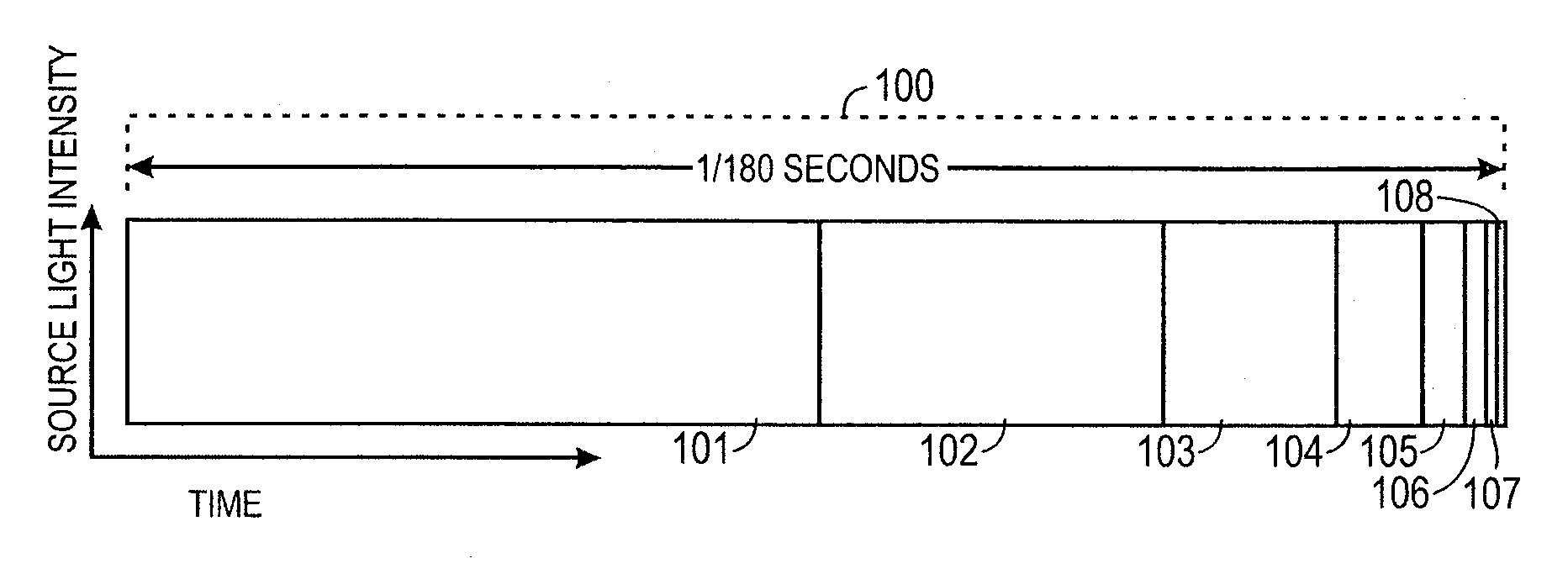
[0050]In a third embodiment, bit-splitting is deployed to divide higher order bits (e.g., the most significant bit (MSB) 101), which have the longest temporal duration, into smaller subunits that total the duration of the original pulse of MSB 101. The split bits may be distributed and interleaved for all three stimulus colors a, b, c, which are thus intermixed (unlike prior art bit-splitting which is limited to bit-splitting within a single primary due to the exigencies of color wheel operation native to the displays incorporating such techniques). FIG. 4A illustrates the four most significant bits 101, 102, 103, and 104 of the original primary color binary weighting paradigm set forth in FIG. 1. FIG. 4B illustrates how the larger, more significant bits (e.g., bits 101, 102, 103 illustrated in FIG. 4A) can be subdivided. In this example, bits 101, 102, and 103 are all subdivided into multiples of the duration set for the fourth most significant bit 104, as shown in FIG. 4B. The val...
PUM
 Login to View More
 Abstract
Description
Claims
Application Information
 Login to View More