Check patentability & draft patents in minutes with Patsnap Eureka AI!

Method For Measuring Subterranean Formation Density Using A Neutron Generator

a technology of neutron generator and formation density, which is applied in the direction of measurement devices, instruments, nuclear radiation detection, etc., can solve the problems of significant errors in formation density estimation and inaccurate disclosure methods, and achieve the effect of improving accuracy and formation density

Inactive Publication Date: 2013-12-12
SCHLUMBERGER TECH CORP
View PDF53 Cites 6 Cited by
  • Summary
  • Abstract
  • Description
  • Claims
  • Application Information

AI Technical Summary

Benefits of technology

The present invention provides better accuracy for measuring the density of formations during wireline and MWD operations using a neutron generator. This is achieved by selecting primarily inelastic gamma rays generated in the formation.

Problems solved by technology

Such radioactive chemical sources have obvious disadvantages from a radiation safety viewpoint and these disadvantages are of some concern in measurement or logging while drilling (MLWD) applications.
While the '215 and '822 patents disclose methods for estimating a formation bulk density without using a chemical source of gamma rays, the disclosed methods tend to be inaccurate.
The failure to discriminate between gamma rays originating in the formation and gamma rays originating in the tool or the borehole fluid essentially averages all detected gamma rays, which can lead to significant errors in the estimated formation density.

Method used

the structure of the environmentally friendly knitted fabric provided by the present invention; figure 2 Flow chart of the yarn wrapping machine for environmentally friendly knitted fabrics and storage devices; image 3 Is the parameter map of the yarn covering machine
View more

Image

Smart Image Click on the blue labels to locate them in the text.
Viewing Examples
Smart Image
  • Method For Measuring Subterranean Formation Density Using A Neutron Generator
  • Method For Measuring Subterranean Formation Density Using A Neutron Generator
  • Method For Measuring Subterranean Formation Density Using A Neutron Generator

Examples

Experimental program
Comparison scheme
Effect test

embodiment 100

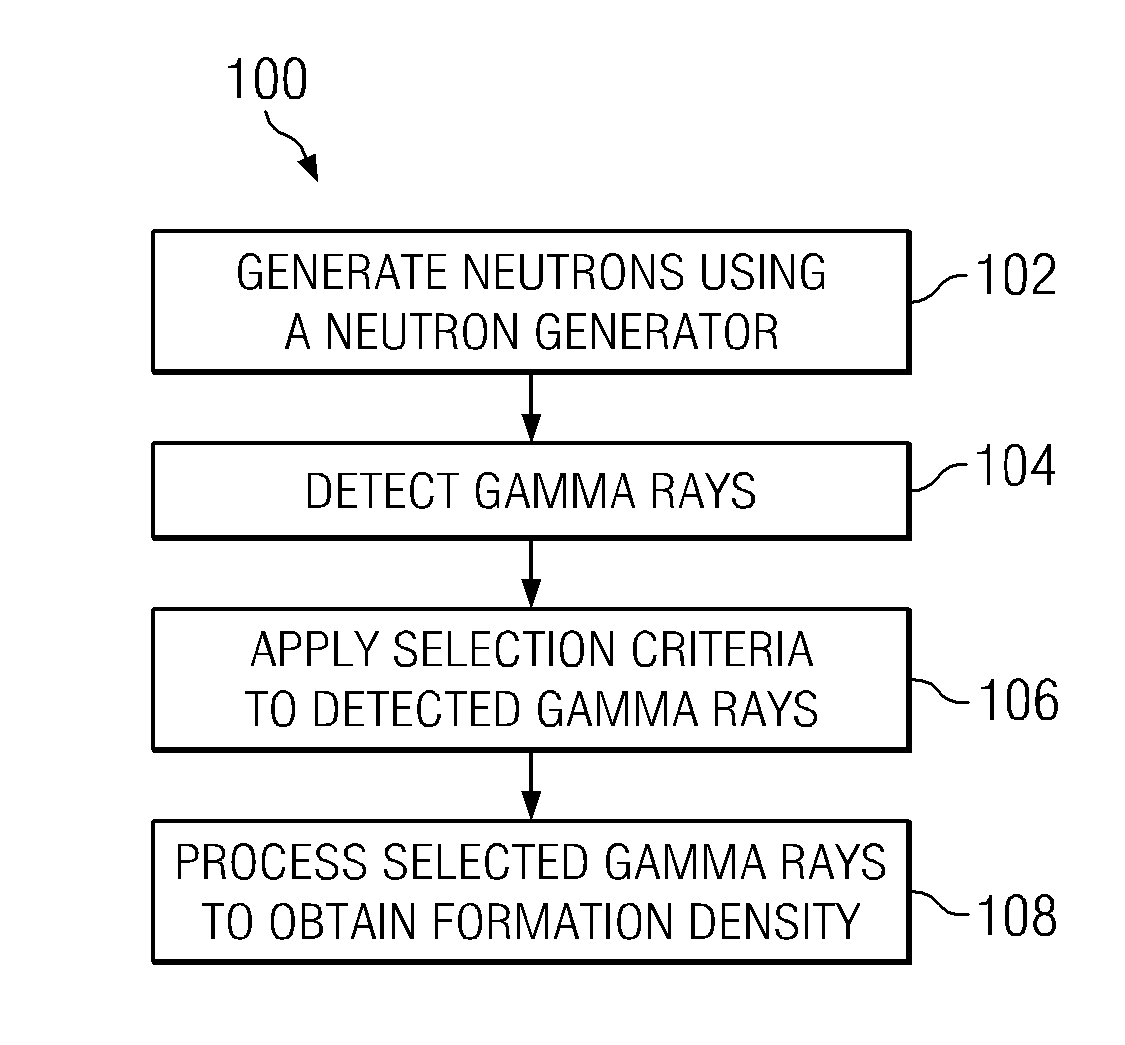
[0021]FIG. 2 depicts a flow chart of one exemplary method embodiment 100 in accordance with the present invention. Method 100 includes a method for estimating a bulk formation density from the detection of gamma rays. At 102 neutrons are generated using a neutron generator, for example, an accelerator based generator making use of the deuterium-tritium (D-T) fusion reaction. The neutrons emerge from the generator and interact with the borehole (i.e., with the environment surrounding the borehole including the tool, the borehole fluid and the formation) to produce secondary gamma rays as described above in the Background Section. These gamma rays may be detected at 104 using one or more gamma ray detectors deployed on the downhole tool. Predetermined selection criteria are applied to the detected gamma rays at 106. Gamma rays that meet the criteria are selected while that those that do not meet the criteria are rejected. The selected gamma rays are then processed at 108 to compute a ...

embodiment 150

[0026]FIG. 5 depicts a flow chart of an alternative method embodiment 150 in accordance with the present invention. Method 150 is similar to method 100 in that it includes a method for computing a formation density from the detection of gamma rays. Neutrons are generated using a neutron generator and emitted into a subterranean formation at 152. The neutron generator may include, for example, an accelerator based generator making use of a deuterium-tritium (D-T) fusion reaction as described in more detail above with respect to FIGS. 2 and 3. Gamma rays are detected at 154 using at least one gamma ray detector (e.g., detectors 66 on FIG. 3). Alpha particles are detected at 156 using at least one alpha particle deployed in close proximity to the neutron generator (e.g. detector(s) 58 on FIG. 3). Neutrons may also optionally be detected at 156 (e.g., using neutron detector 64 on FIG. 3).

[0027]The detected alpha particles and gamma rays are evaluated in combination at 160 to determine w...

the structure of the environmentally friendly knitted fabric provided by the present invention; figure 2 Flow chart of the yarn wrapping machine for environmentally friendly knitted fabrics and storage devices; image 3 Is the parameter map of the yarn covering machine
Login to View More

PUM

No PUM Login to View More

Abstract

A method for determining a bulk formation density using a neutron generator includes detected secondary gamma rays and evaluating the detected gamma rays according to pre-determined selection criteria. Selected gamma rays are then used to compute the formation density. The selection criteria may include, for example, a time delay between the detection of a neutron and an associated particle and / or a direction of propagation of the neutron.

Description

FIELD OF THE INVENTION[0001]The present invention relates generally to methods for making formation density measurements in a subterranean borehole. More particularly, the present invention relates to methods for measuring formation density measurements using a neutron generator.BACKGROUND OF THE INVENTION[0002]Nuclear logging techniques are commonly used in both wireline logging and logging while drilling operations. For example, neutron logging techniques are commonly employed to compute formation porosity. Gamma ray logging techniques are employed to compute bulk formation density, from which formation porosity can also be derived, possibly in combination with the neutron porosity measurement. Conventional bulk density measurements commonly make use of an isotopic source of gamma rays (also referred to as a chemical source), such as 137 Cs . Such radioactive chemical sources have obvious disadvantages from a radiation safety viewpoint and these disadvantages are of some concern i...

Claims

the structure of the environmentally friendly knitted fabric provided by the present invention; figure 2 Flow chart of the yarn wrapping machine for environmentally friendly knitted fabrics and storage devices; image 3 Is the parameter map of the yarn covering machine
Login to View More

Application Information

Patent Timeline
no application Login to View More
IPC IPC(8): G01V5/10
CPCG01V5/101G01V5/104
Inventor XU, LIBAIMCKINNY, KEVIN S.HUISZOON, CORNELIS
Owner SCHLUMBERGER TECH CORP
Features
  • R&D
  • Intellectual Property
  • Life Sciences
  • Materials
  • Tech Scout
Why Patsnap Eureka
  • Unparalleled Data Quality
  • Higher Quality Content
  • 60% Fewer Hallucinations
Social media
Patsnap Eureka Blog
Learn More