
Reduced compression height piston and piston assembly therewith and methods of construction thereof
a compression height and piston technology, applied in the direction of trunk pistons, machines/engines, plungers, etc., can solve the problems of limiting the degree to which the compression height, the overall engine size, and the compression height can be reduced, so as to achieve the reduction of the compression height and weight of the piston, the compression load is increased, and the compression height (ch) and the compression height of the piston are able to be minimized
- Summary
- Abstract
- Description
- Claims
- Application Information
AI Technical Summary
Benefits of technology
Problems solved by technology
Method used
Image

Examples
Embodiment Construction
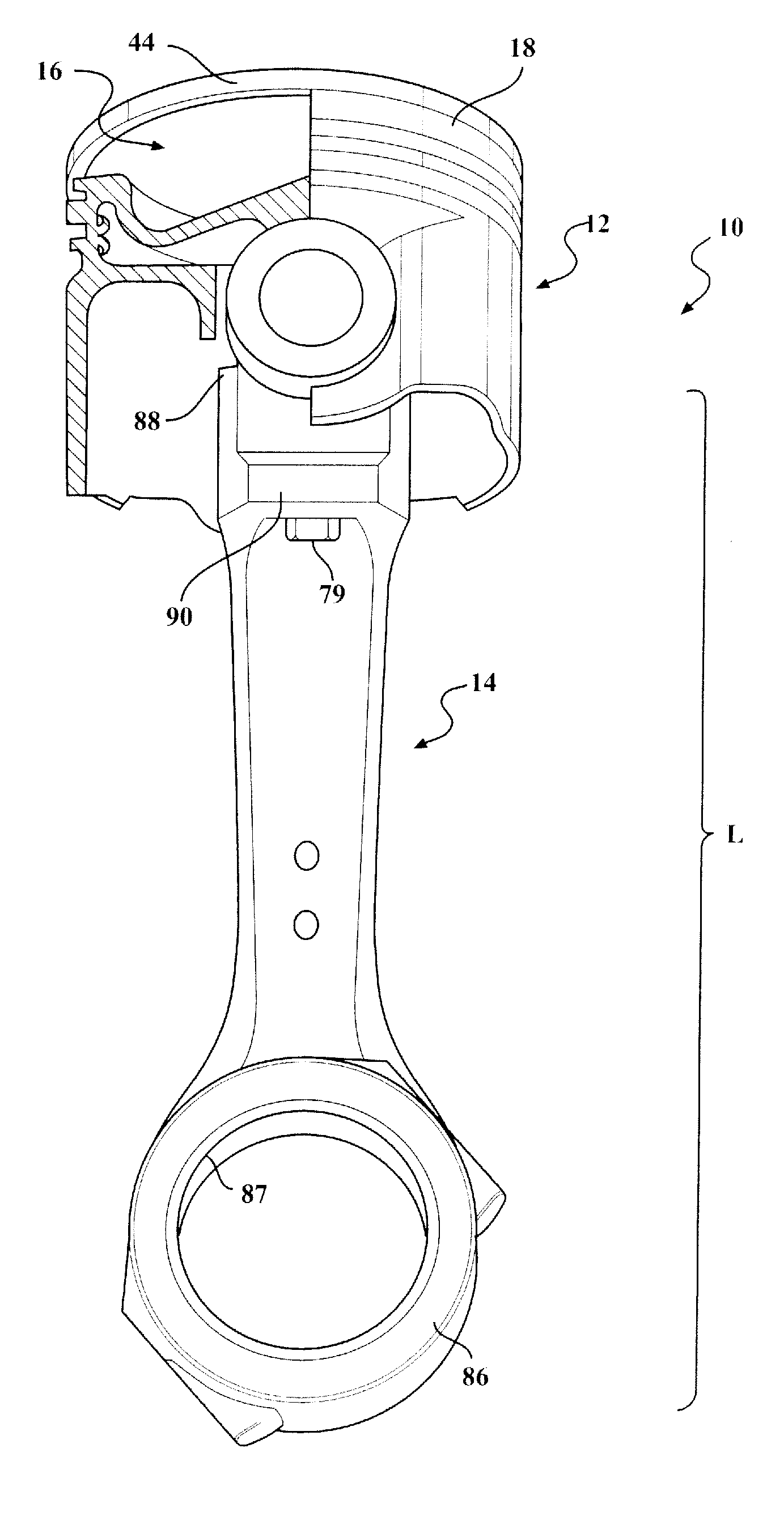
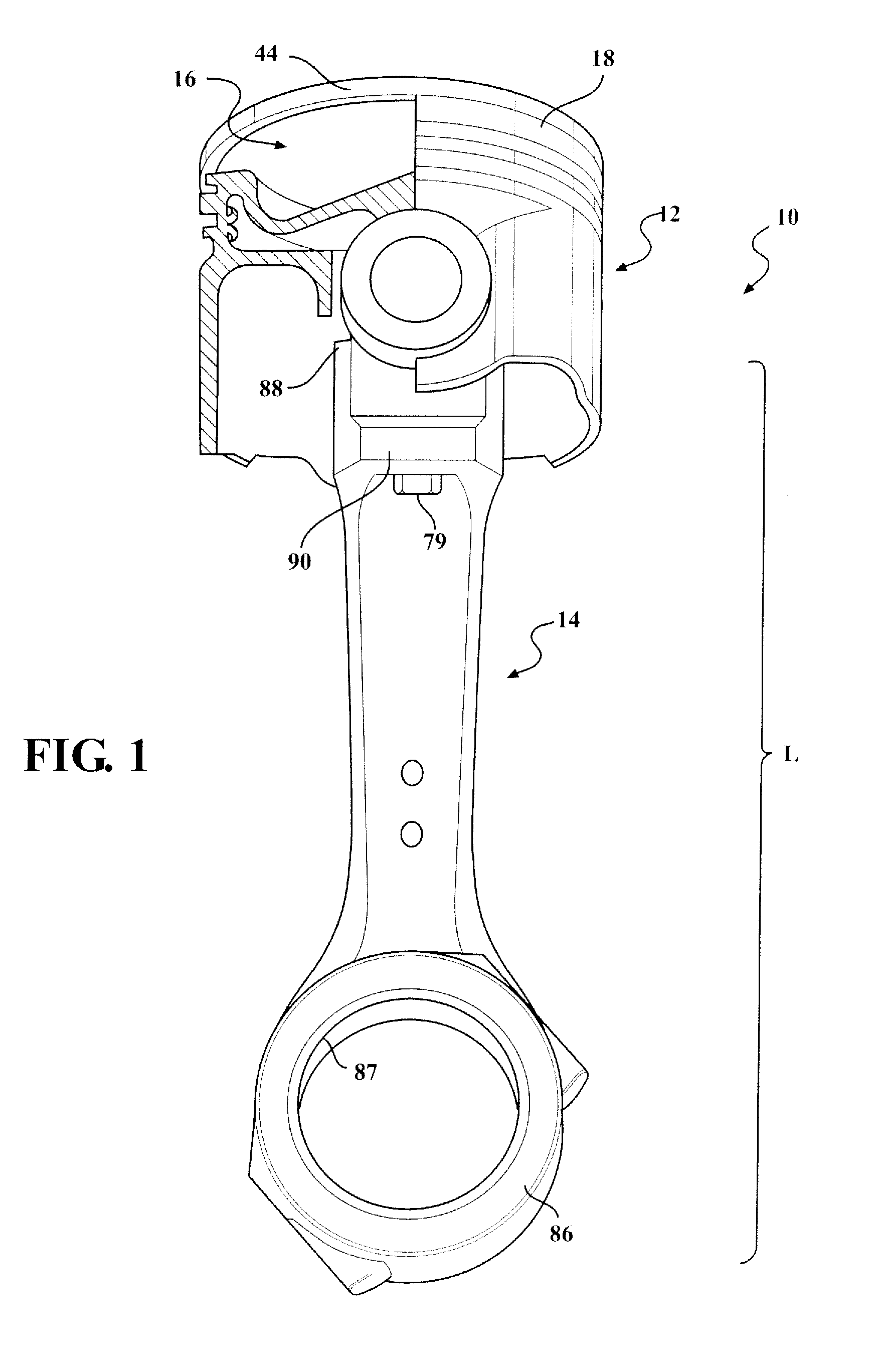
[0069]Referring in more detail to the drawings, FIG. 1 illustrates a partially sectioned perspective view of a piston and connecting rod assembly, referred to hereafter as assembly 10, constructed in accordance with one presently preferred embodiment of the invention, for reciprocating movement in a cylinder bore or chamber (not shown) of an internal combustion engine, such as a modern, compact, high performance vehicle engine, such as a gas or diesel engine for example. The assembly 10 includes a piston 12, a connecting rod 14 and a wrist pin 16. The connecting rod 14 is operably connected to the piston 12 via fixed attachment to the wrist pin 16 for conjoint oscillation with the wrist pin 16. The piston 12 has a body 18 made of at least two separate pieces that are initially fabricated as separate parts and subsequently joined to one another within a head region across some form of a weld joint (i.e., induction weld, friction weld, braze joint, charge carrier rays, laser, resistan...
PUM
| Property | Measurement | Unit |
|---|---|---|
| thermal conductivity | aaaaa | aaaaa |
| melting temperature | aaaaa | aaaaa |
| particle size | aaaaa | aaaaa |
Abstract
Description
Claims
Application Information
 Login to View More