
Asphalt mixture, process for production of same, and paving method using same
a technology of asphalt mixture and process, applied in the direction of building components, building insulations, constructions, etc., can solve the problems of significant temperature drop immediately after the mixture, difficulty in applying hot asphalt mixture, and reduced temperature of the mixture, so as to achieve enhanced strength and durability, low viscosity, and high strength
- Summary
- Abstract
- Description
- Claims
- Application Information
AI Technical Summary
Benefits of technology
Problems solved by technology
Method used
Image

Examples
first embodiment
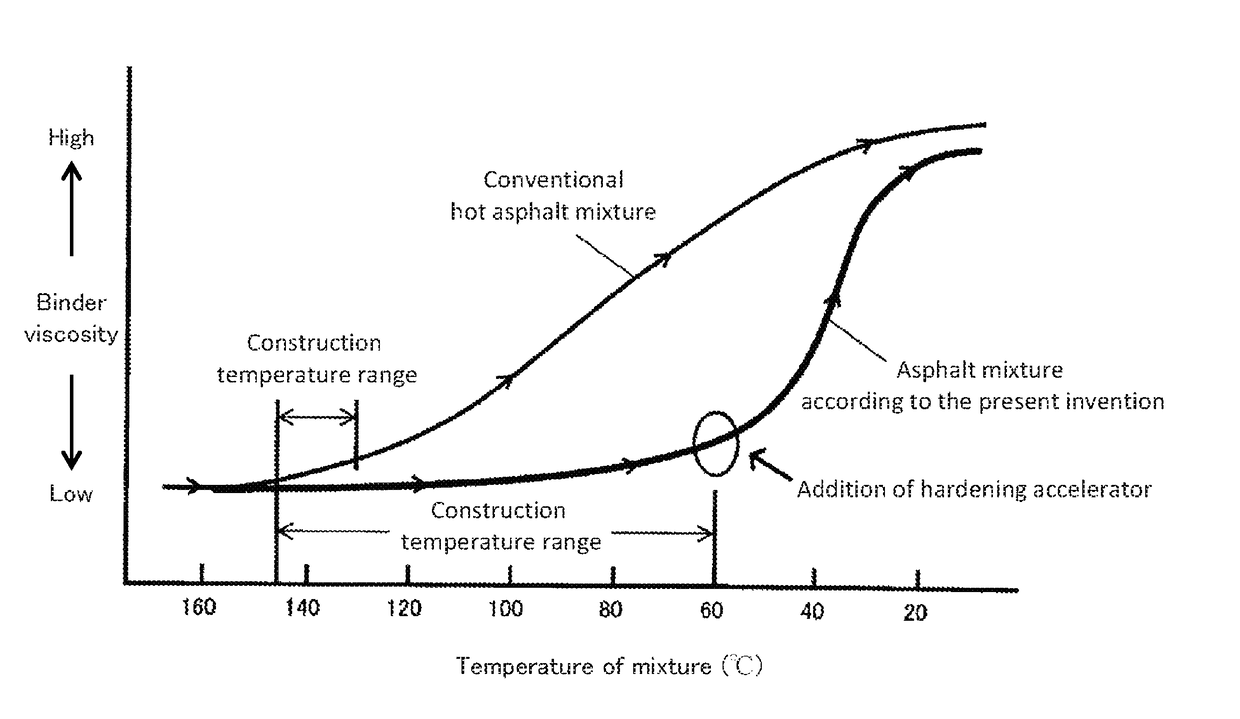
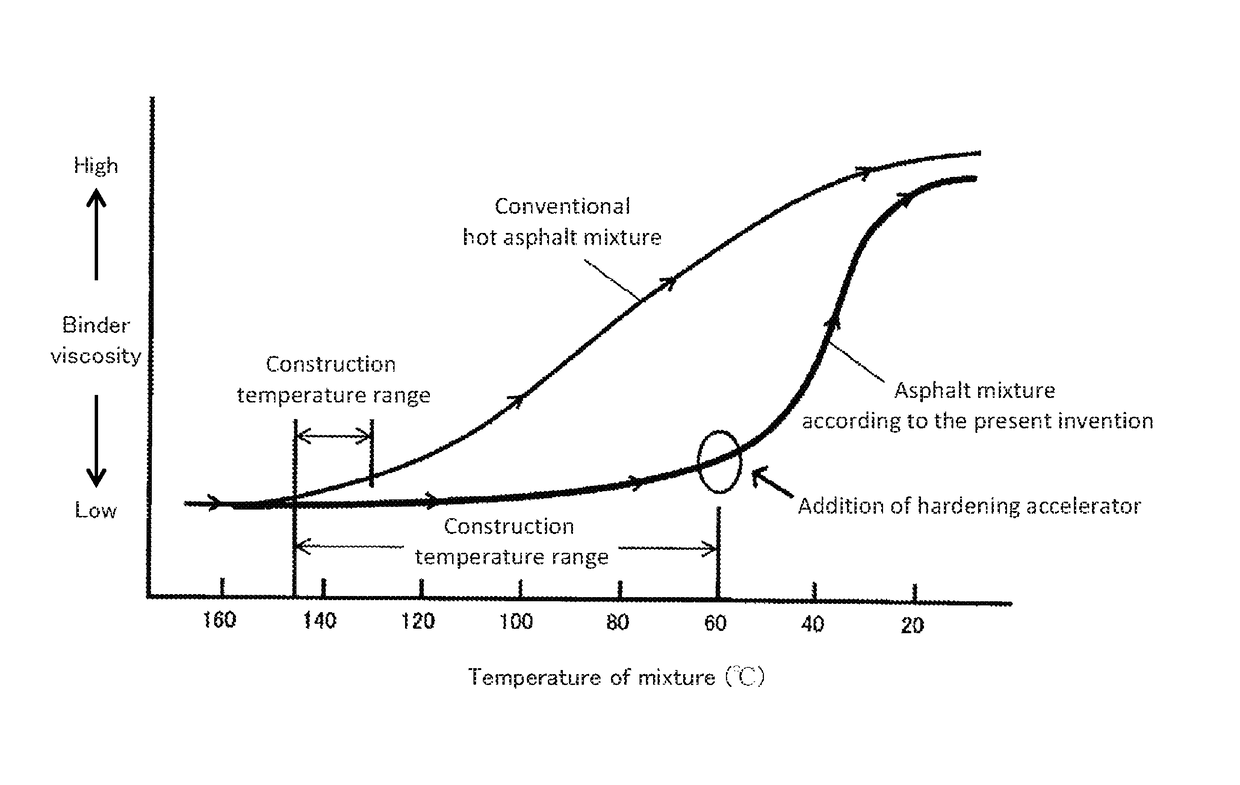
[0043]The asphalt mixture according to the present invention may be produced by the method as will be described below, for example, and the obtained mixture may be enclosed in a bag that comprises a moisture permeation preventing layer and a thermal fusion bonding layer, and can thereby be stored for a long time (e.g. 6 months).
[0044]A process for production of the asphalt mixture according to the present embodiment will hereinafter be described.
[0045]First, an aggregate is put into a mixing apparatus, and dry mixing for the aggregate is performed. The dry mixing may be performed under a condition in which the aggregate is heated to 100-170° C., preferably 100-140° C., and more preferably 110-130° C. The temperature and the amount of time for the dry mixing are not particularly limited, but the temperature for the dry mixing may ordinarily be 100-140° C. and preferably 110-130° C., while the amount of time for the dry mixing may ordinarily be about 1 second to 1 minute. In the prese...
second embodiment
[0054]In an alternative embodiment of the present invention, the mixture to be obtained in the above process may be configured such that the alkaline additive material is added thereto, in addition to the hardening accelerator (e.g. water), when the lubricative solidification material and the alkaline component are subjected to a saponification reaction or a neutralization reaction.
[0055]In this case, the above-described alkaline additive material may be used as the alkaline additive material to be added with the hardening accelerator, for example, but it is particularly preferred to use potassium pyrophosphate.
[0056]According to the present embodiment, by employing a configuration in which the alkaline additive material is added in addition to the hardening accelerator when the lubricative solidification material and the alkaline component are subjected to a saponification reaction or a neutralization reaction, the ratio of the alkaline additive material to be contained in the asph...
examples
[0057]The present invention will hereinafter be described with reference to more detailed examples, but the present invention is not limited to these examples.
PUM
| Property | Measurement | Unit |
|---|---|---|
| Temperature | aaaaa | aaaaa |
| Temperature | aaaaa | aaaaa |
| Fraction | aaaaa | aaaaa |
Abstract
Description
Claims
Application Information
 Login to View More