Unlock instant, AI-driven research and patent intelligence for your innovation.

Thermoelectric devices having reduced parasitics

a technology of thermoelectric devices and parasitics, applied in the field of thermoelectric devices, can solve the problems of large electrical parasitic losses and significant power loss

Inactive Publication Date: 2014-10-16
NEMIR DAVID CHARLES +2
View PDF4 Cites 13 Cited by
  • Summary
  • Abstract
  • Description
  • Claims
  • Application Information

AI Technical Summary

Benefits of technology

This patent is about improving the performance of thermoelectric devices by reducing thermal and electrical parasitic influences. The invention relates to the construction of thermoelectric devices to reduce thermal and electrical performance issues. The key component of a thermoelectric device is the thermoelement, which is the active portion that does the energy conversion. The invention claims the priority of U.S. patent application Ser. No. 12 / 653,721, filed on Dec. 17, 2009, and U.S. Provisional Patent Application No. 61 / 624,509 filed on Apr. 16, 2012. The invention takes into account the heat source and sink, as well as thermal resistances and other material properties that affect the performance of thermoelectric devices. The technical effects of the invention include improved efficiency, reduced thermal and electrical parasitic influences, and improved system performance.

Problems solved by technology

The use of single element tubes results in significant power loss due to parasitic electrical resistance.
If this connecting member is chosen to have small cross-section to minimize heat transfer, then it will have relatively large electrical resistance and result in large electrical parasitic losses.

Method used

the structure of the environmentally friendly knitted fabric provided by the present invention; figure 2 Flow chart of the yarn wrapping machine for environmentally friendly knitted fabrics and storage devices; image 3 Is the parameter map of the yarn covering machine
View more

Image

Smart Image Click on the blue labels to locate them in the text.
Viewing Examples
Smart Image
  • Thermoelectric devices having reduced parasitics
  • Thermoelectric devices having reduced parasitics
  • Thermoelectric devices having reduced parasitics

Examples

Experimental program
Comparison scheme
Effect test

Embodiment Construction

[0189]In the following paragraphs, the present invention will be described in detail through examples and detailed drawings.

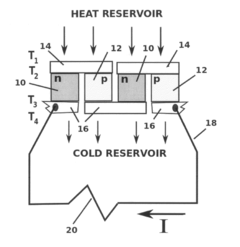
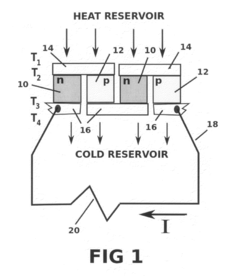
[0190]FIG. 1 depicts a four element thermoelectric device. N-type thermoelements 10 and p-type thermoelements 12 are connected in thermal parallel and electrical series through top electrical conductors 14 and bottom electrical conductors 16. In a thermoelectric generator, the heat flow is from hot to less hot, so in the FIG. 1 depiction, the heat reservoir is on the top and heat energy flows in a downward direction through the generator, with some of the heat energy being converted to electrical energy and the remainder flowing to the cold reservoir. The electrical conductors 14 and 16 are generally chosen to be a metallic conductor such as copper or nickel in order to have very low electrical resistance. Since good electrical conductors such as copper or nickel are also good thermal conductors, there is generally a minimal temperature drop across the top cond...

the structure of the environmentally friendly knitted fabric provided by the present invention; figure 2 Flow chart of the yarn wrapping machine for environmentally friendly knitted fabrics and storage devices; image 3 Is the parameter map of the yarn covering machine
Login to View More

PUM

No PUM Login to View More

Abstract

A tubular thermoelectric device wherein conductive substrates and completion elements serve a multiple role of structural support, thermal conductance and electrical conductance. Improved system thermoelectric performance accrues from the minimization of the number of interfaces between dissimilar materials, leading to a reduction in system thermal parasitics and system electrical parasitics. By engineering the shape and orientation of substrates and completion elements, improvements in heat transfer to heat reservoirs is accomplished and improved electrical conductivity is accomplished.

Description

CROSS-REFERENCE TO RELATED APPLICATIONS[0001]This application is a continuation-in-part application of U.S. patent application Ser. No. 12 / 653,721 entitled “Thin walled thermoelectric devices and methods for production thereof” which was filed on Dec. 17, 2009 and which claims the priority date of U.S. Provisional Patent Application Ser. No. 61 / 138,574 which was filed on Dec. 18, 2008. This application further claims the priority of U.S. Provisional Patent Application 61 / 624,509 filed Apr. 16, 2012, which is incorporated by reference as if written herein in its entirety.BACKGROUND OF THE INVENTION[0002]1. Field of the Invention[0003]This invention relates to thermoelectric devices and methods for building such devices to reduce thermal and electrical parasitic influences and thereby improve system performance.[0004]2. Background of the Invention[0005]Thermoelectric phenomena arise out of the intercoupled electrical and thermal currents in a conductor or semiconductor material. A the...

Claims

the structure of the environmentally friendly knitted fabric provided by the present invention; figure 2 Flow chart of the yarn wrapping machine for environmentally friendly knitted fabrics and storage devices; image 3 Is the parameter map of the yarn covering machine
Login to View More

Application Information

Patent Timeline
no application Login to View More
Patent Type & Authority Applications(United States)
IPC IPC(8): H01L35/32H01L35/34H10N10/01H10N10/17
CPCH01L35/34H01L35/325H10N10/17
Inventor NEMIR, DAVID CHARLESRUBIO, EDWARDBECK, JAN BASTIAN
Owner NEMIR DAVID CHARLES