Unlock instant, AI-driven research and patent intelligence for your innovation.

Methods for Producing Insulin-Secreting Beta Cells From Human Pluripotent Stem Cells

a technology of pluripotent stem cells and beta cells, which is applied in the field of producing insulin-secreting beta cells from human pluripotent stem cells, can solve the problems of limiting this therapy to very few patients, the amount of islet cells which can be harvested from human cadavers is extremely limited, and the amount of insulin produced is relatively limited

Active Publication Date: 2014-11-06
WISCONSIN ALUMNI RES FOUND
View PDF3 Cites 3 Cited by
  • Summary
  • Abstract
  • Description
  • Claims
  • Application Information

AI Technical Summary

Benefits of technology

The present invention provides methods for culturing human pluripotent stem cells to produce posterior foregut cells and pancreatic lineage cells, which can be used for drug screening and cell / tissue transplantation. The methods involve inducing the formation of mesendoderm / primitive streak and definitive endoderm cells, followed by further culturing the cells in the presence of insulin, transferrin, selenium, and other factors to produce cells of the pancreatic lineage. The resulting cell populations can be used for drug screening and cell / tissue transplantation.

Problems solved by technology

However, the lack of available and variable quality of organs and islet cells has restricted this therapy to very few patients.
The amount of islet cells which can be harvested from human cadavers is extremely limited.
While the resulting cells were PDX1+Insulin+, the amount of insulin produced is relatively limited.
However the percentage of insulin-positive cells is low, and secretion of human C-peptide into the medium is also low.
Although these protocols are highly reproducible, the relatively long culture period amplifies the cost of media and personnel time, and impedes efficient testing of additional growth factors that may advance the protocol.
In addition, the longer culture period can promote undesirable deviation from specific directed lineage progression and variability in the results.

Method used

the structure of the environmentally friendly knitted fabric provided by the present invention; figure 2 Flow chart of the yarn wrapping machine for environmentally friendly knitted fabrics and storage devices; image 3 Is the parameter map of the yarn covering machine
View more

Image

Smart Image Click on the blue labels to locate them in the text.
Viewing Examples
Smart Image
  • Methods for Producing Insulin-Secreting Beta Cells From Human Pluripotent Stem Cells
  • Methods for Producing Insulin-Secreting Beta Cells From Human Pluripotent Stem Cells
  • Methods for Producing Insulin-Secreting Beta Cells From Human Pluripotent Stem Cells

Examples

Experimental program
Comparison scheme
Effect test

example 1

Protocol

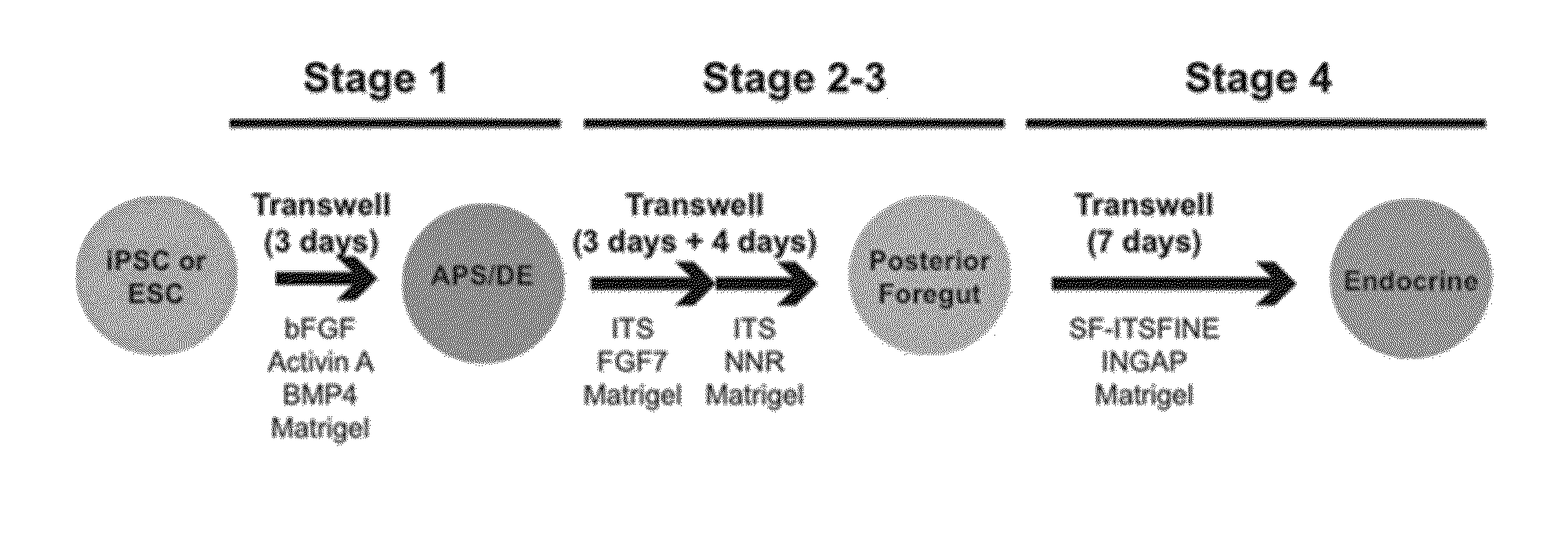
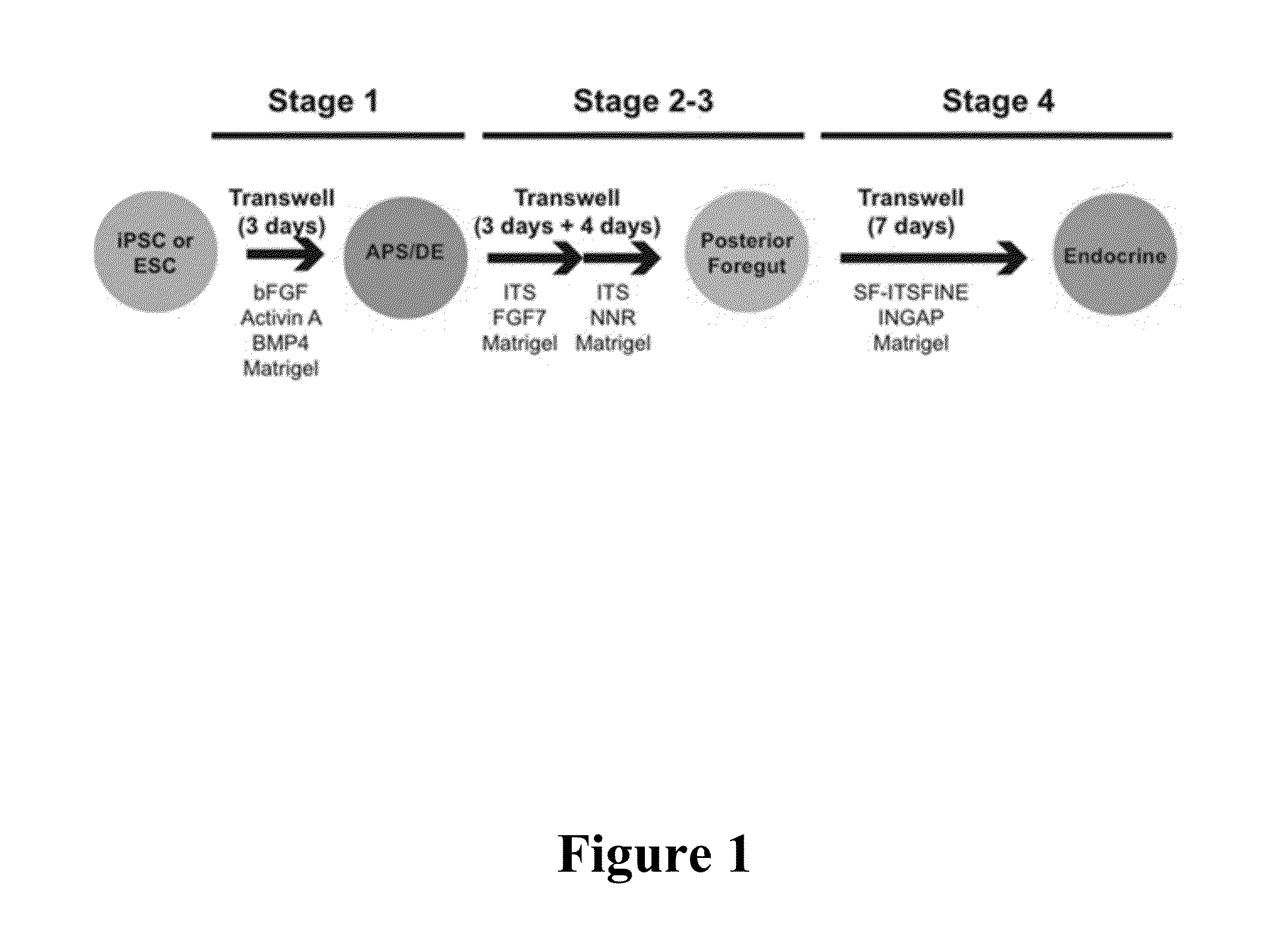
[0134]The genes and intercellular signaling molecules controlling definitive endoderm and pancreas development in vertebrates are rapidly being elucidated. This knowledge has informed the establishment of methods for generating such cells from human ES and iPS cells in vitro. Based on the defined roles of nodal / Activin signaling in definitive endoderm development, we have identified a protocol using Activin A, BMP, and FGF in chemically defined, serum-free media which efficiently directs human pluripotent stem cells into a homogeneous population of foregut and pancreatic progenitors, including PDX1 and Sox9 expressing cells. Under defined conditions, a proportion of progenitors ultimately gives rise to insulin +C-peptide+ / PDX1+ / β-like cells as well as cells expressing other endocrine hormones in vitro.

[0135]Cells

[0136]Cultures of undifferentiated hESCs or human iPS (hiPS) cells were used. Cell lines used were NIH-approved H1 (WA01) and H9 (WA09) between passage 18 and 42, th...

example 2

Results

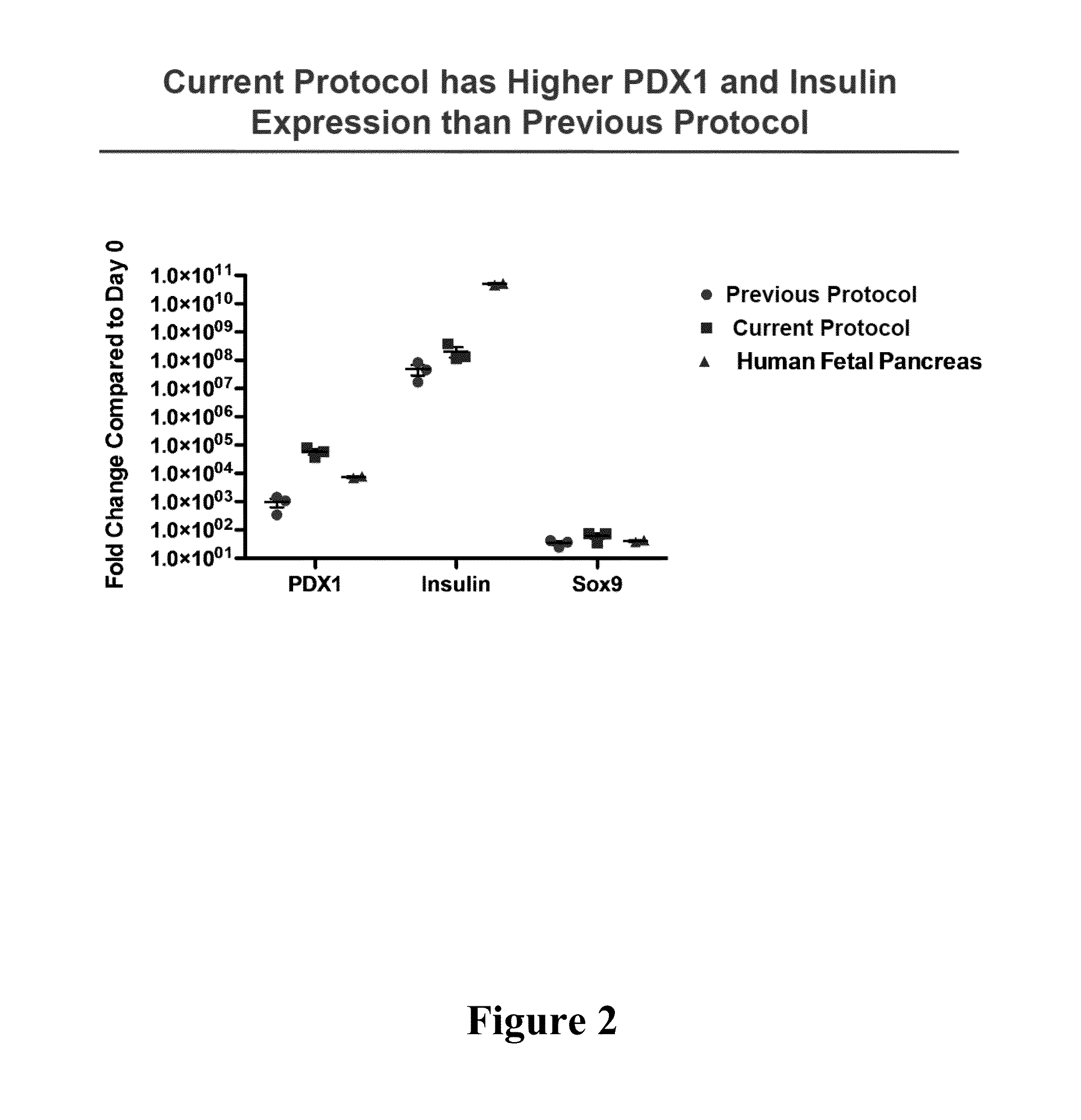
[0156]An analysis of the gene expression of the cells cultured under conditions of the present protocol, as well as a comparison to those of the cells cultured under conditions of the previously disclosed protocols in U.S. Pat. No. 8,247,229 and U.S. Patent Application Publication No. 2012 / 0264209 and other protocols known in the art, is described below. A number of terminologies or acronyms have been used to describe these protocols, as summarized in Table 3 below.

TABLE 3Summaries of ProtocolsOther namesCurrentTW-FAB, or FAB / ITS-FGF7 / ITS-NNR / ITSFINE-Noggin-Protocolcontinuous on TW (total culturing time: 18 days)PreviousFAB, or the standard protocol disclosed in U.S.ProtocolPatent Application Publication No. 2012 / 0264209,or FAB / MEF-CM / ITS-bFGF / ITSFINE / RPMI-NB-no TW (total culturing time: 49 days)SimplifiedThe simplified protocol disclosed in U.S. PatentProtocolApplication Publication No. 2012 / 0264209, orFAB / ITS-bFGF / ITSFINE- continuous on TW(total culturing time: 32 days)

[015...

the structure of the environmentally friendly knitted fabric provided by the present invention; figure 2 Flow chart of the yarn wrapping machine for environmentally friendly knitted fabrics and storage devices; image 3 Is the parameter map of the yarn covering machine
Login to View More

PUM

No PUM Login to View More

Abstract

A method of culturing human pluripotent stem cells to produce pancreatic lineage, the method comprising the steps of (a) culturing the stem cells in the presence of a chemically defined medium comprising an effective amount of FGF, Activin A, and BMP; (b) culturing the cells from step (a) in the presence of a chemically defined medium comprising an effective amount of insulin, transferrin, and selenium (ITS), and FGF; (c) culturing the cells from step (b) in the presence of a chemically defined medium comprising an effective amount of insulin, transferrin, and selenium (ITS), and Noggin-Nicotinamide-Retinoic acid; and (d) culturing the cells from step (c) in the presence of a serum free chemically defined medium (ITSFINE and Noggin) comprising an effective amount of ITS, FGF7, islet neogenesis associated peptide (INGAP), nicotinamide, and Exendin-4, wherein pancreatic lineage cells are produced, wherein the pancreatic lineage cells are insulin+ cells.

Description

CROSS-REFERENCE TO RELATED APPLICATIONS[0001]This application claims the benefit of U.S. Provisional Patent Application Ser. No. 61 / 817,061, filed on Apr. 29, 2013, which is incorporated by reference in its entirety for all purposes.STATEMENT REGARDING FEDERALLY SPONSORED RESEARCH OR DEVELOPMENT[0002]N / ABACKGROUND OF THE INVENTION[0003]Type I diabetes is an autoimmune disease of humans caused by destruction of pancreatic islet cells. Transplantations of whole pancreas or isolated islet cells are effective treatments for Type I diabetes to restore insulin independence, when combined with immunosuppressive therapy. Successful transplantation of isolated islets from human cadaver donors is a proof-in-principle that a cell-based therapy for human diabetes can be successful. However, the lack of available and variable quality of organs and islet cells has restricted this therapy to very few patients. The amount of islet cells which can be harvested from human cadavers is extremely limite...

Claims

the structure of the environmentally friendly knitted fabric provided by the present invention; figure 2 Flow chart of the yarn wrapping machine for environmentally friendly knitted fabrics and storage devices; image 3 Is the parameter map of the yarn covering machine
Login to View More

Application Information

Patent Timeline
no application Login to View More
IPC IPC(8): C12N5/071C12N5/074
CPCC12N5/0676C12N5/0607C12N2506/03C12N2501/119C12N2500/30C12N2501/16C12N2501/33C12N2501/30C12N2501/335C12N2501/155C12N2500/25C12N2501/115C12N2501/117C12N2501/385C12N2501/998C12N2506/02C12N2506/45C12N2533/90
Inventor ODORICO, JON SCOTTXU, XIAOFANGWITTKOWSKE, MELISA
Owner WISCONSIN ALUMNI RES FOUND