
Refrigerant evaporator
a technology of refrigerant evaporator and liquid-phase refrigerant, which is applied in the direction of indirect heat exchangers, refrigeration components, lighting and heating apparatus, etc., can solve the problems of unfavorable refrigerant distribution, liquid backflow phenomenon, and inability to easily reach the tube location of liquid-phase refrigerant, so as to reduce the deterioration of refrigerant distributing properties and improve the distribution of refrigerant in the core uni
- Summary
- Abstract
- Description
- Claims
- Application Information
AI Technical Summary
Benefits of technology
Problems solved by technology
Method used
Image

Examples
first embodiment
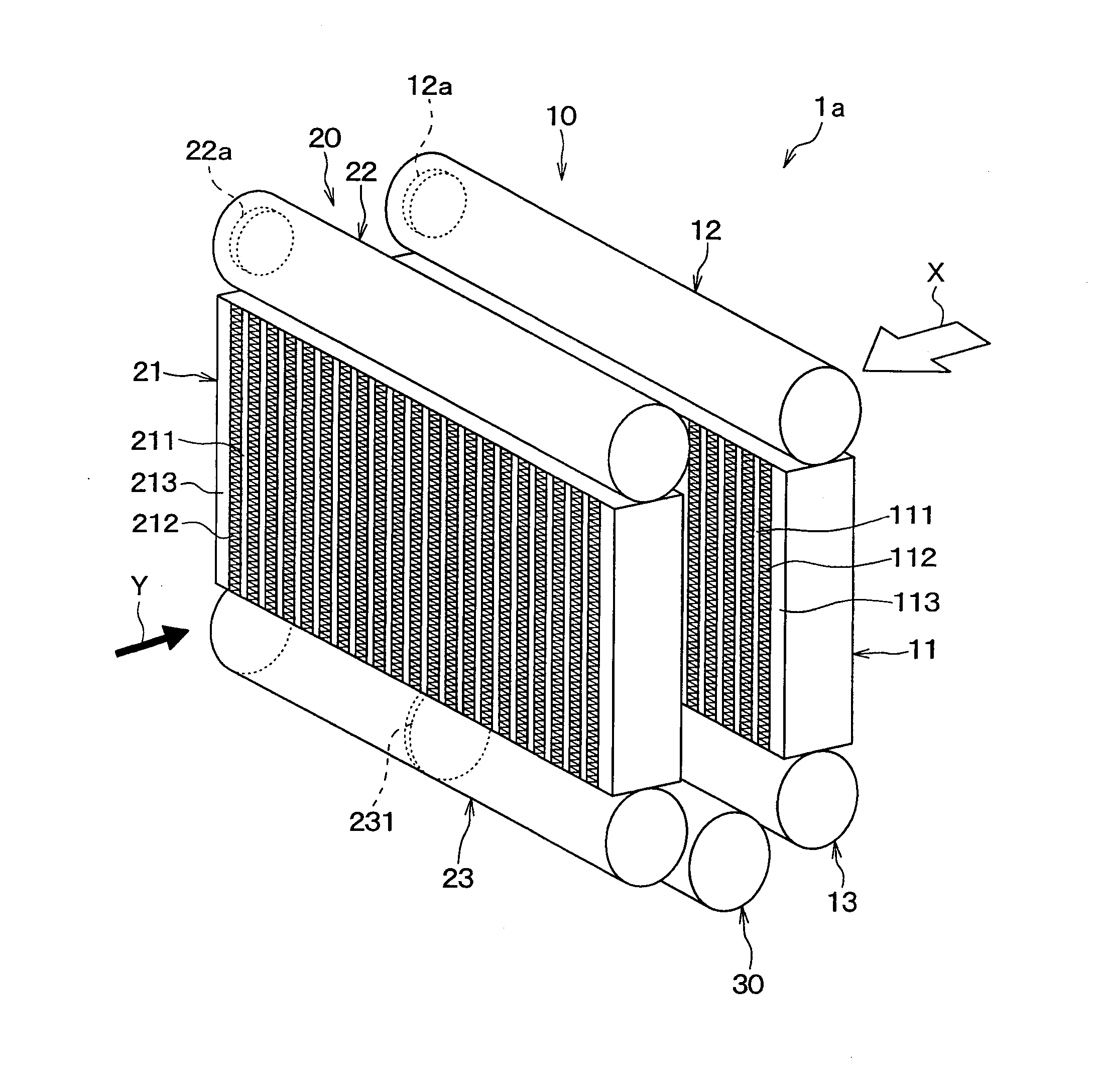
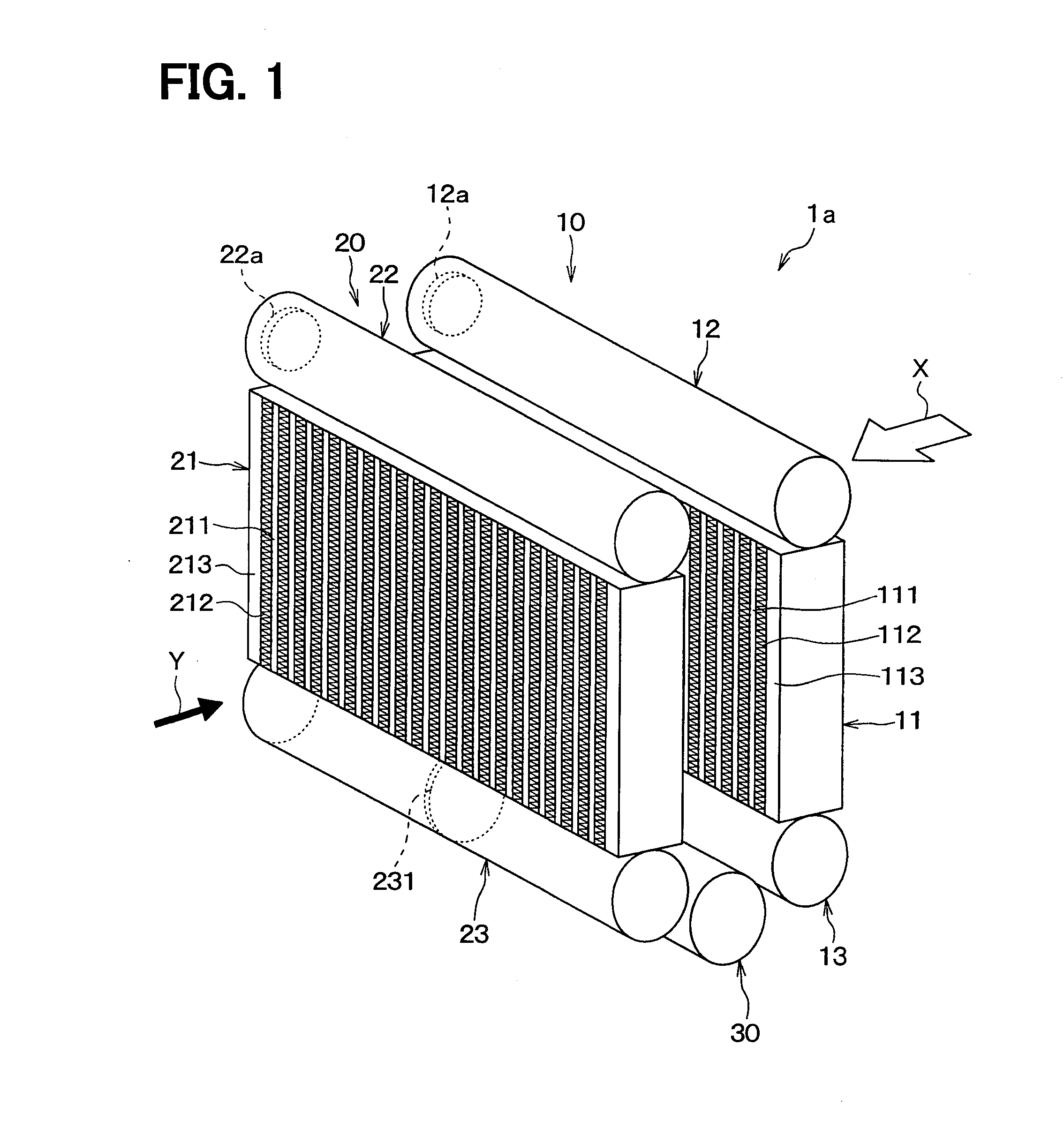
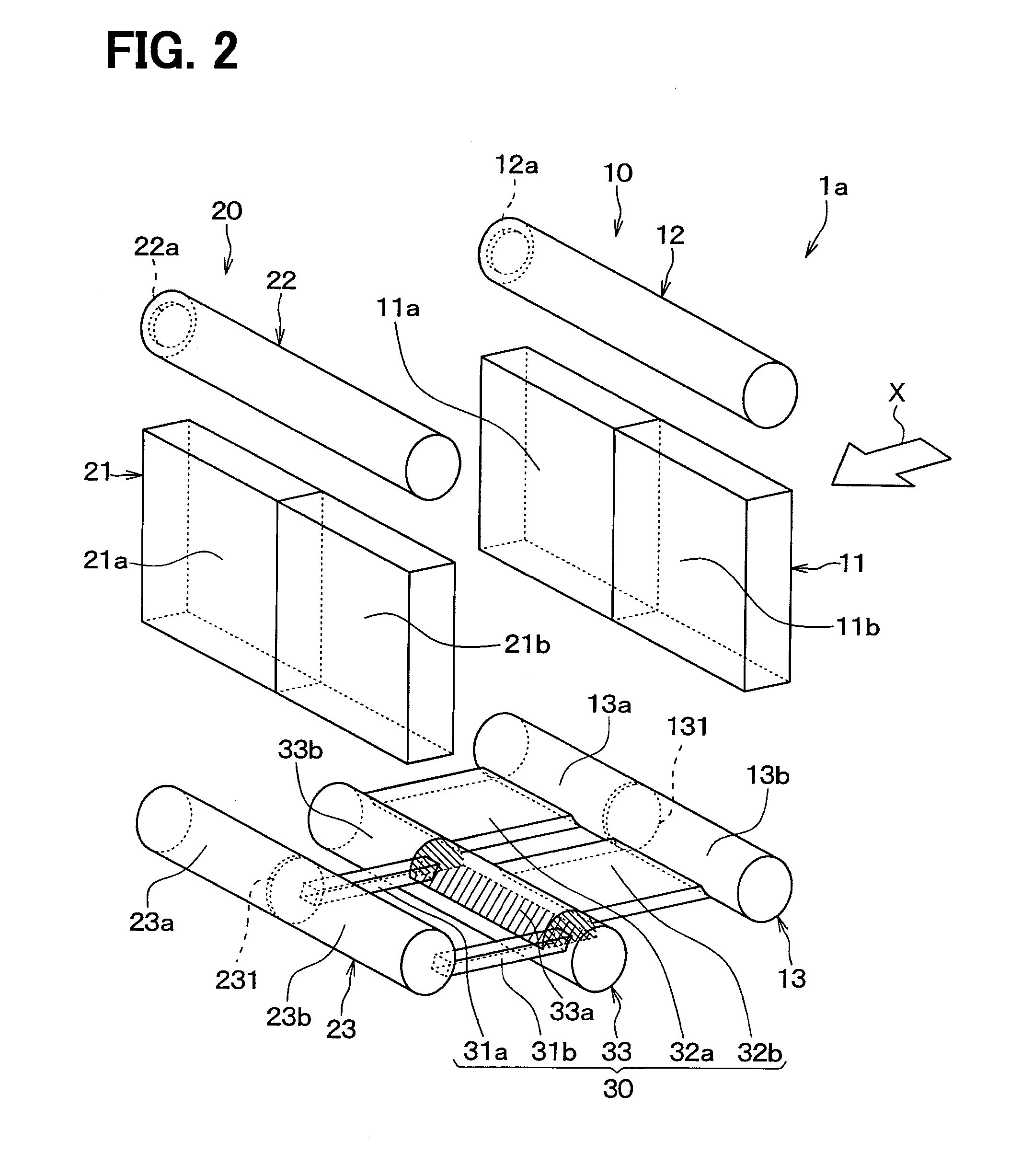
[0095]Referring now to FIG. 1 to FIG. 10, a first embodiment of the present disclosure will be described. A refrigerant evaporator 1a of the present embodiment is applied to a vapor compression refrigerating cycle of a vehicle air-conditioning apparatus configured to adjust the temperature in a cabin, and is a cooling heat exchanger configured to cool blast air by absorbing heat from the blast air supplied into the cabin and evaporating refrigerant (liquid-phase refrigerant). In the present embodiment, the blast air corresponds to “a subject-to-cooling fluid flowing outside”.
[0096]A refrigerating cycle includes a compressor, a heat radiator (condenser), and an expansion valve, which are not illustrated, in addition to the refrigerant evaporator 1a, which are well known and, in the present embodiment, is used as a receiver cycle which includes a liquid receiver arranged between the heat radiator and the expansion valve.
[0097]FIG. 1 is a schematic perspective view of the refrigerant e...
second embodiment
[0171]Subsequently, a second embodiment of the present disclosure will be described. In the present embodiment, the configurations of the third and fourth coupling members 32a, 32b are different from those in the first embodiment. In the present embodiment, description of parts which are the same as or equivalent to those of the first embodiment is omitted, or is given briefly.
[0172]FIG. 11 is an explanatory drawing for explaining the third and fourth coupling members 32a, 32b according to the present embodiment.
[0173]As illustrated in FIG. 11(a), in the present embodiment, the third and fourth coupling members 32a, 32b each include multiple coupling members (three coupling members in the present embodiment). The multiple coupling members each includes a cylindrical member having a refrigerant passage in which the refrigerant flows inside thereof, and is connected at one end side to the second windward tank unit 13 and at the other end side to the intermediate tank unit 33.
[0174]As ...
third embodiment
[0177]Subsequently, a third embodiment of the present disclosure will be described. The present embodiment is different from the first embodiment in the opening widths of the third and fourth coupling members 32a, 32b of the refrigerant exchanging portion 30. In the present embodiment, a description of parts which are the same as or equivalent to those of the first and second embodiments is omitted, or is given briefly.
[0178]As described in conjunction with the first embodiment, in the refrigerant evaporator 1a according to the comparative example, the distributing properties of the liquid-phase refrigerant to the second windward core portion 11b of the windward heat exchanging core unit 11 are not good, and when viewing in the blast air flowing direction X, a portion where the liquid-phase refrigerant can hardly flow is generated in the second windward core portion 11b (see FIG. 7(c)).
[0179]Accordingly, in the present embodiment, as shown in FIG. 12, the opening width Lb2 of the fo...
PUM
 Login to View More
 Abstract
Description
Claims
Application Information
 Login to View More