Aircraft wing structure
a technology for aircraft wings and wings, applied in the field of aircraft wings, to achieve the effect of reducing energy consumption, maximising the lift generation capability of aircraft in flight, and reducing the amount of energy consumed
- Summary
- Abstract
- Description
- Claims
- Application Information
AI Technical Summary
Benefits of technology
Problems solved by technology
Method used
Image



Examples
Embodiment Construction
)
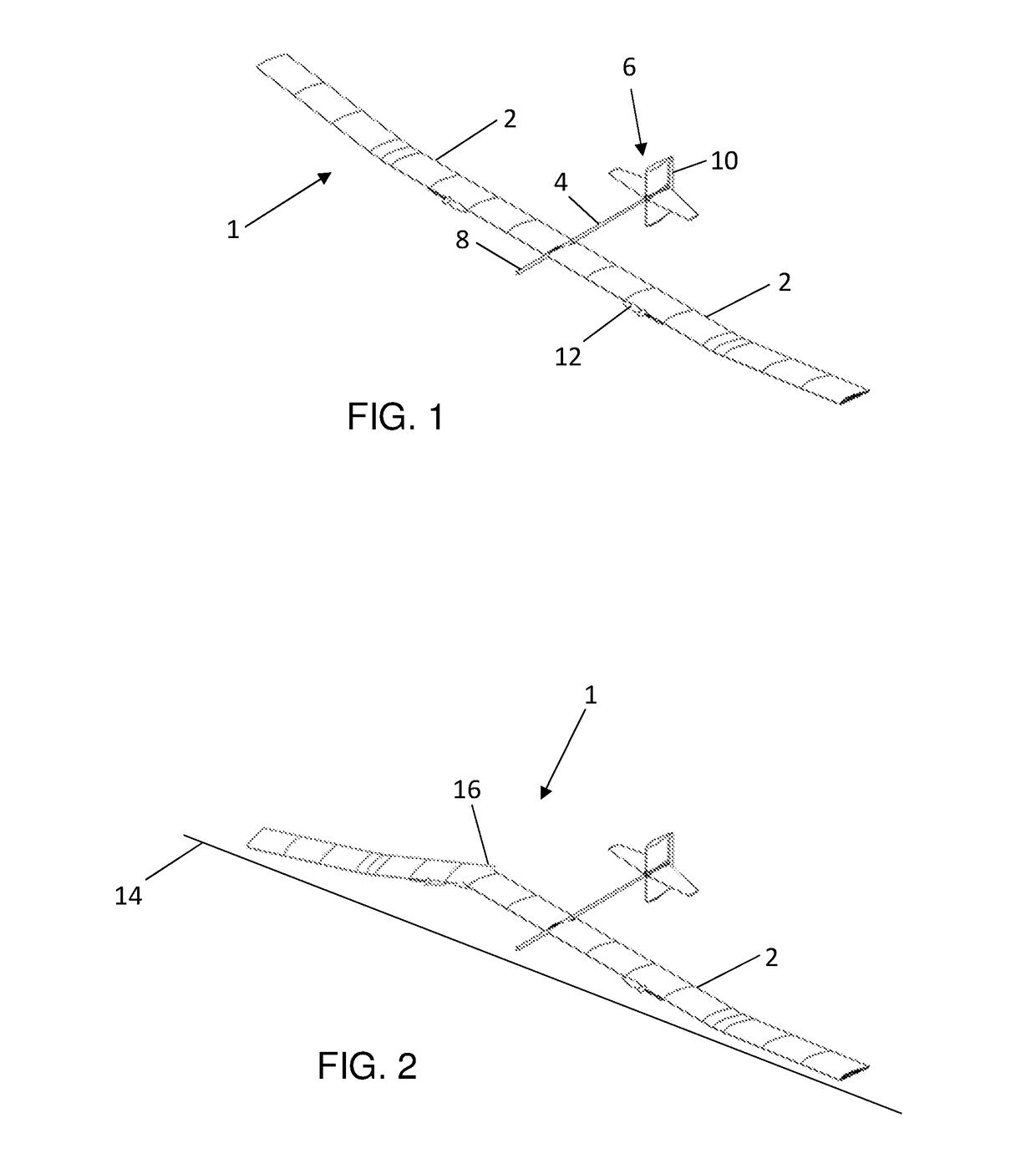
[0031]In an embodiment, the aircraft is a UAV 1 having two wings 2, a fuselage 4, and a tailplane 6, as shown in FIG. 1.
[0032]In this embodiment the fuselage 4 is a minimal structure, comprising simply a lightweight tube, with the wings 2 and tailplane 6 attached to the tube. The tube is of carbon fibre construction, having a diameter in the range of 60 to 120 mm and a wall section of 0.5 mm. In alternative embodiments, the fuselage may be constructed of any lightweight material, for example wood, plastic or fibre reinforced composite, and may be hollow or solid, and of any shape suitable for having wings and tailplane attached. The shape and dimensions of the fuselage may vary along the length of the fuselage, for example to provide weight balance, and may be elliptical or tapered. The nose 8 of the fuselage extends forwards of the wings and acts to counter balance the weight of the tailplane. The nose 8 also provides optional payload storage capacity.
[0033]The tailplane 6 has cru...
PUM
 Login to View More
 Abstract
Description
Claims
Application Information
 Login to View More