The write failures are most generally random, and have a characteristic
failure rate.
A high write error rate (WER) may make the memory unreliable.
The error rate can typically increase with age and increased use of the memory.
Bit-errors can result in
system crashes, but even if a bit-error does not result in a
system crash, it may cause severe problems because the error can linger in the
system causing incorrect calculations and multiply itself into further data.
This is problematic especially in certain applications, e.g., financial, medical, automotive, etc. and is generally commercially unacceptable.
The corrupted data can also propagate to storage media and grow to an extent that is difficult to diagnose and recover.
Further, other conventional error correction schemes may require considerable overhead because the addresses / locations of all the bad bits in the
memory chip need to be stored prior to performing the correction.
The Content Addressable Memories (CAMs) required to store such addresses and locations occupy significant surface area and are expensive because of the high overhead involved in saving the bit addresses / locations for all the failing bits.
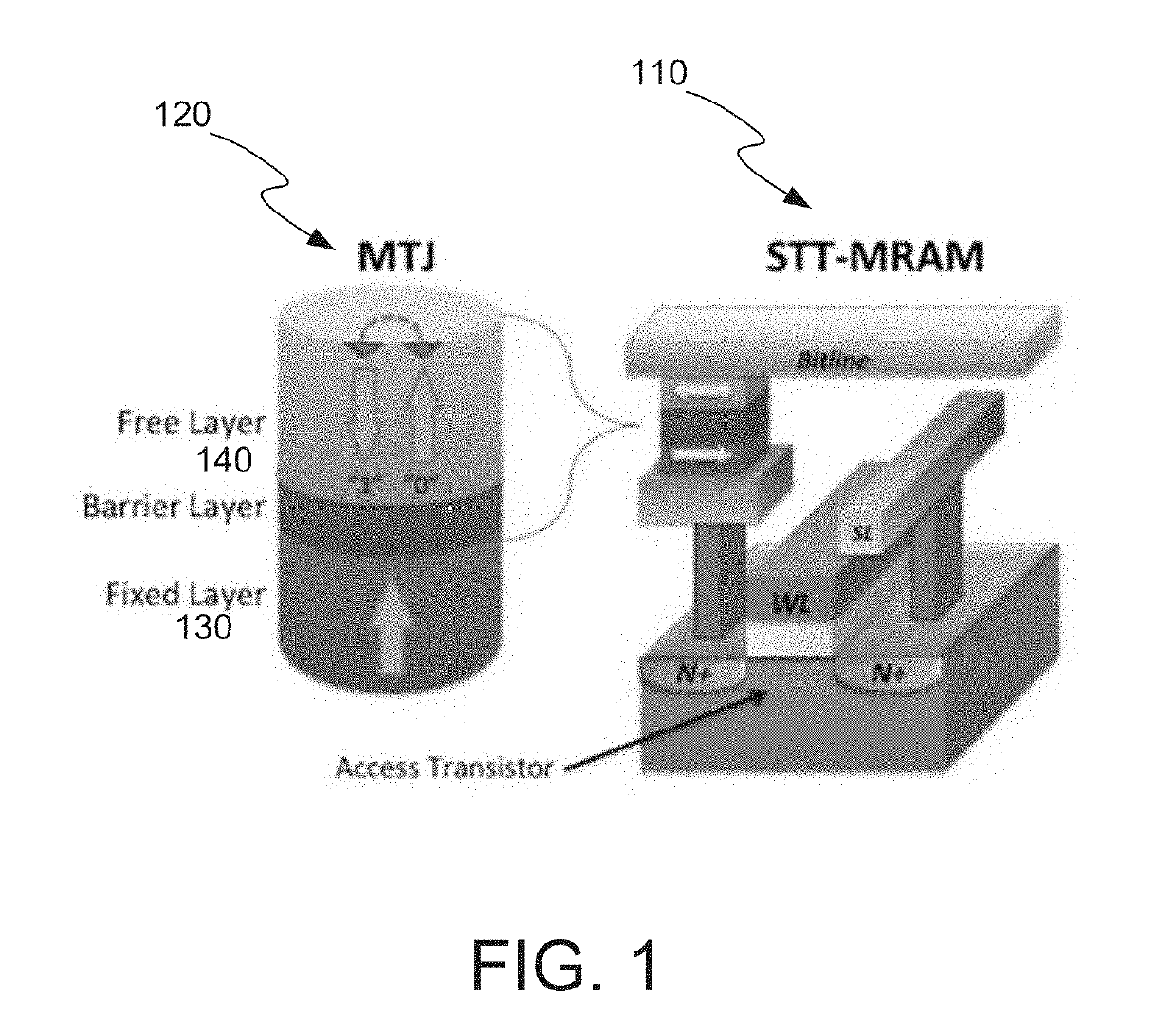
Further, storing addresses of bad bits and then replacing them with good bits is also not an optimal scheme for STT-MRAM memories because the defect rate is typically high and too much memory would be required to store the addresses of all the bad bits.
Also, this
error mitigation scheme does not work for defects that are discovered on-the-fly (e.g. replacing the bad bits with good bits may have only happened at the tester phase in manufacturing).
Further, typically, error schemes like ECC can detect and correct errors during a read operation, but it does not write the data back into the memory array.
This behavior causes the error to stay resident inside the memory array across multiple accesses and may contribute to a
memory failure at a later time when additional errors occur.
For example, if the memory is used for longer periods of time, there is an increased probability of a second failure occurring in the same ‘word’ as a first failure.
The first failure may lie silently for years as the internal ECC logic repairs the error every time the word is read.
. . ) error hits the same word, the internal ECC circuitry is unable to repair the word and corrupted read data is provided to the system.
Additionally, ECC is not efficient for correcting high fixed defect rates.
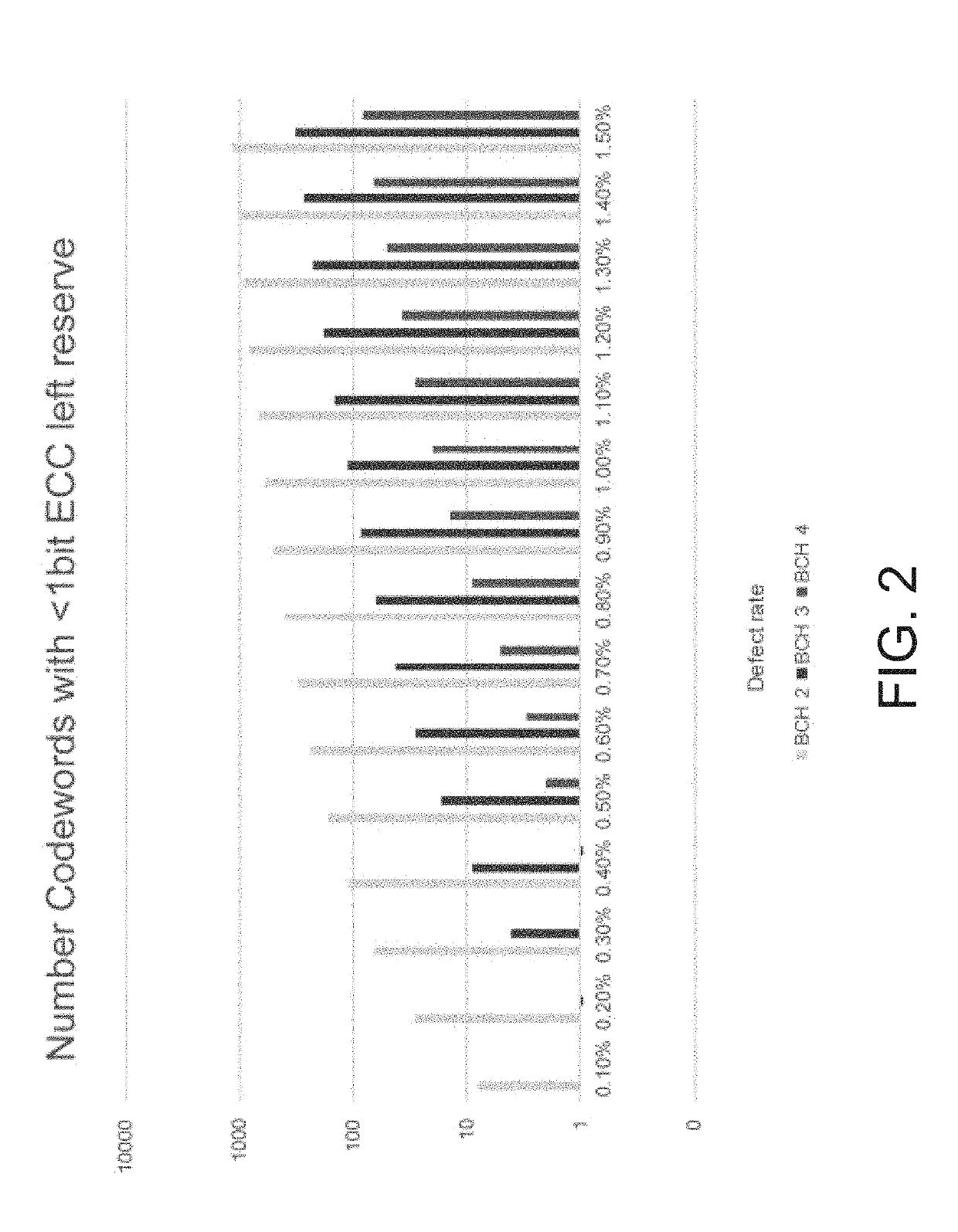
This is particularly problematic for memories comprising STT-MRAM that typically have higher failure rates as compared to other memories. FIG. 2 illustrates the number of codewords with less than 1 bit ECC left reserved as a function of the defect rate.
For memories with higher defect rates ECC and other error correction schemes become problematic.
Accordingly, in memory applications comprising STT-MRAM where defect rates are higher, using only conventional
error mitigation schemes like ECC results in inefficiencies.


 Login to View More
  Login to View More