Check patentability & draft patents in minutes with Patsnap Eureka AI!

Forcing bits as bad to widen the window between the distributions of acceptable high and low resistive bits thereby lowering the margin and increasing the speed of the sense amplifiers

a resistive bit and bit-as-bad technology, applied in the field of random access memory (ram), can solve the problems of unreliable memory, large overhead, and characteristic failure rate, and achieve the effect of not incurring a large overhead to the peripheral circui

Active Publication Date: 2019-11-19
INTEGRATED SILICON SOLUTION CAYMAN INC
View PDF561 Cites 0 Cited by
  • Summary
  • Abstract
  • Description
  • Claims
  • Application Information

AI Technical Summary

Benefits of technology

This approach effectively corrects bit defects in real-time, reduces the overhead in peripheral circuits, and extends the lifetime of the memory chip by continuously addressing defects over its operational period, enhancing data integrity and reliability.

Problems solved by technology

The write failures are most generally random, and have a characteristic failure rate.
A high write error rate (WER) may make the memory unreliable.
The error rate can typically increase with age and increased use of the memory.
Bit-errors can result in system crashes, but even if a bit-error does not result in a system crash, it may cause severe problems because the error can linger in the system causing incorrect calculations and multiply itself into further data.
This is problematic especially in certain applications, e.g., financial, medical, automotive, etc. and is generally commercially unacceptable.
The corrupted data can also propagate to storage media and grow to an extent that is difficult to diagnose and recover.
Further, other conventional error correction schemes may require considerable overhead because the addresses / locations of all the bad bits in the memory chip need to be stored prior to performing the correction.
The Content Addressable Memories (CAMs) required to store such addresses and locations occupy significant surface area and are expensive because of the high overhead involved in saving the bit addresses / locations for all the failing bits.
Further, storing addresses of bad bits and then replacing them with good bits is also not an optimal scheme for STT-MRAM memories because the defect rate is typically high and too much memory would be required to store the addresses of all the bad bits.
Also, this error mitigation scheme does not work for defects that are discovered on-the-fly (e.g. replacing the bad bits with good bits may have only happened at the tester phase in manufacturing).
Further, typically, error schemes like ECC can detect and correct errors during a read operation, but it does not write the data back into the memory array.
This behavior causes the error to stay resident inside the memory array across multiple accesses and may contribute to a memory failure at a later time when additional errors occur.
For example, if the memory is used for longer periods of time, there is an increased probability of a second failure occurring in the same ‘word’ as a first failure.
The first failure may lie silently for years as the internal ECC logic repairs the error every time the word is read.
. . ) error hits the same word, the internal ECC circuitry is unable to repair the word and corrupted read data is provided to the system.
Additionally, ECC is not efficient for correcting high fixed defect rates.
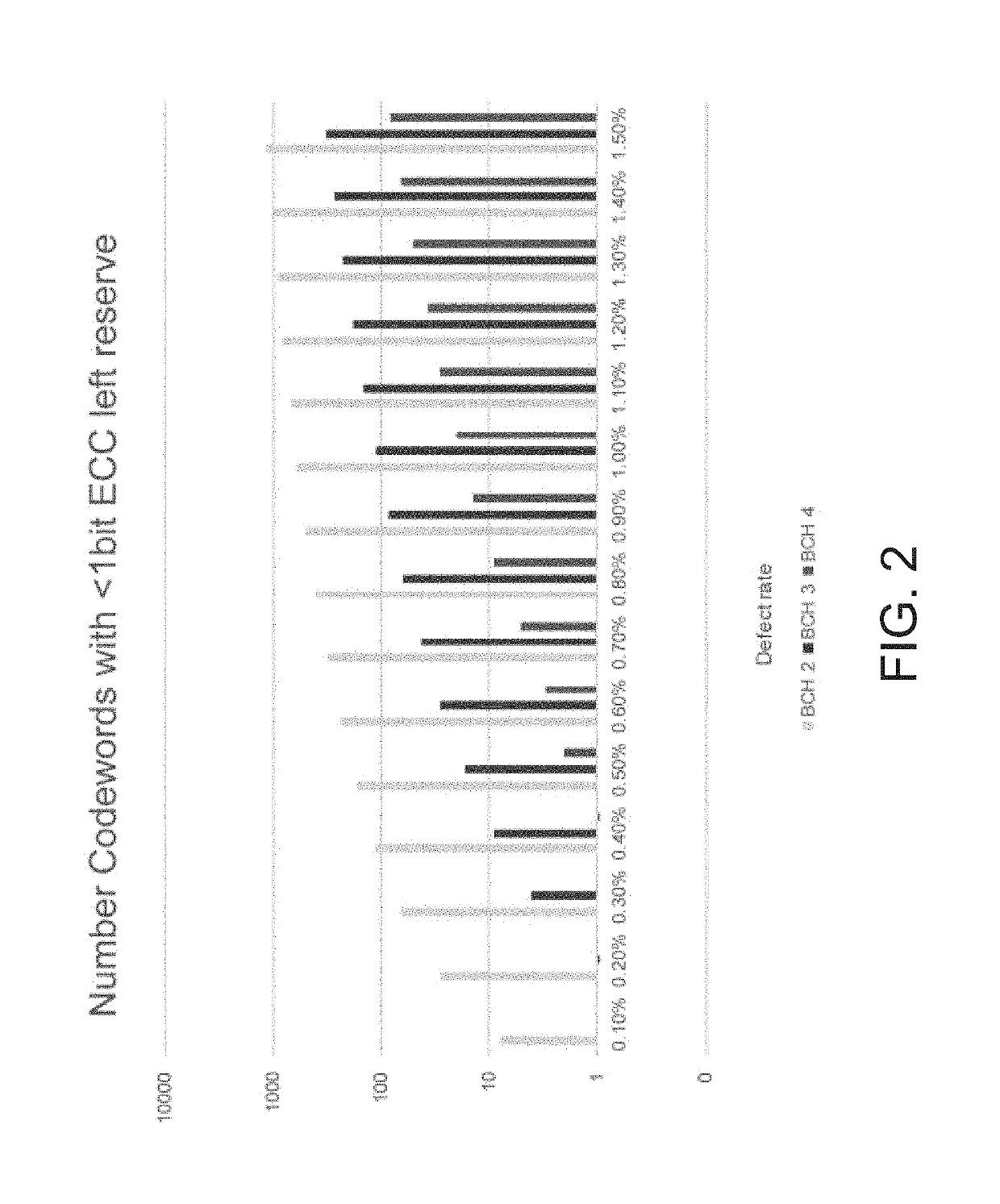
This is particularly problematic for memories comprising STT-MRAM that typically have higher failure rates as compared to other memories. FIG. 2 illustrates the number of codewords with less than 1 bit ECC left reserved as a function of the defect rate.
For memories with higher defect rates ECC and other error correction schemes become problematic.
Accordingly, in memory applications comprising STT-MRAM where defect rates are higher, using only conventional error mitigation schemes like ECC results in inefficiencies.

Method used

the structure of the environmentally friendly knitted fabric provided by the present invention; figure 2 Flow chart of the yarn wrapping machine for environmentally friendly knitted fabrics and storage devices; image 3 Is the parameter map of the yarn covering machine
View more

Image

Smart Image Click on the blue labels to locate them in the text.
Viewing Examples
Smart Image
  • Forcing bits as bad to widen the window between the distributions of acceptable high and low resistive bits thereby lowering the margin and increasing the speed of the sense amplifiers
  • Forcing bits as bad to widen the window between the distributions of acceptable high and low resistive bits thereby lowering the margin and increasing the speed of the sense amplifiers
  • Forcing bits as bad to widen the window between the distributions of acceptable high and low resistive bits thereby lowering the margin and increasing the speed of the sense amplifiers

Examples

Experimental program
Comparison scheme
Effect test

Embodiment Construction

[0038]Reference will now be made in detail to the various embodiments of the present disclosure, examples of which are illustrated in the accompanying drawings. While described in conjunction with these embodiments, it will be understood that they are not intended to limit the disclosure to these embodiments. On the contrary, the disclosure is intended to cover alternatives, modifications and equivalents, which may be included within the spirit and scope of the disclosure as defined by the appended claims. Furthermore, in the following detailed description of the present disclosure, numerous specific details are set forth in order to provide a thorough understanding of the present disclosure. However, it will be understood that the present disclosure may be practiced without these specific details. In other instances, well-known methods, procedures, components, and circuits have not been described in detail so as not to unnecessarily obscure aspects of the present disclosure.

[0039]S...

the structure of the environmentally friendly knitted fabric provided by the present invention; figure 2 Flow chart of the yarn wrapping machine for environmentally friendly knitted fabrics and storage devices; image 3 Is the parameter map of the yarn covering machine
Login to View More

PUM

No PUM Login to View More

Abstract

A method for correcting bit defects in a memory array is disclosed. The method comprises determining a margin area associated with a resistance distribution for the memory array, wherein the resistance distribution comprises a distribution of bit-cell resistances for all bits comprising the memory array, wherein the margin area is a bandwidth of bit-cell resistances centered around a reference point associated with a sense amplifier, wherein the bit-cell resistances of memory bit-cells associated with the margin area are ambiguous. The method further comprises forcing the bit-cell resistances of memory bit-cells associated with the margin area to short circuits. Finally, the method comprises replacing each short-circuited memory bit-cell with a corresponding redundant bit in the codeword associated with the short-circuited memory bit-cell.

Description

CROSS-REFERENCE TO RELATED APPLICATIONS[0001]The present application is a Continuation-in-Part of, claims the benefit of and priority to U.S. application Ser. No. 15 / 792,672, filed Oct. 24, 2017, entitled “ON-THE-FLY BIT FAILURE DETECTION AND BIT REDUNDANCY REMAPPING TECHNIQUES TO CORRECT FOR FIXED BIT DEFECTS” and hereby incorporated by reference in its entirety.FIELD[0002]The present patent document relates generally to random access memory (RAM). More particularly, the present patent document relates to failure detection and correction operations in magnetoresistive random-access-memory (“MRAM”). The methods and devices described herein are particularly useful in spin-transfer torque magnetic memory (STT-MRAM) devices.BACKGROUND[0003]Magnetoresistive random-access memory (“MRAM”) is a non-volatile memory technology that stores data through magnetic storage elements. These elements are two ferromagnetic plates or electrodes that can hold a magnetic field and are separated by a non...

Claims

the structure of the environmentally friendly knitted fabric provided by the present invention; figure 2 Flow chart of the yarn wrapping machine for environmentally friendly knitted fabrics and storage devices; image 3 Is the parameter map of the yarn covering machine
Login to View More

Application Information

Patent Timeline
no application Login to View More
Patent Type & Authority Patents(United States)
IPC IPC(8): G06F11/00G06F11/10G11C29/52G11C11/16G11C29/04
CPCG06F11/1048G11C29/52G06F11/1068G11C11/1673G11C2029/0409G11C11/1675
Inventor BERGER, NEALLOUIE, BENJAMINEL-BARAJI, MOURADCRUDELE, LESTER
Owner INTEGRATED SILICON SOLUTION CAYMAN INC
Features
  • R&D
  • Intellectual Property
  • Life Sciences
  • Materials
  • Tech Scout
Why Patsnap Eureka
  • Unparalleled Data Quality
  • Higher Quality Content
  • 60% Fewer Hallucinations
Social media
Patsnap Eureka Blog
Learn More