[0069]The molecular assembly according to the present invention comprises: an amphiphilic block polymer A1 comprising a hydrophilic block having a aaroosine unit and a hydrophobic block having a lactic acid unit; and an amorphous hydrophobic polymer A2 having an aliphatic hydroxy acid unit. In the molecular assembly, the number of aliphatic hydroxy acid units (UA2) contained in the amorphous hydrophobic polymer A2 exceeds twice the number of lactic acid units (UA1) contained in the hydrophobic block of the amphiphilic block polymer A1 [UA2>2·UA1]. This lactosome molecular assembly is considered to be formed as a micelle by self-assembly of the amphiphilic block polymer A1 and the hydrophobic polymer A2. More specifically, the hydrophilic block chain of the amphiphilic block polymer A1 forms a shell part, and the hydrophobic block chain of the amphiphilic block polymer A1 forms a core part, and the hydrophobic polymer A2 is located in the hydrophobic core due to affinity for the hydrophobic block chain. The hydrophobic polymer A2 is a hydrophobic polymer whose number of aliphatic hydroxy acid units (UA2) exceeds twice the number of lactic acid units (UA1) contained in the hydrophobic block of the amphiphilic block polymer A1 [UA2>2·UA1], and therefore has a longer chain length than the hydrophobic block of A1. The hydrophobic polymer A2 is amorphous and is therefore present in a random-coil conformation. For this reason, in spite of being a long-chain polymer, the hydrophobic polymer A2 can be stably present in the hydrophobic core. Therefore, the hydrophobic polymer A2 increases the volume of the hydrophobic core and, at the same time, increases the particle diameter of the micelle. However, neither vesicle-like particles nor rod-like particles other than micelles are excluded.
[0070]The volume of the random coil-like hydrophobic polymer A2 can be changed by changing the number of aliphatic hydroxy acid units (UA2) of the hydrophobic polymer A2 under the condition that the number exceeds twice the number of lactic acid units (UA1) contained in the hydrophobic block of the amphiphilic block polymer A1 [UA2>2·UA1]. Therefore, changing the number of aliphatic hydroxy acid units (UA2) of the hydrophobic polymer A2, that is, changing the length of the hydrophobic polymer A2 makes it possible to increase or decrease the volume of the hydrophobic core and, at the same time, to control the particle diameter of the micelle.
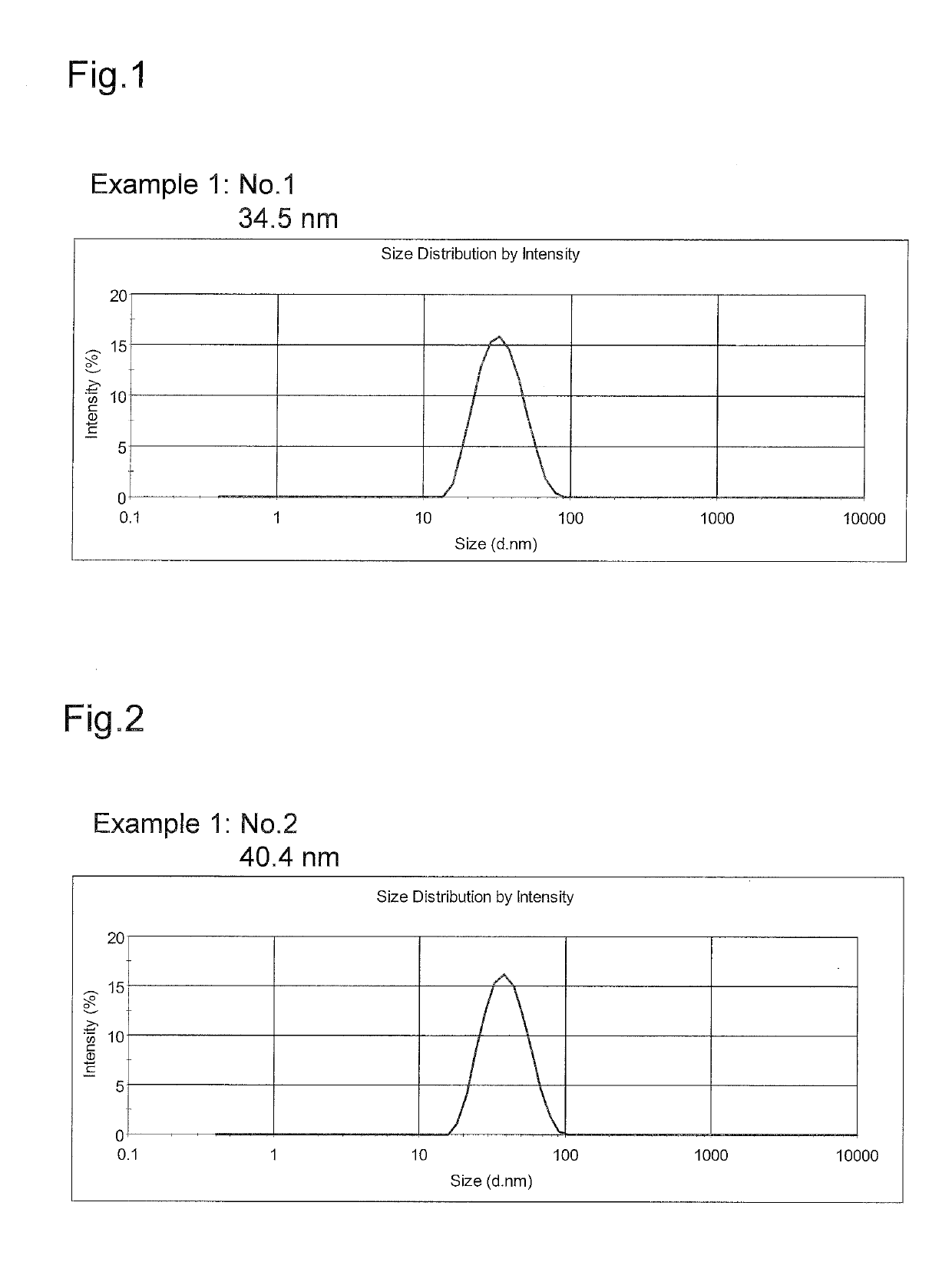
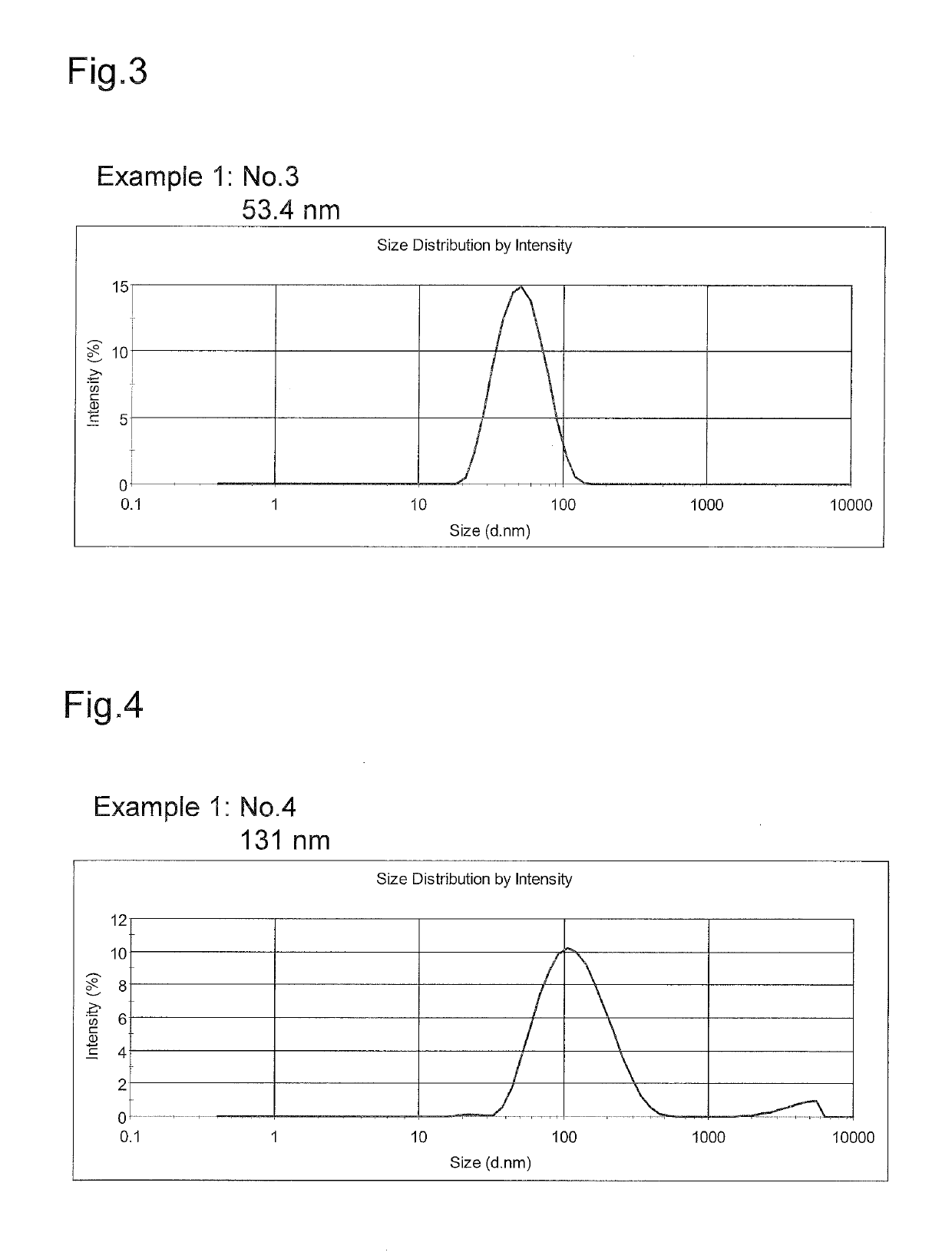
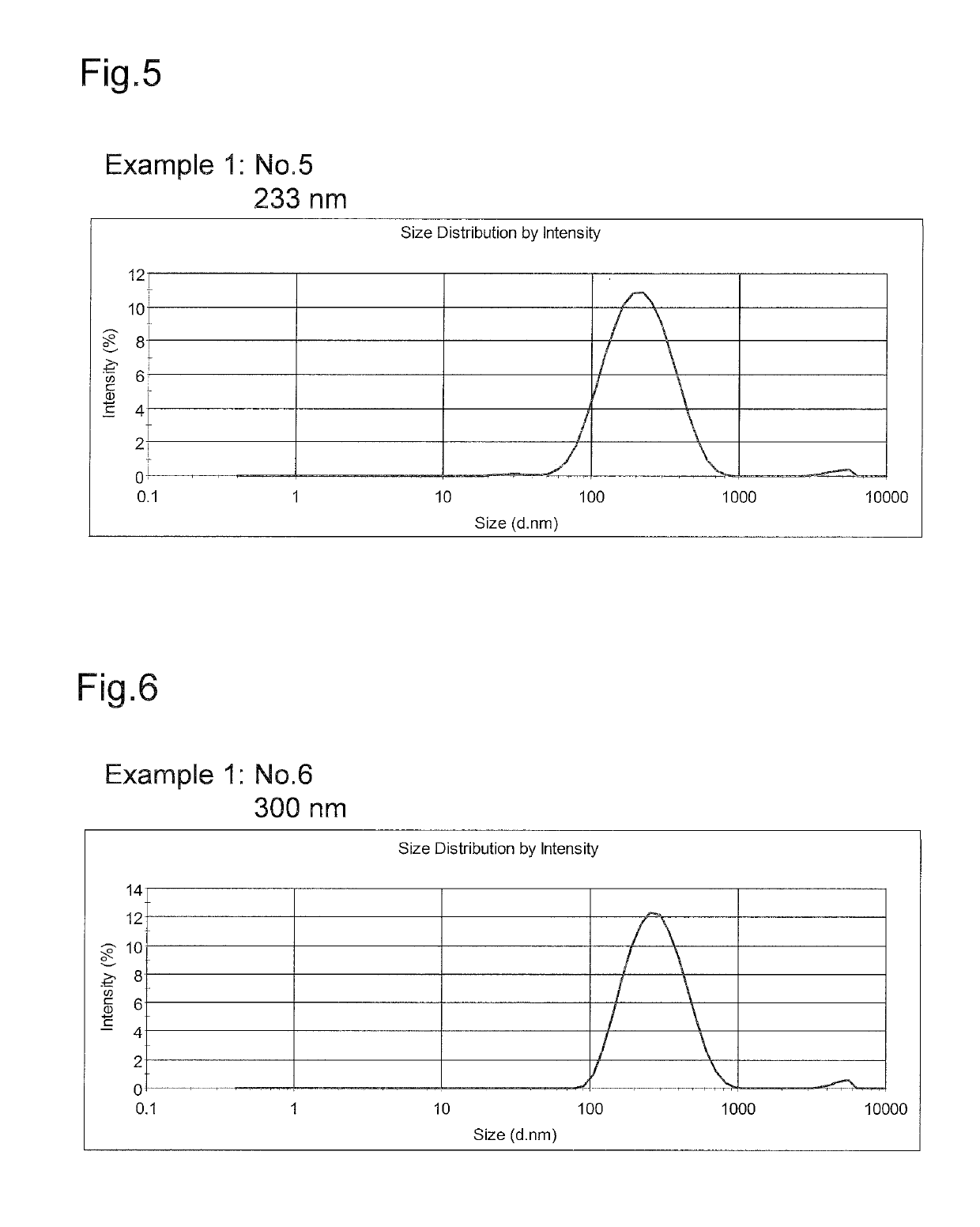
[0071]As described above, controlling each of the structural units of the amphiphilic block polymer A1 and the amorphous hydrophobic polymer A2 makes it possible to continuously control the particle diameter of the molecular assembly according to the present invention in a wider range of, for example, 10 to 1,000 nm and to obtain lactosome particles uniform in particle diameter.
[0072]Further, even when the same amphiphilic block polymer A1 is used, the particle diameter of the molecular assembly according to the present invention can be continuously controlled by using a different type of the amorphous hydrophobic polymer A2 together with the same amphiphilic block polymer A1, that is, by changing the number of aliphatic hydroxy acid units (UA2) of the hydrophobic polymer A2. The present invention is very advantageous in that the particle diameter of the molecular assembly can be continuously controlled by changing the amorphous hydrophobic polymer A2 even when the amphiphilic block polymer A1 whose synthesis requires greater effort is not changed.
[0073]According to the present invention, it is possible to provide, in various fields such as pharmaceutical drugs, agricultural chemicals, cosmetics, food products, and electronics (e.g., battery materials), a molecular assembly having any nano-sized particle diameter depending on its intended use and application. It is also possible to provide, in the above various fields, a nano-carrier for delivering various substances using the molecular assembly having any nano-sized particle diameter depending on its intended use and application. For example, in general, a DDS carrier for cosmetics preferably has a larger particle diameter than that for medical use. According to the present invention, it is possible to provide a molecular assembly having a nano-sized particle diameter suitable for such an application. As described above, the molecular assembly according to the present invention can be used for various applications.
[0074]More particularly, according to the present invention, it is possible to provide a molecular assembly that is less likely to accumulate in tissue other than cancer tissue and is highly safe for a living body by controlling the particle diameter thereof, and it is also possible to provide a nano-carrier using the molecular assembly for use in delivering a drug or a labeling agent.


 Login to View More