Every industry faces the challenge of improving its construction process, the main
error factor thereof being the difference between the requester's description (“the case”) and what the industry produces (the solution).
The person who requires that a certain solution be designed (the requester) is usually not an expert designer of the specific industry, and thus, would not be able to construct the solution on his own.
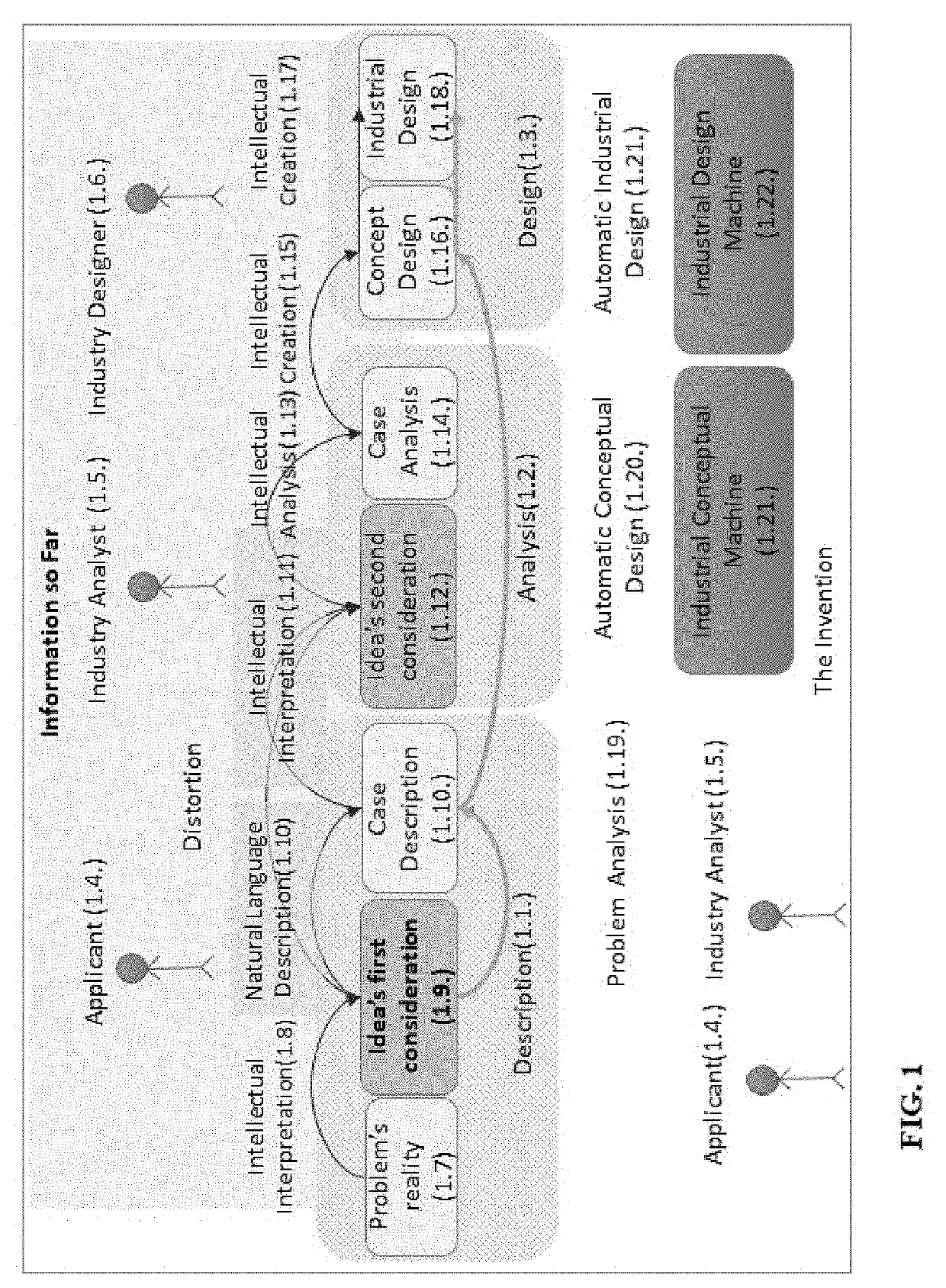
He needs the industry analyst and the industry designer to properly interpret his requirements and capture them in the solution design for “the case.” It so happens that this is impossible in practice because the requester does not understand the
design language (architect, civil engineer, book designer, software designer, among other applications), and thus does not have control over the resulting design in order to ensure that a solution for “the case” he described will be constructed.
As a consequence, the requester receives a design and a resulting product (a house, a piece of software, a piece of furniture, a book, etc.) that are not perfectly adjusted to his needs.
This approach to handling the technical problem necessarily produces multiple interpretations of the requirements, because the translation of the language used by the requester (natural language) into the language used by the analysts and designers (technical languages) entails a transformation resulting in a loss of knowledge, which nobody can control precisely.
Thus, the software industry of “the case” faces the challenge of improving
software construction projects, the main
error factor thereof being the difference between the requester's description (the problem) and what “the case” solves (the solution).
The type of user that needs designed custom-made software is ordinarily not a software designer nor a
software development engineer, and thus, would not be able to build it on his own.
It so happens that this is impossible in practice because the requester does not understand the
design language, because of which he does not have control over the resulting design in order to ensure that “the case” he requested will be constructed.
That is, consequently, the requester would receive a design and a resulting product (a piece of software) that is not usually adjusted perfectly to his requirements, modifications or subsequent changes (which in some cases can take more time or be more complex and more expensive than had been initially expected).
However, these tools do not function with natural language, and thus present several of the previously described limitations.
This approach to handling the technical problem necessarily produces multiple interpretations of the problem, because the translation between the language used by the user or
client familiar with the process (natural language) and the language used by analysts and designers (technical languages) entails a transformation resulting in a loss of knowledge, which nobody can control precisely.
Current prior art states that software is designed by hand or partially by hand, which by its nature poses the following problems:
Ambiguity in interpreting
system requirements, high cost of fixing design errors, difficulties in design scaling and development, and outdated
documentation, among others.



 Login to View More
  Login to View More