
METHOD AND APPARATUS FOR ASYMMETRIC CRYPTOSYSTEM BASED ON QUASI-CYCLIC MODERATE DENSITY PARITY-CHECK CODES OVER GF(q)
a cryptosystem and quasi-cyclic mode density technology, applied in the field of cybersecurity encryption/decryption of messages, can solve the problems of sub-optimal performance, difficult use of the mceliece system in practical situations, leakage of private key information, etc., and achieve better error correction capability, shorter transmission delay, and better decryption failure rate
- Summary
- Abstract
- Description
- Claims
- Application Information
AI Technical Summary
Benefits of technology
Problems solved by technology
Method used
Image

Examples
Embodiment Construction
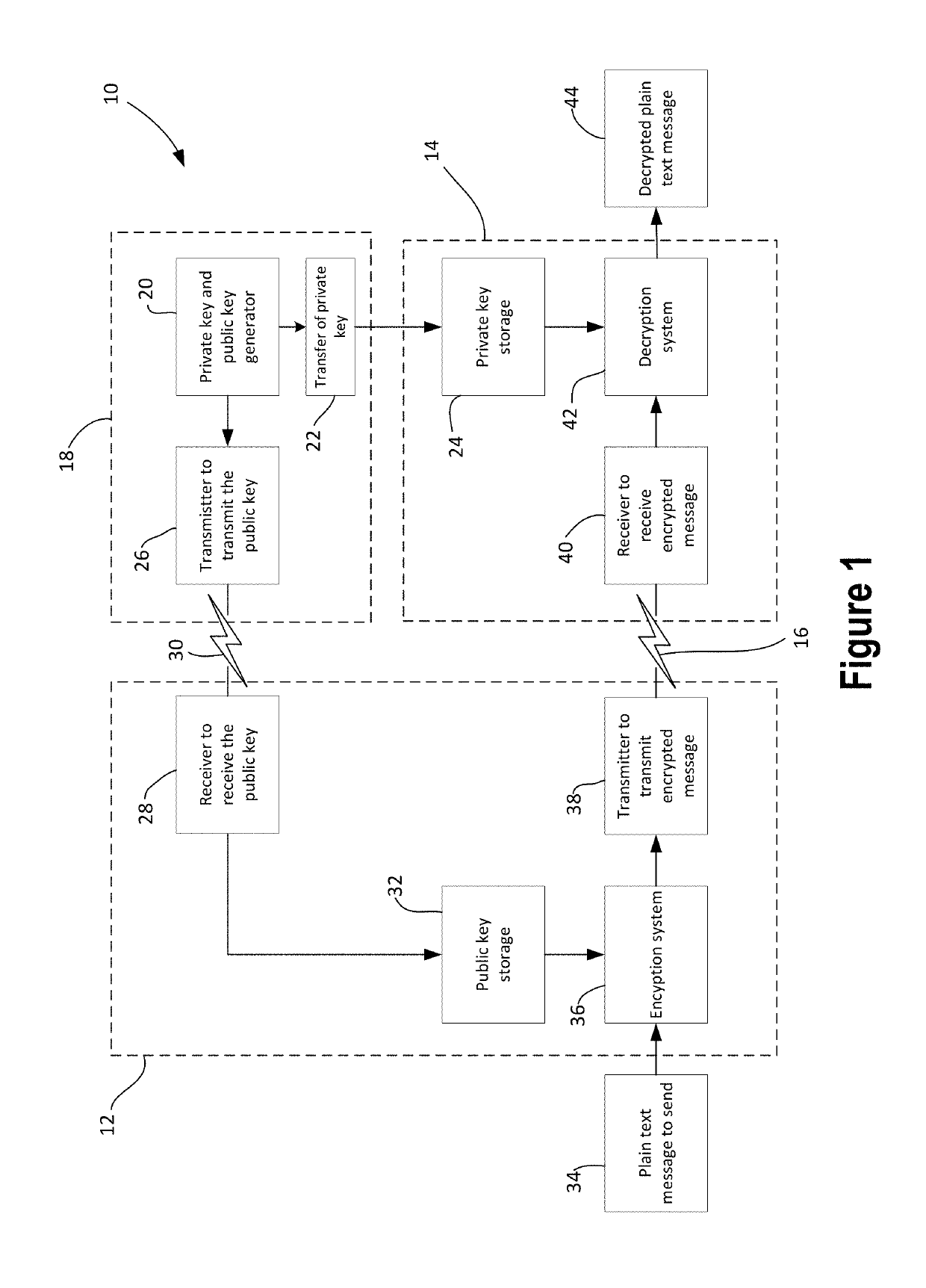
[0032]FIG. 1 shows an example of a communication system 10 for secure communication from a sending device 12 to a receiving device 14 using a non-secure communication channel 16. The communication channel 16 may be any wired or wireless communication channel or may be a combination of the two. The communication channel 16 need not be secure and may carry communications that are accessible by the public. The sending and receiving devices 12 and 14 may be any type of device such as a computer device, server, tablet computer, smart phone or other phone, e-reader, personal digital assistant, television, wired or wireless communication device, or other device that may use secure communications.
[0033]A public key and a private key are each needed for the secure communication. A key generator system or device 18 may be used to generate the keys. The key generator system or device 18 may be part of the receiving device 18 or may be separate from the receiving device 14. For instance, the ke...
PUM
 Login to View More
 Abstract
Description
Claims
Application Information
 Login to View More