
Map information system
a map and information system technology, applied in navigation instruments, instruments, transportation and packaging, etc., can solve the problems of insufficient accuracy of reliability calculation based on brightness distribution and high reliability, and achieve high accuracy, high accuracy, and increase in accuracy (quality)
- Summary
- Abstract
- Description
- Claims
- Application Information
AI Technical Summary
Benefits of technology
Problems solved by technology
Method used
Image

Examples
first example
4-1. First Example
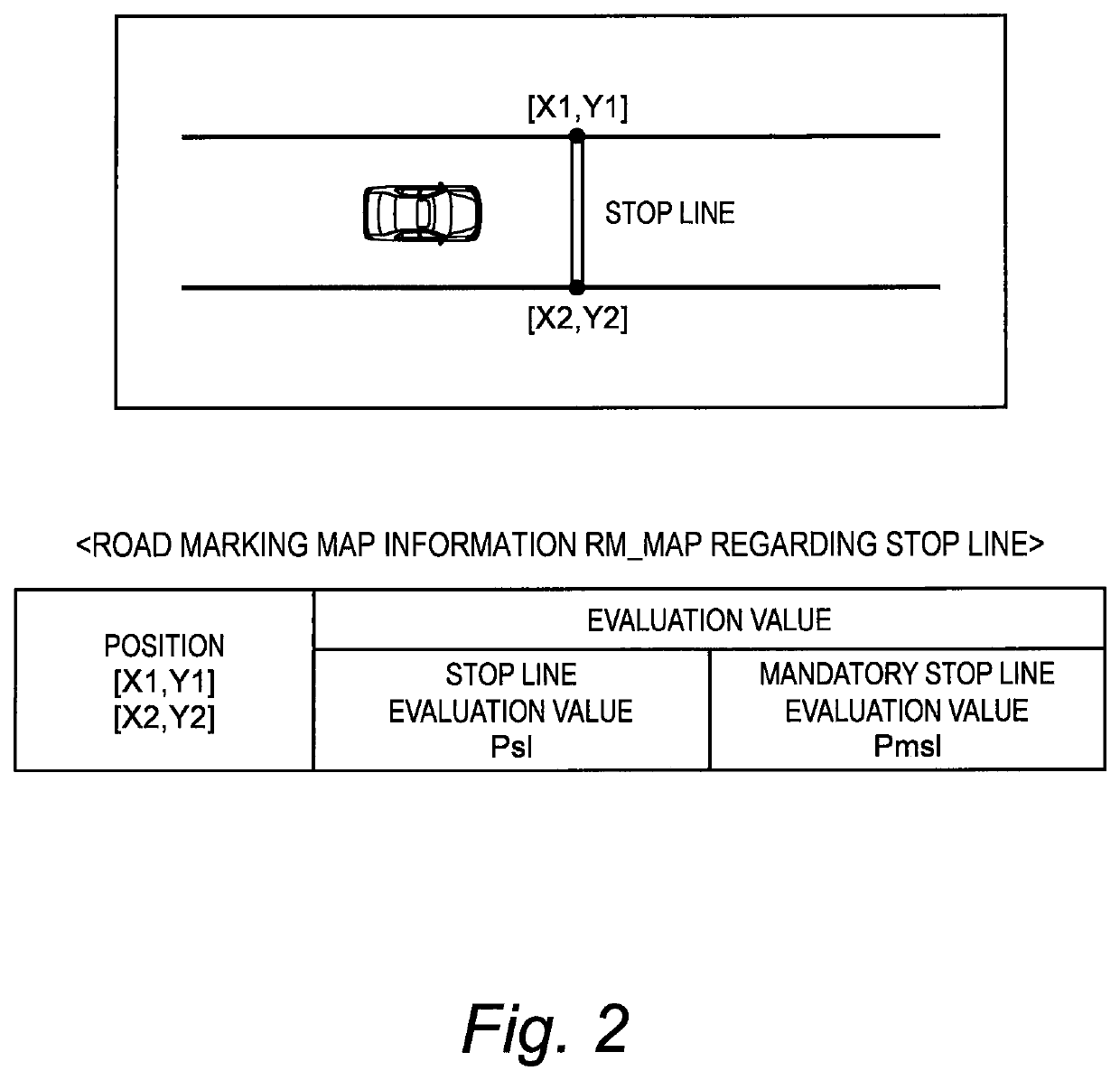
[0118]FIGS. 11 and 12 are conceptual diagrams for explaining a first example. In the first example, we consider the “stop line candidate” being a candidate for the stop line SL. The stop line evaluation value Psl indicates certainty of the stop line candidate being the stop line SL. It should be noted that the stop line SL here includes the mandatory stop line.
[0119]FIG. 11 shows a situation where the vehicle 1 passes the stop line SL. In general, a trajectory TR of the vehicle 1 passing the stop line SL is almost orthogonal to a longitudinal direction L of the stop line SL. In other words, an angle θ between the trajectory TR of the vehicle 1 and the longitudinal direction L of the stop line SL is close to 90 degrees. On the other hand, FIG. 12 shows another situation where the vehicle 1 crosses a center line CL. An angle θ between the trajectory TR of the vehicle 1 and a longitudinal direction L of the center line CL is small. Therefore, it is possible to determi...
second example
4-2. Second Example
[0121]A second example is a modification example of the first example. In the second example, a trajectory TR of another vehicle 2 (see FIG. 4) instead of the vehicle 1 is used. More specifically, the database management device 30 recognizes the trajectory TR of another vehicle 2 passing the stop line candidate as the vehicle behavior, based on the surrounding situation information 210. Then, the database management device 30 calculates an angle θ between the trajectory TR of said another vehicle 2 and the longitudinal direction L of the stop line candidate. The database management device 30 increases the stop line evaluation value Psl as the angle θ is closer to 90 degrees. In other words, the database management device 30 calculates the stop line evaluation value Psl to be higher as the angle θ is closer to 90 degrees.
third example
4-3. Third Example
[0122]FIGS. 13 and 14 are conceptual diagrams for explaining a third example. In the third example, we consider the mandatory stop line MSL. The mandatory stop line evaluation value Pmsl indicates certainty of the stop line candidate being the mandatory stop line MSL. When the vehicle 1 passes the stop line candidate, the database management device 30 determines the mandatory stop line evaluation value Pmsl in addition to the stop line evaluation value Psl described in the above first and second examples.
[0123]FIG. 13 shows a speed when the vehicle 1 passes the mandatory stop line MSL. The vehicle 1 is required to always stop before the mandatory stop line MSL. Therefore, the speed of the vehicle 1 on the mandatory stop line MSL is generally low. On the other hand, FIG. 14 shows a speed when the vehicle 1 passes the stop line SL other than the mandatory stop line MSL. The vehicle 1 does not necessarily stop before the stop line SL. It is therefore possible to deter...
PUM
 Login to View More
 Abstract
Description
Claims
Application Information
 Login to View More