Unlock instant, AI-driven research and patent intelligence for your innovation.

Needle for extracting endodontic separated instruments

Pending Publication Date: 2020-04-30
UNIV OF SHARJAH
View PDF0 Cites 0 Cited by
  • Summary
  • Abstract
  • Description
  • Claims
  • Application Information

AI Technical Summary

Benefits of technology

The present invention is a simple, flexible, cost-effective instrument that can effectively retrieval broken endodontic instruments from root canals, regardless of their shape. The instrument can contract and expand as per the canal morphology, thereby accessing areas in the canal which conventional instruments could not access. It has excellent resistance to cyclic fatigue and can adapt to canal irregularities. The method for removal of a separated endodontic instrument from a root canal involves enlarging the canal coronal to the instrument, exposing its upper end using an ultrasonic tip, inserting a needle into the canal to engage the instrument, and then injecting a hot irrigant to securely engage the instrument and remove it from the canal.

Problems solved by technology

Although NiTi instruments exhibit a high amount of flexibility and elasticity with an increased torsional fractional resistance, fracturing or breaking of these instruments in the canal of the tooth remains an inadvertent incident during clinical use.
This mishap impedes the suitable cleaning of the root canal, thus leading to failure of the endodontic treatment.
Instrument fractures during root canal treatment hinder the clinician from optimal preparation and obturation of the entire root canal system.
This affects the long term prognosis of root canal treatment negatively In some scenarios, leaving the broken instruments in the canal of the tooth can result in serious complications and in the end may require extraction of the tooth.
Particularly, most of these broken instruments are either files, bore or cutting instruments that break during the root canal procedure and get embedded in the tooth causing severe pain to the patient post the treatment.
In most cases, removal of broken instruments from the root canal is difficult and often hopeless.
To date, no standardized procedure for the safe removal of fractured instruments exists, although various techniques and devices have been used in the past.
These techniques have shown only limited success, while often causing considerable damage to the remaining root.
Complications because of these techniques include excessive loss of root canal dentin, ledging, perforation, and extrusion of the fractured instrument fragment through the apex.
Therefore, many techniques cannot be used in narrow and curved canals.
It must be noted that root canals are seldom straight and often have bends and twists thereby making it difficult for removal of broken endodontic fragments.
However, removal of longer fragments (usually more than 4.5 mm) or endodontic instruments broken in curved canals by ultrasonic activation is not recommended as it results in extra removal of dentine, which in turn makes the tooth weak in structure.
However, all previous instruments have certain clinical limitations.
From clinical experience, the Terauchi loop is very fragile, expensive and difficult to manipulate once inserted in the root canal of the tooth making it very difficult for extracting the broken endodontic instruments especially from curved root canals.
The other tools also consist of two units that should be used together and this limits their use especially in the curved part of the canal.
The removal of the broken instrument segments that are apically located to the curvature of the canal is usually not possible.
The failure of using a conventional endodontic instrument in curved roots, has contributed to a lack of success in removing fractured instruments.

Method used

the structure of the environmentally friendly knitted fabric provided by the present invention; figure 2 Flow chart of the yarn wrapping machine for environmentally friendly knitted fabrics and storage devices; image 3 Is the parameter map of the yarn covering machine
View more

Image

Smart Image Click on the blue labels to locate them in the text.
Viewing Examples
Smart Image
  • Needle for extracting endodontic separated instruments
  • Needle for extracting endodontic separated instruments
  • Needle for extracting endodontic separated instruments

Examples

Experimental program
Comparison scheme
Effect test

examples

Preparation of the Needle

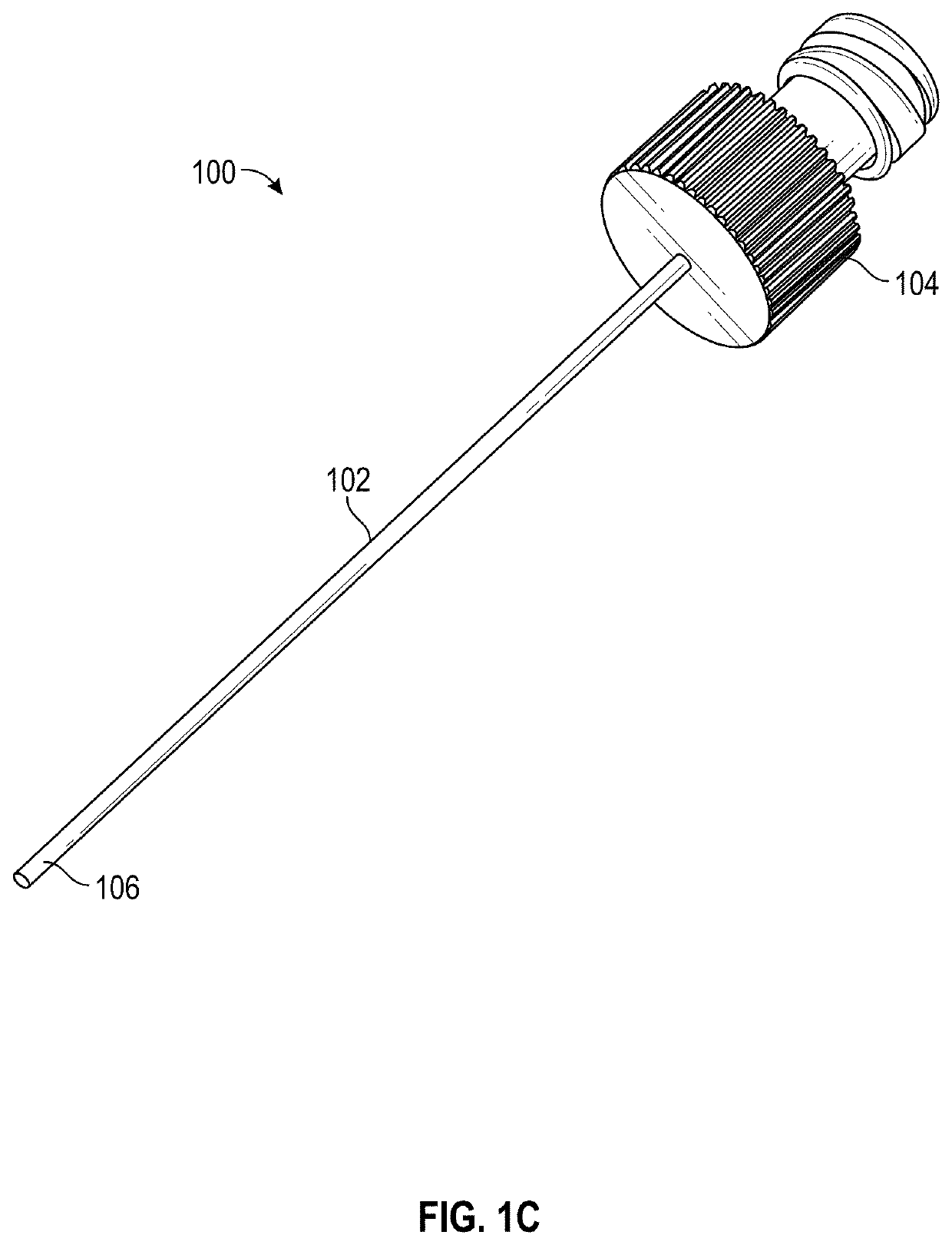
[0064]A wire will be used as a core to build up the needle. The diameter of the core represents the internal diameter of the extractor needle. Large variety of materials can be used to fabricate this core. Elastic (with shape memory) alloy (e.g., nickel-titanium) or polymer (e.g., VERI-FLEX) are preferred as they can be used repeatedly. The terminal end of the core will be fabricated in a specific snake-shape with respect to angles as illustrated in FIG. 1A.

[0065]As illustrated in FIG. 1A, to prepare the snake-shape figure, the core is bent 160° at point (a) which is 3 mm far from the tip. Next, the wire is bent 90° at point (b) which is 1 mm far from point (a). so, the length of [ab] is determined to be 1 mm. The wire is bent again at (c). (c) point is located at a level so that the vertical dimension between (c) and the core axis equals the vertical dimension between (b) and the core axis (i.e. [fg]=[gh]). Based on the trigonometric equations and laws, the...

the structure of the environmentally friendly knitted fabric provided by the present invention; figure 2 Flow chart of the yarn wrapping machine for environmentally friendly knitted fabrics and storage devices; image 3 Is the parameter map of the yarn covering machine
Login to View More

PUM

No PUM Login to View More

Abstract

There is provided a needle tip for extracting separated endodontic instruments from the root canal of a tooth. The needle tip is fabricated with a thermomechanically treated alloy exhibiting both shape memory and super-elasticity. There is also provided for a needle comprising a handle and a terminal tip, which is fabricated with a thermomechanically treated alloy. The alloy is thermomechanically treated nickel-titanium alloy. The needle is straight at room temperature and takes on a specific shape when inserted in the canal of the tooth from which the endodontic separated instrument is to be extracted. Also provided herein is a method for removal of endodontic separated instruments from the canal of a tooth.

Description

FIELD OF THE INVENTION[0001]The present invention relates to the field of endodontics and more particularly relates to a needle for extracting pieces of endodontic instruments, which were separated in a root canal during a root canal therapy.BACKGROUND OF THE INVENTION[0002]Background description includes information that may be useful in understanding the present invention. It is not an admission that any of the information provided herein is prior art or relevant to the presently claimed invention, or that any publication specifically or implicitly referenced is prior art.[0003]In the early days of dentistry, the only way to treat an infected tooth was by extracting the tooth. In recent times, endodontists have successfully learned to remove the infected pulp material from the nerve of the tooth. This treatment is commonly known as a root canal treatment. A “root canal” is the term used to describe the natural cavity within the center of the tooth. The pulp or the pulp chamber is ...

Claims

the structure of the environmentally friendly knitted fabric provided by the present invention; figure 2 Flow chart of the yarn wrapping machine for environmentally friendly knitted fabrics and storage devices; image 3 Is the parameter map of the yarn covering machine
Login to View More

Application Information

Patent Timeline
no application Login to View More
IPC IPC(8): A61C5/46
CPCA61C5/46
Inventor AL SHEHADAT, SAAID AYESH
Owner UNIV OF SHARJAH