Lift, drop, swing, and attenuation apparatus and method

a technology of attenuation apparatus and method, which is applied in the field of new systems and methods for climbing walls, pendulum falls, swing mechanisms, etc., to achieve the effects of rapid attenuation, reduced labor costs, and reduced labor costs

US20220054877A1Pending Publication Date: 2022-02-24ZIPHLDG
54 Cites 3 Cited by

Patent Information

Authority / Receiving Office
US · United States
Patent Type
Applications(United States)
Current Assignee / Owner
Publication Date
2022-02-24

Smart Images

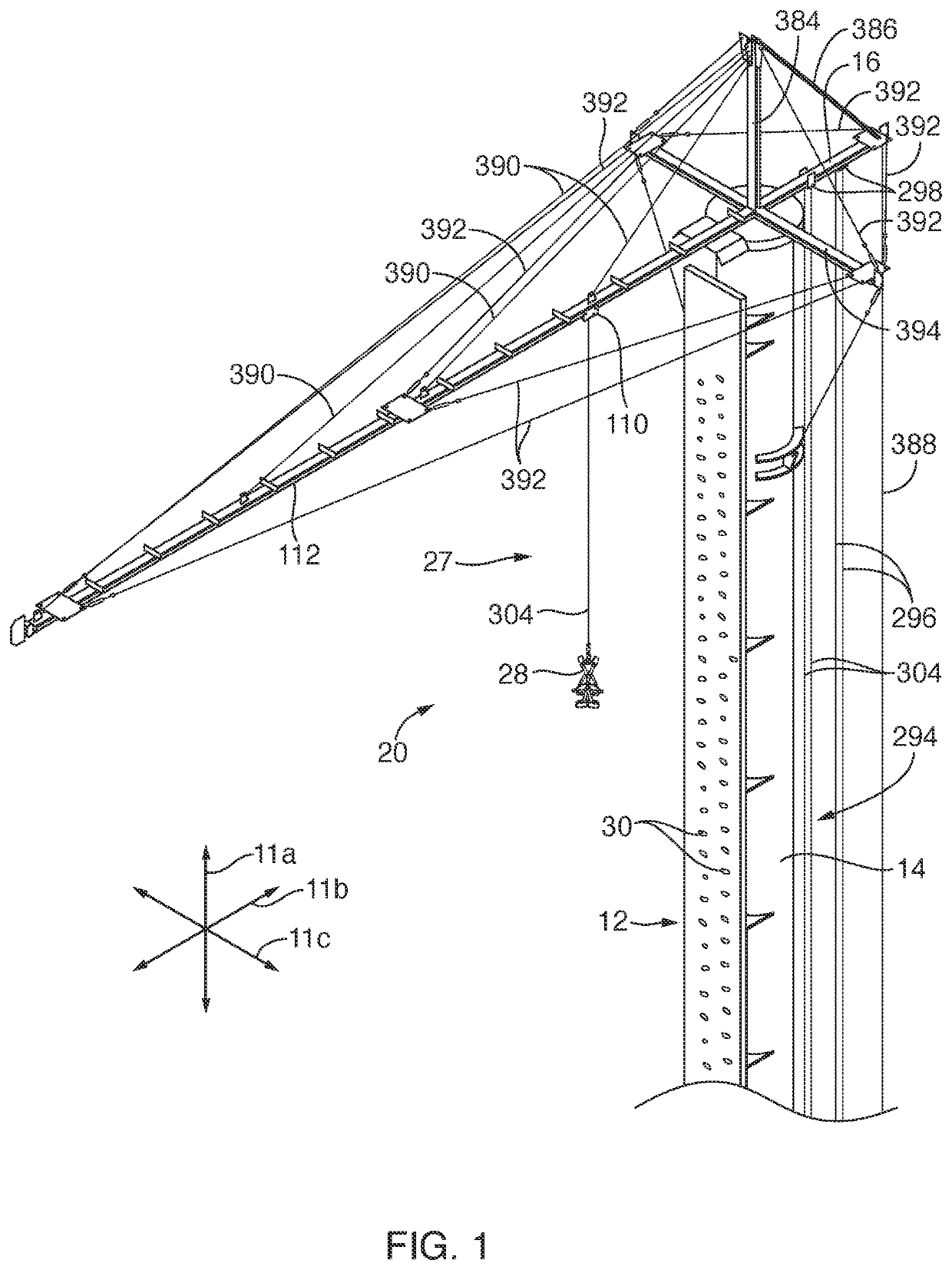
  • Figure 1
    Figure 1
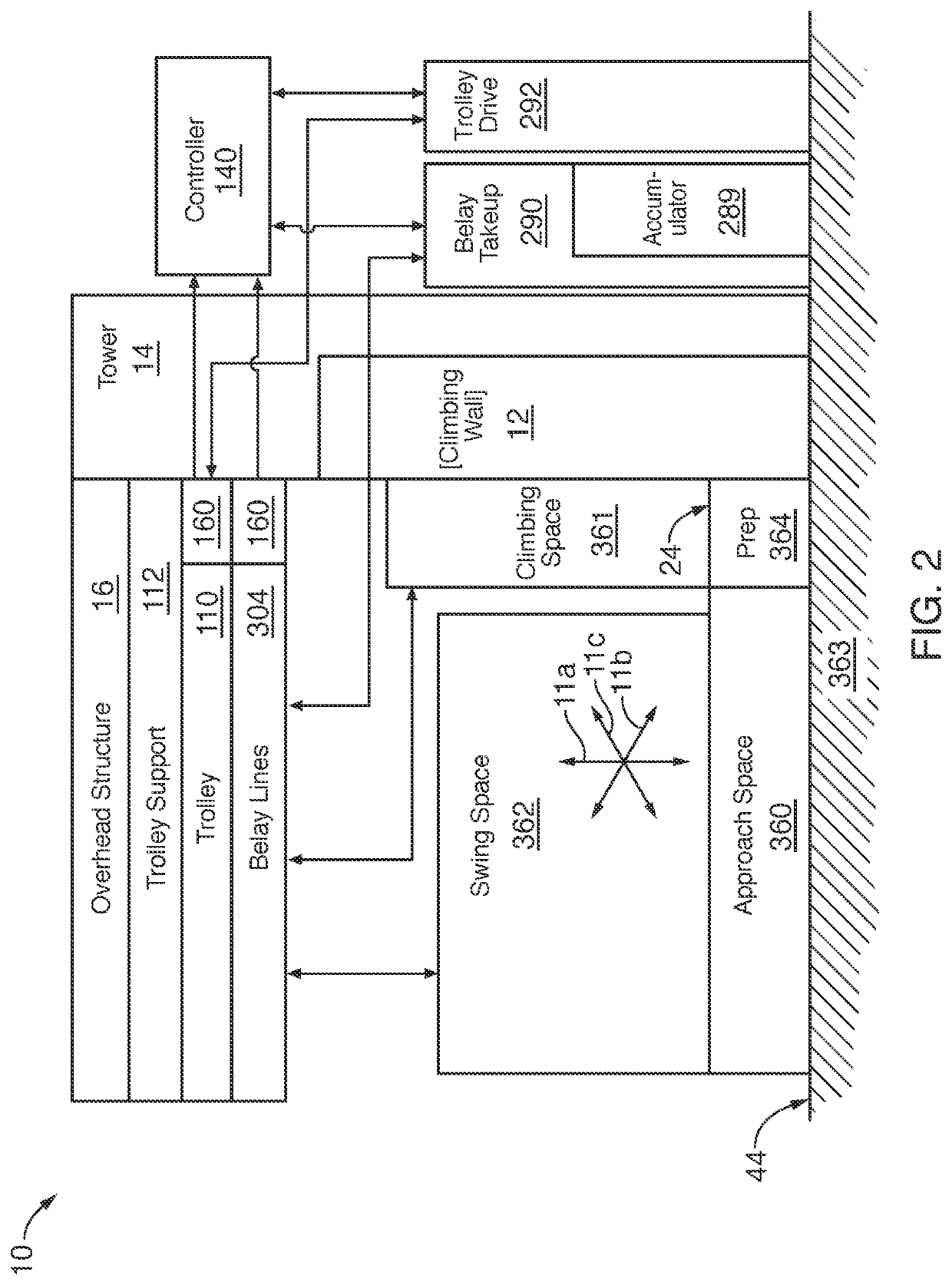
  • Figure 2
    Figure 2
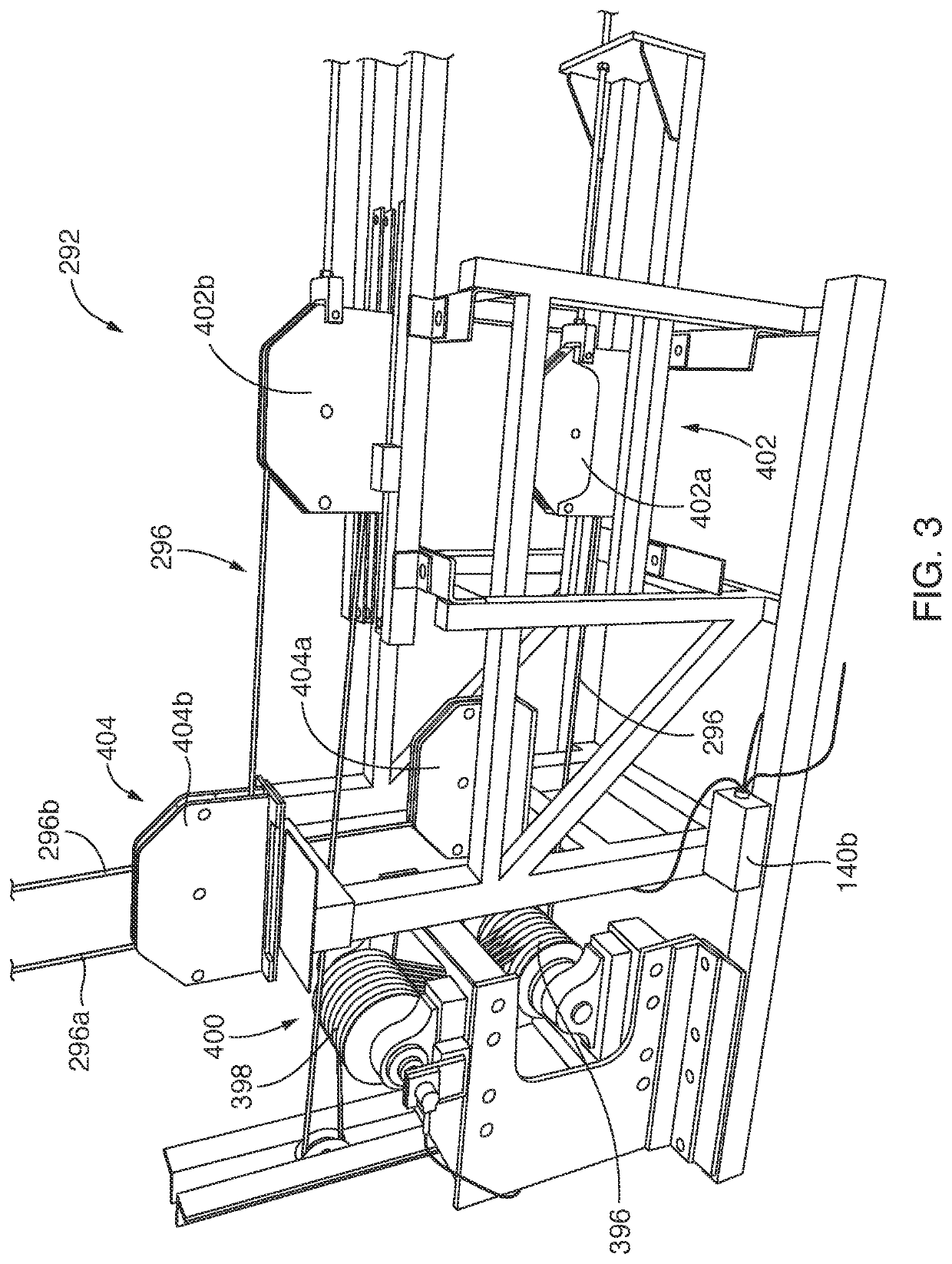
  • Figure 3
    Figure 3
Patent Text Reader

Abstract

A tower may support a horizontal track and a vertical climbing wall therebelow. A trolley, movable along the track, may be selectively driven toward and away from the tower by belay lines, line and capstan, positive drive, or some combination. Belay lines reeved over pulleys on the trolley may be taken up and paid out independently from the trolley, while fixed or moving. A rider may climb, be lifted, or both to near the intersection of the tower and track, from there to fall or jump into a controllable trajectory such as swinging or simulating a parachute landing. Swinging may be rapidly attenuated almost entirely by “bumps,” lifting a rider to remove momentum and kinetic energy as a rider moves toward a pivot point overhead. Control may be simplified based on sensing and using timing past bottom dead center (BDC).
Need to check novelty before this filing date? Find Prior Art

Description

RELATED APPLICATIONS

[0001] This application claims the benefit of U.S. provisional Patent Application Ser. No. 63 / 089,657, filed Oct. 9, 2020 and U.S. provisional Patent Application Ser. No. 63 / 073,288, filed Sep. 1, 2020. This application is a continuation in part of U.S. patent application Ser. No. 17 / 217,660, filed Mar. 30, 2021, which is a continuation (divisional) application of U.S. patent application Ser. No. 16 / 431,524, filed Jun. 4, 2019, now issued as U.S. Pat. No. 10,960,252 on Mar. 30, 2021; which claims the benefit of U.S. provisional Patent Application Ser. No. 62 / 680,909, filed Jun. 5, 2018, U.S. Provisional Patent Application Ser. No. 62 / 757,577, filed Nov. 8, 2018, and U.S. Provisional Patent Application Ser. No. 62 / 839,665, filed Apr. 27, 2019. All of the foregoing are hereby incorporated herein by reference in their entireties.

[0002] This patent application hereby incorporates herein by reference the following patents: U.S. Pat. No. 10,053,115, issued Aug. 21, 2018,...

Examples

example

[0229]Here's how a system 10 works in one current embodiment in accordance with the invention. Once the cycle is initiated, harnessed patrons have 20 seconds to climb as high up the wall 12 as they can before time runs out, at which point the ZipWhipper™ 10 takes over and pulls them to the top of the wall. The height climbed and time of each climber is recorded by the controller 140, allowing participants 60 to compete against each other.

[0230]At the top of the climbing wall 12, participants 60 are given a short time (a second to a few seconds) to look around, place feet in a rappelling stance, and contemplate their height before the ZipWhipper™ drops them backwards into a breathtaking pendulum free fall trajectory 410, swinging them outward 11b away from the wall 12. This part simulates a “lead fall” when rock climbing.

[0231]What happens next is a function of the attraction's unique technology. The ZipWhipper's swing dampening system measures each climber's swing time, and automati...