Unlock instant, AI-driven research and patent intelligence for your innovation.

Hiding Stable Machine Instructions in Noise

a stable machine instruction and noise technology, applied in the field of protecting the privacy of computer and machine instructions, information and devices, can solve the problems of no notion nor use of stability to build instruction opcodes and operands, and no prior art method addresses the malware problem

Pending Publication Date: 2022-02-24
FISKE MICHAEL STEPHEN
View PDF0 Cites 1 Cited by
  • Summary
  • Abstract
  • Description
  • Claims
  • Application Information

AI Technical Summary

Benefits of technology

The present invention relates to methods and devices for securely transmitting information and computer instructions through communication systems. The invention aims to protect the privacy of information and devices from being captured by unauthorized individuals or malicious software. The invention uses quantum randomness to build unpredictable stable instructions and applies them to hide data in noise. The invention also describes a method for dynamically hiding information in noiseless channels. The technical effects of the invention include improved data privacy, protection against malware sabotage, and the ability to perform secure computing tasks with different representations of program instructions during each run.

Problems solved by technology

In other words, FHE defers the malware problem to the user's local computer; FHE does not address how to hinder malware on the local computer.
These memory requirements are not economically feasible for protecting instructions in hardware.
In [28], they do not address malware attacks at the machine instruction (physical hardware) level; there is no notion nor use of stability to build instruction opcodes and operands that are resistant to small changes.
Overall, none of these prior art methods address the malware problem, described in section 4.
Even if there is a procedure to assure that the register machine program is executing correctly, this friendly procedure may never execute due to just one rogue branch instruction.
With a small change, the tampered register machine program still can execute, but does not perform the task that the original program was designed to accomplish.

Method used

the structure of the environmentally friendly knitted fabric provided by the present invention; figure 2 Flow chart of the yarn wrapping machine for environmentally friendly knitted fabrics and storage devices; image 3 Is the parameter map of the yarn covering machine
View more

Image

Smart Image Click on the blue labels to locate them in the text.
Viewing Examples
Smart Image
  • Hiding Stable Machine Instructions in Noise
  • Hiding Stable Machine Instructions in Noise
  • Hiding Stable Machine Instructions in Noise

Examples

Experimental program
Comparison scheme
Effect test

example 1

[0233]This example provides some perspective on some ϵ-tails and Eve's conditional probabilities. For n=2500, the scatter mean μ is 1250 and the standard deviation

σ=2⁢5⁢0⁢02=2⁢5.

Set c=20, so μ−cσ=750. A calculation shows that

2-2⁢5⁢0⁢0⁢∑j=07⁢5⁢0⁢(2500j)<1⁢0-9⁢1.

For n=4096, the scatter mean is 2048 and the standard deviation σ=32. Set c=50 standard deviations, so μ−cσ=448. A calculation shows that

2-4⁢0⁢9⁢6⁢∑j=04⁢4⁢8⁢(4096j)<1⁢0-6⁢2⁢1.

[0234]Some of Eve's conditional probabilities are calculated for n=2500 and data size m=576. The average number of 1's in a key is μkey=288 and the standard deviation σkey=12.

[0235]A typical case is when j=300 and k=1275, which are both one standard deviation to the right of the data and scatter mean, respectively. When Eve's conditional probability equals 2−m, the secrecy ratio is exactly 1. Using equation 10.3, a computer calculation shows that the secrecy ratio is

P⁡(Bl,300|A1⁢2⁢7⁢5)2-576≈1.576,

so 2−576l,300|A1275)−575.

[0236]A rare event is when j...

example 2

CD Program

[0355]

SETA6SETB10IFA0; Instruction 2JMP12IFB0JMP13IFGTABSUBABIFGTBASUBBAIFNABJMP2SETAB; Instruction 12SETBA; Instruction 13

GCD Instructions Executed:

[0356]

SETA6SETB10IFA0IFB0IFGTABIFGTBASUBBAIFNABJMP2IFA0IFB0IFGTABSUBABIFGTBASUBBAIFNABSETABSETBA

After the last instruction SET B A executes, both registers A and B are storing 2. Observe that the instruction numbers in an SM program always start at 0, so JMP 2 causes the machine to execute IF A 0.

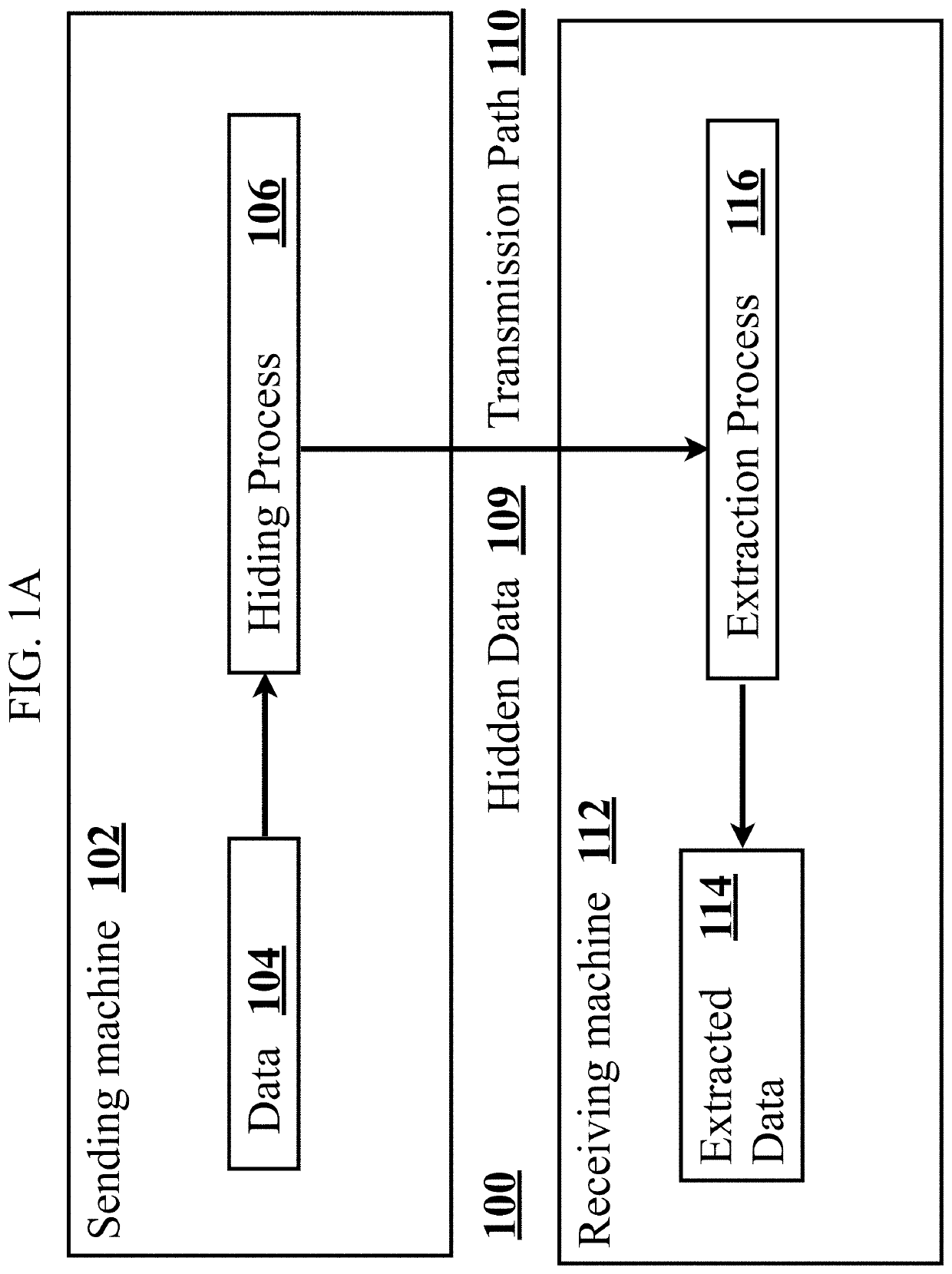
[0357]Next, we show what our GCD program looks like to Eve in Unprotected Memory after two distinct compilations, generated by our SM tool. In compilations 1 and 2, we selected input n=64 for machine procedure 1, and inputs l=25, m=12, and n=64 for machine procedure 3. In compilation 1 and 2, we selected input n=128 for machine procedure 4; input η=8 for machine procedure 5; and inputs k=64 and n=128 for machine procedure 6. This means the first and the second operands are hidden in 128 bits: 64 bits of signal and 64 bits of noise.

[03...

the structure of the environmentally friendly knitted fabric provided by the present invention; figure 2 Flow chart of the yarn wrapping machine for environmentally friendly knitted fabrics and storage devices; image 3 Is the parameter map of the yarn covering machine
Login to View More

PUM

No PUM Login to View More

Abstract

Our machine architecture and machine procedures use robustness, unpredictability and variability to hinder malware infection. In some embodiments, our machine instruction opcodes are randomized. The computing behavior of our machine is structurally stable (invariant) to small changes made to its machine instructions. Our invention expands the engineering method of stability to a cryptographically stable machine that is resistant to malware sabotage by an adversary.Our procedures use quantum randomness to build unpredictable stable instructions. Our machine procedures can execute just before running a program so that the computing task can be performed with a different representation of its instructions during each run. A process of hiding a key or data inside of random noise is described that protects the privacy of the machine instruction opcodes and operands. In some embodiments, quantum randomness generates random noise, using photonic emission with a light emitting diode.

Description

1 RELATED APPLICATIONS[0001]This application claims priority benefit of U.S. Provisional Patent Application Ser. No. 62 / 085,338, entitled “Hiding Data Transmissions in Random Noise”, filed Nov. 28, 2014, which is incorporated herein by reference; this application claims priority benefit of U.S. Provisional Patent Application Ser. No. 62 / 092,795, entitled “Hiding Data Transmissions in Random Noise”, filed Dec. 16, 2014, which is incorporated herein by reference; this application claims priority benefit of U.S. Non-provisional patent application Ser. No. 14 / 953,300, entitled “Hiding Information in Noise”, filed Nov. 28, 2015, which is incorporated herein by reference. This application claims priority benefit of U.S. Non-provisional Pat. No. 10,360,395, entitled “Hiding Information in Noise”, issued Jul. 23, 2019, which is incorporated herein by reference. This application claims priority benefit of U.S. Non-provisional Pat. No. 10,356,061, entitled “Hiding a Public Key Exchange in Noi...

Claims

the structure of the environmentally friendly knitted fabric provided by the present invention; figure 2 Flow chart of the yarn wrapping machine for environmentally friendly knitted fabrics and storage devices; image 3 Is the parameter map of the yarn covering machine
Login to View More

Application Information

Patent Timeline
no application Login to View More
IPC IPC(8): G06F9/30G06N10/00
CPCG06F9/30058G06F9/30054G06N10/00G06F9/30156G06F21/57G06F21/6254H04L9/0852H04L2209/16
Inventor FISKE, MICHAEL STEPHEN
Owner FISKE MICHAEL STEPHEN
Features
  • R&D
  • Intellectual Property
  • Life Sciences
  • Materials
  • Tech Scout
Why Patsnap Eureka
  • Unparalleled Data Quality
  • Higher Quality Content
  • 60% Fewer Hallucinations
Social media
Patsnap Eureka Blog
Learn More