Unlock instant, AI-driven research and patent intelligence for your innovation.

System and method for characterizing cellular phenotypic diversity from multi-parameter cellular, and sub-cellular imaging data

Pending Publication Date: 2022-07-07
UNIVERSITY OF PITTSBURGH
View PDF0 Cites 1 Cited by
  • Summary
  • Abstract
  • Description
  • Claims
  • Application Information

AI Technical Summary

Benefits of technology

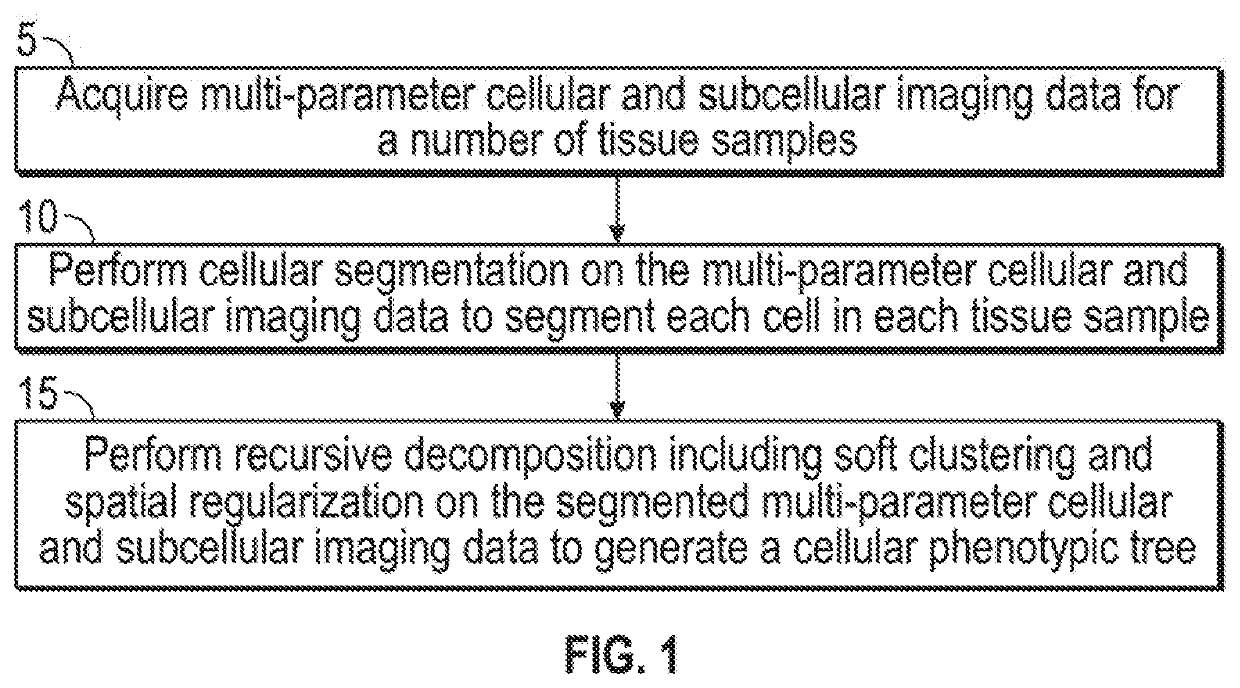
The patent describes a method and system for analyzing cellular data from different samples to identify different cell types based on the data collected from imaging techniques. This analysis is done by segmenting the data and using a series of techniques to identify specific patterns and assign cells to different groups or phenotypes. This can be useful for studying the characteristics and behavior of different cells in different tissues or in in vitro models.

Problems solved by technology

Because of the manual labor involved, the current workflow practices are time consuming, error-prone and subjective.
One challenge for digital pathology is how to accurately and efficiently characterize the various cell types and their activations from multi-parameter cellular and sub-cellular imaging data obtained from various multi to hyperplexed imaging modalities.

Method used

the structure of the environmentally friendly knitted fabric provided by the present invention; figure 2 Flow chart of the yarn wrapping machine for environmentally friendly knitted fabrics and storage devices; image 3 Is the parameter map of the yarn covering machine
View more

Image

Smart Image Click on the blue labels to locate them in the text.
Viewing Examples
Smart Image
  • System and method for characterizing cellular phenotypic diversity from multi-parameter cellular, and sub-cellular imaging data
  • System and method for characterizing cellular phenotypic diversity from multi-parameter cellular, and sub-cellular imaging data
  • System and method for characterizing cellular phenotypic diversity from multi-parameter cellular, and sub-cellular imaging data

Examples

Experimental program
Comparison scheme
Effect test

Embodiment Construction

[0012]As used herein, the singular form of “a”, “an”, and “the” include plural references unless the context clearly dictates otherwise.

[0013]As used herein, the statement that two or more parts or components are “coupled” shall mean that the parts are joined or operate together either directly or indirectly, i.e., through one or more intermediate parts or components, so long as a link occurs.

[0014]As used herein, the term “number” shall mean one or an integer greater than one (i.e., a plurality).

[0015]As used herein, the terms “component” and “system” are intended to refer to a computer related entity, either hardware, a combination of hardware and software, software, or software in execution. For example, a component can be, but is not limited to being, a process running on a processor, a processor, an object, an executable, a thread of execution, a program, and / or a computer. By way of illustration, both an application running on a server and the server can be a component. One or...

the structure of the environmentally friendly knitted fabric provided by the present invention; figure 2 Flow chart of the yarn wrapping machine for environmentally friendly knitted fabrics and storage devices; image 3 Is the parameter map of the yarn covering machine
Login to View More

PUM

No PUM Login to View More

Abstract

A method of characterizing cellular phenotypes includes receiving multi-parameter cellular and sub-cellular imaging data for a number of tissue samples from a number of patients or a number of multicellular in vitro models, performing cellular segmentation on the multi-parameter cellular and sub-cellular imaging data to create segmented multi-parameter cellular and sub-cellular imaging data, and performing recursive decomposition on the segmented multi-parameter cellular and subcellular imaging data to identify a plurality of computational phenotypes. The recursive decomposition includes a plurality of levels of decomposition with each level of decomposition including soft / probabilistic clustering and spatial regularization, and each cell in the segmented multi-parameter cellular and subcellular imaging data is probabilistically assigned to one or more of the plurality of computational phenotypes.

Description

GOVERNMENT CONTRACT[0001]This invention was made with government support under grant #CA204826 awarded by the National Institutes of Health (NIH). The government has certain rights in the invention.BACKGROUND OF THE INVENTION1. Field of the Invention[0002]The present invention pertains to digital pathology, and, in particular, to an unsupervised hierarchical learning system and method for characterizing and classifying the various cell types and their activations (cellular phenotypes) from multi-parameter cellular and sub-cellular imaging data (e.g., multi to hyperplexed imaging data) obtained from various imaging modalities.2. Description of the Related Art[0003]Digital pathology refers to the acquisition, storage and display of histologically stained tissue samples and is initially gaining traction in niche applications such as second-opinion telepathology, immunostain interpretation, and intraoperative telepathology. Typically, in digital pathology, a large volume of patient data...

Claims

the structure of the environmentally friendly knitted fabric provided by the present invention; figure 2 Flow chart of the yarn wrapping machine for environmentally friendly knitted fabrics and storage devices; image 3 Is the parameter map of the yarn covering machine
Login to View More

Application Information

Patent Timeline
no application Login to View More
IPC IPC(8): G16H30/40G16H30/20G16H10/40G06K9/62
CPCG16H30/40G06K9/6218G16H10/40G16H30/20G16H50/50G06V20/695G06V20/698G06V10/7625G06V10/84G06V10/7715G06F18/23
Inventor CHENNUBHOTLA, SRINIVAS C.PULLARA, FILIPPOFURMAN, SAMANTHA A.
Owner UNIVERSITY OF PITTSBURGH