Computer implemented method of personal identity verification including blockchain enhancements
a technology of personal identity and blockchain, applied in the field of computer implemented methods for verification, can solve problems such as identity theft, security breaches in which such personal identifying information is stolen (identity theft) from computer networks and databases, and numerous other security and societal problems
- Summary
- Abstract
- Description
- Claims
- Application Information
AI Technical Summary
Benefits of technology
Problems solved by technology
Method used
Image



Examples
example 1
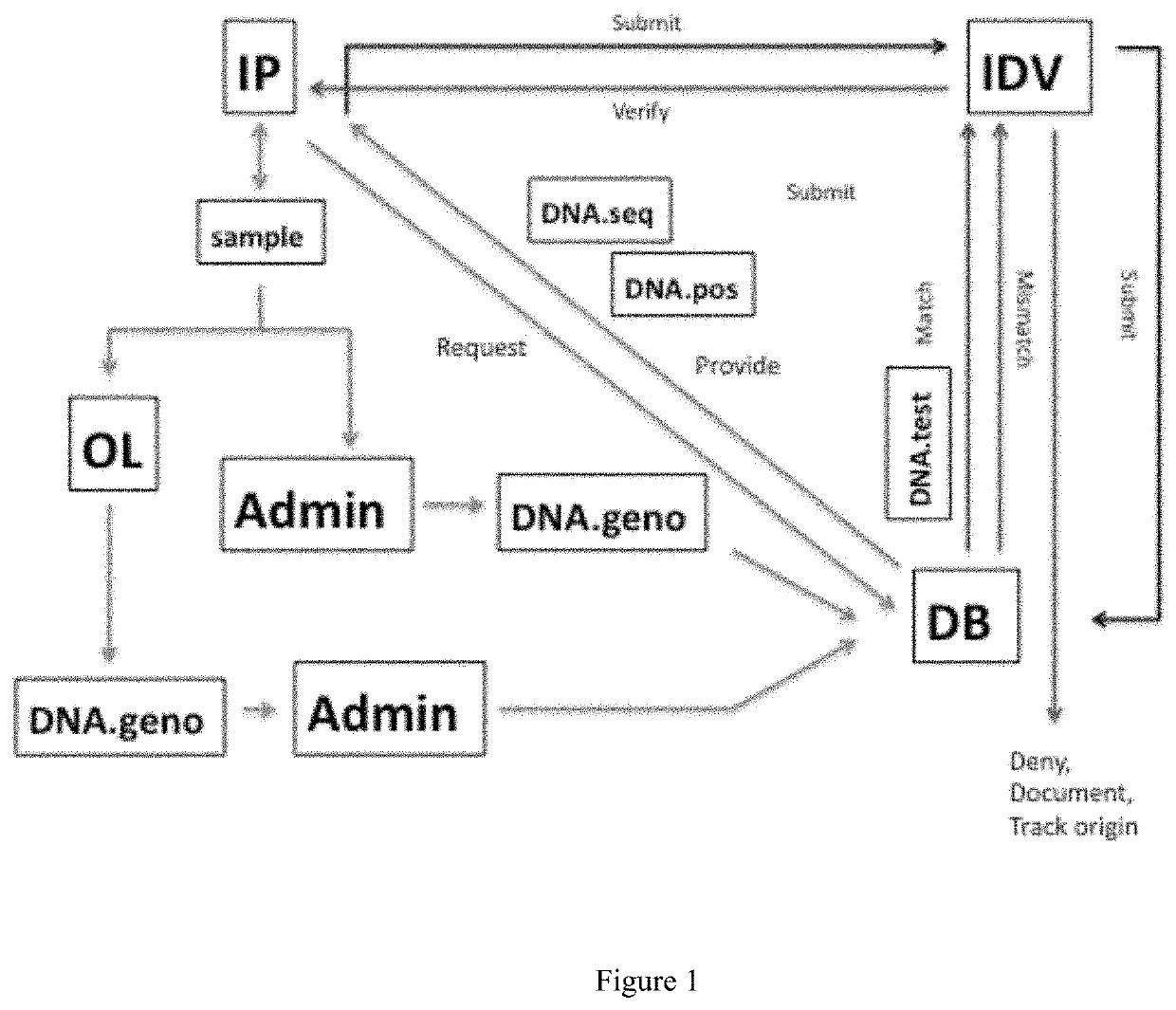
[0077]An IP (named 0001 in this example) requests an identity verification process (IDV) to confirm their identity for a transaction / purpose. 0001 had previously had DNA sequence analysis performed on her genome and the resulting DNA.geno file, which is named 000001_23_2012.08.18.0139.txt in this example, deposited in the DB in the directory DNA>GenExp_DNA.Seq. The DNA.geno file (000001_23_2012.08.18.0139.txt) is genotype data from a microarray that interrogated approximately 967,000 SNPs, and is included as part of this patent filing. In this example, a computer with the Unix operating system is used, and Unix commands (termed scripts) are used to automate the process. The information flow and actions in this example are depicted in FIGS. 1 and 2.
Step 1. 0001 initiates the IDV by submitting a request to the DB to provide two files based on her DNA.geno: DNA.pos and DNA.seq.
Step 2. In response to the 0001 request, DB generates two files:[0078]DNA.pos
[0079]Six SNPs are randomly selec...
example 2
[0086]A separate entity (named 000X in this example) wishes to be identified as an IP (named 0001 in this example), most likely for nefarious purposes, but in any event the IDV is not authorized by 0001. The information flow and actions in this example are depicted in FIG. 2. This is a fraudulent attempt to obtain identity verification as 0001, and 000X is indicated as F-IP in FIG. 2.
[0087]0001 had previously had DNA sequence analysis performed on her genome and the resulting DNA.geno file deposited in the DB in the directory DNA>GenExp_DNA.Seq. In this example, the DNA.geno of IP 0001 is named 000001_23_2012.08.18.0139.txt, the genotype data is from a microarray that interrogated approximately 967,000 SNPs, and the data file (000001_23_2012.08.18.0139.txt) is included in this patent filing. In this example, a computer with the Unix operating system is used, and Unix commands (termed scripts) are used to automate the process.
Step 1. 000X initiates the IDV by submitting two files to ...
example 3
[0091]A separate entity (named 000Y in this example) wishes to be identified as an IP (named 0001 in this example), most likely for nefarious purposes, but in any event the IDV is not authorized by 0001. The information flow and actions in this example are depicted in FIG. 2. This is a fraudulent attempt to obtain identity verification as 0001, and 000Y is indicated as F-IP in FIG. 2.
[0092]0001 had previously had DNA sequence analysis performed on her genome and the resulting DNA.geno file deposited in the DB in the directory DNA>GenExp_DNA.Seq. In this example, the DNA.geno of IP 0001 is named 000001_23_2012.08.18.0139.txt, the genotype data is from a microarray that interrogated approximately 967,000 SNPs, and the data file (000001_23_2012.08.18.0139.txt) is included in this patent filing. In this example, a computer with the Unix operating system is used, and Unix commands (termed scripts) are used to automate the process.
Step 1. 000Y initiates the IDV by submitting two files to ...
PUM
 Login to View More
 Abstract
Description
Claims
Application Information
 Login to View More