
Smart card or similar electronic device
a technology of electronic devices and smart cards, applied in the field of smart cards or similar electronic devices, can solve the problems of production rejection, difficult operation, limited association cost, etc., and achieve the effect of reducing the cost and the percentage of production rejection
- Summary
- Abstract
- Description
- Claims
- Application Information
AI Technical Summary
Benefits of technology
Problems solved by technology
Method used
Image

Examples
Embodiment Construction
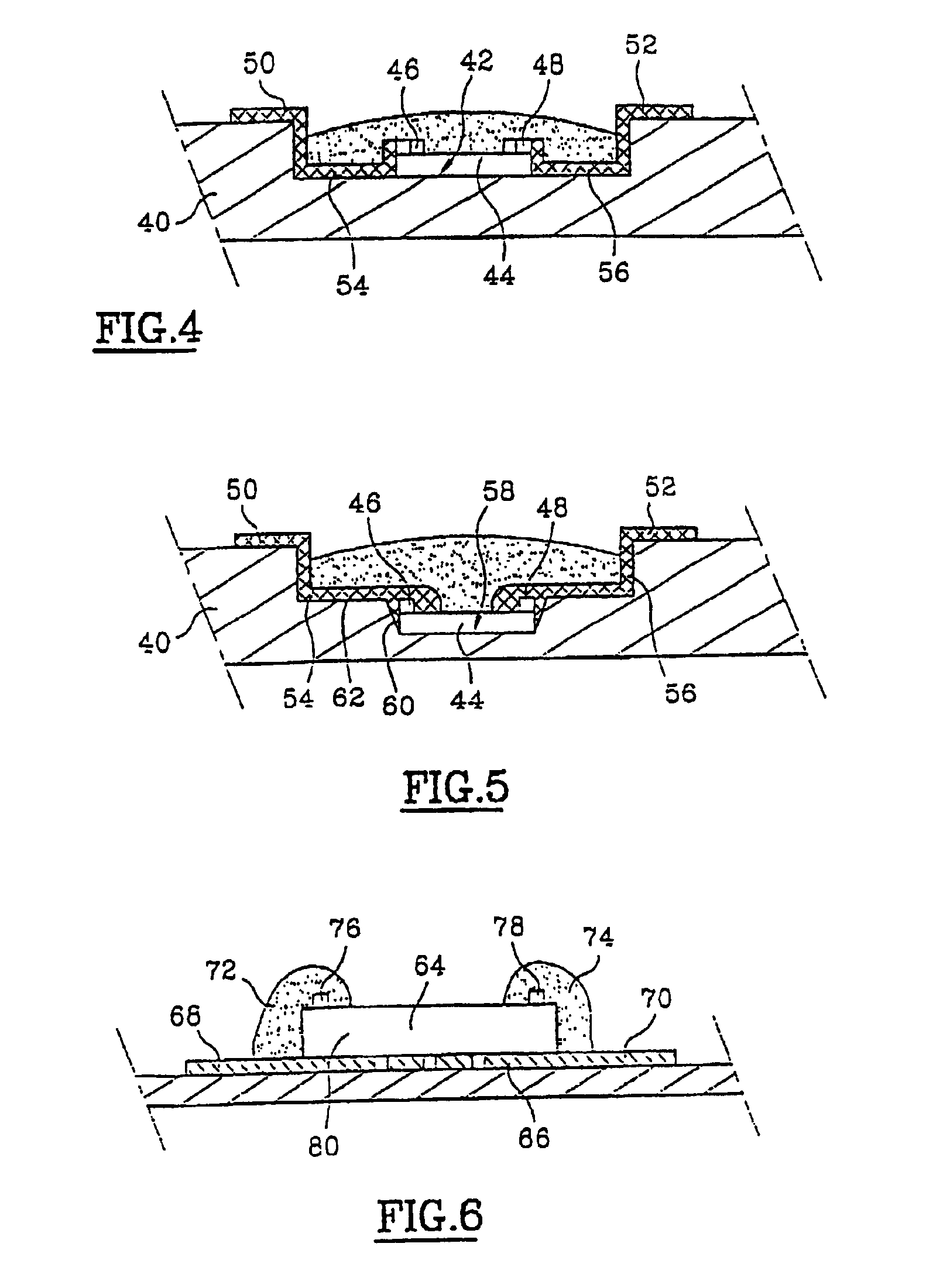
[0036]FIG. 4 shows a smart card with contacts made according to a method of the present invention. Initially, a card body 40 is made which includes a cavity 42 which can be made by injection molding or by colamination of thermoplastic sheets followed by machining of the cavity.
[0037]In a second step, the chip 44 is placed in the cavity with its active side, and particularly its exit hubs 46 and 48, facing upwards, and it is attached by gluing, for example. Local heating of the cavity can also be done followed by placing the chip in the molten thermoplastic material. The active side of the chip does not have to be on the same level as the bottom of the cavity.
[0038]In a third step, the contact terminal block and the connections with the exit hubs 46 and 48 are made by depositing a low-viscosity conducting substance, for example a polymer resin charged with conducting or intrinsically conducting particles, by a technique called “dispensing” by which a liquid or low-viscosity substance...
PUM
 Login to View More
 Abstract
Description
Claims
Application Information
 Login to View More