[0014]An
advantage of the process and product of the present invention is that it provides a thinner final monolithic product which has strength and weight advantages over thicker type products produced on conventional machines. This means that designs with thinner walls and less weight may be provided and approved for use.
[0015]Another
advantage of the product and process of the present invention is that the accuracy of the finished monolithic part is improved. In this instance, the process involves forming and then
machining. If, as in the case of the prior art, the parts are machined, then formed, there may be a variation in how much the machined part will elongate during forming. While this can be predicted to a certain degree, the tolerance band will be wider (approximately 3-4 times minimum) over the accuracy that can be achieved by finished
machining to size after the forming, and its associated elongation or other
distortion, have taken place.
[0016]Another
advantage of the product and process of the present invention is the weight reduction of the finished monolithic part. Weight is reduced by the
elimination of fasteners, typically used to connect skin or panel members and structural framing into a single piece, and to connect such pieces to form a larger portion of a structure, for example an aircraft body. This is related to the accuracy advantage, and the inherent accuracy of final machining after forming, which will allow larger parts to be produced without undue concern for overall part accuracy.
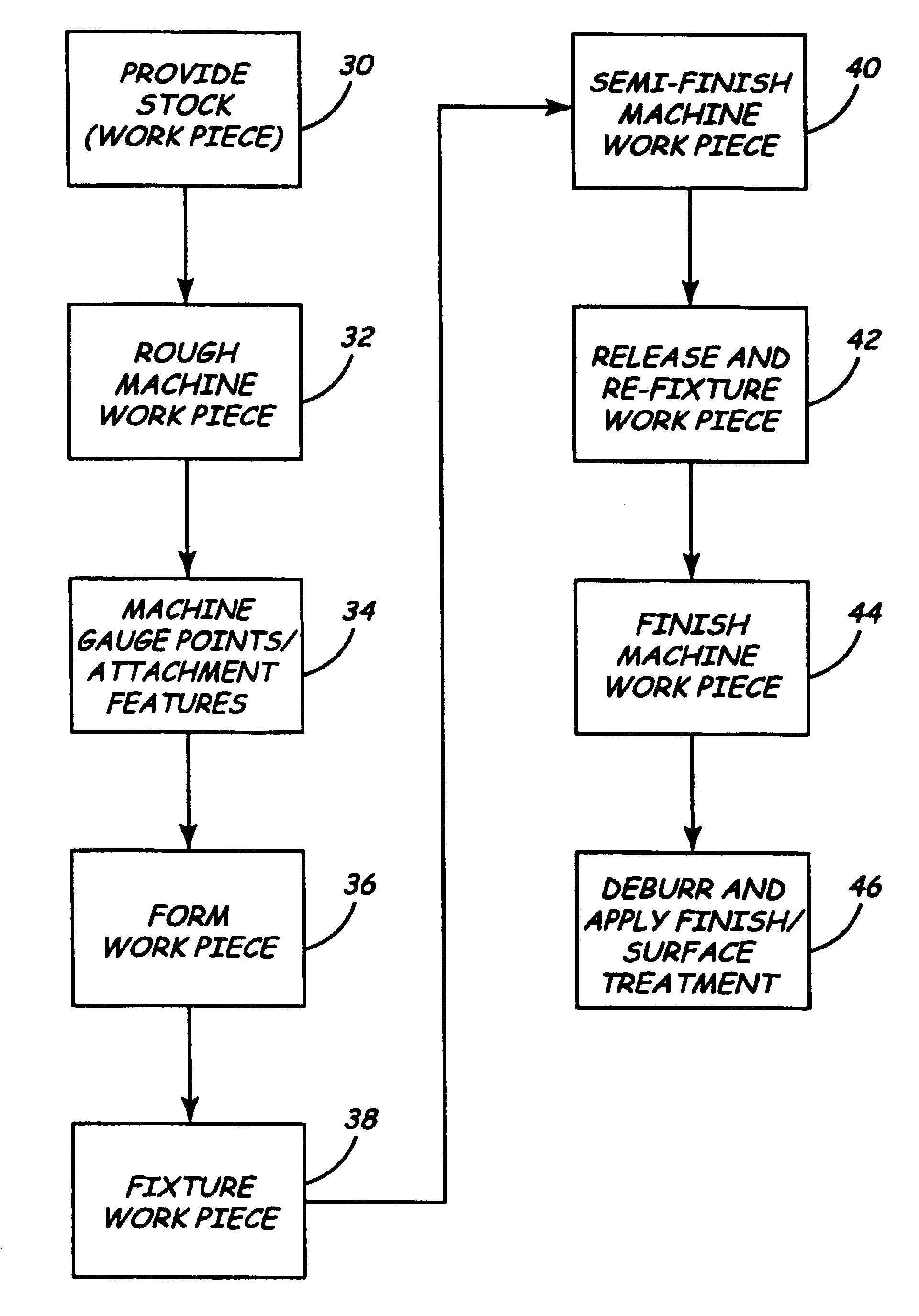
[0018]In some embodiments, the process of the present invention comprises
cold forming and
high velocity machining. Forming prior to machining is a departure from the prior art, particularly when combined, in some embodiments, with the use of
high velocity machining.
High velocity machining has much less
impact on the
raw material than conventional machining. Conventional machining can release or create further stresses in the
parent material. Because of this, products or parts formed, then conventionally machined may continue to distort after the machining operation. Further, this type of
distortion is seldom predictable and / or repeatable. Because of this problem, the standard practice in producing monolithic parts has traditionally been machining then forming.
High velocity machining on the other hand, produces better results by operating within certain developed parameters. For example,
high velocity machining truly shears the material, resulting in less stress being induced into work pieces. Because of this, the
distortion of the formed work piece after machining is much reduced when compared to the product of conventional machining. Also, the subsequent movement of the work piece after machining is more predictable and can be built into the process and product.
[0023]A feature of the process of the present invention is that it may be performed on five axes with minimal
residual stress in the product and with generally uniform stress throughout the product.
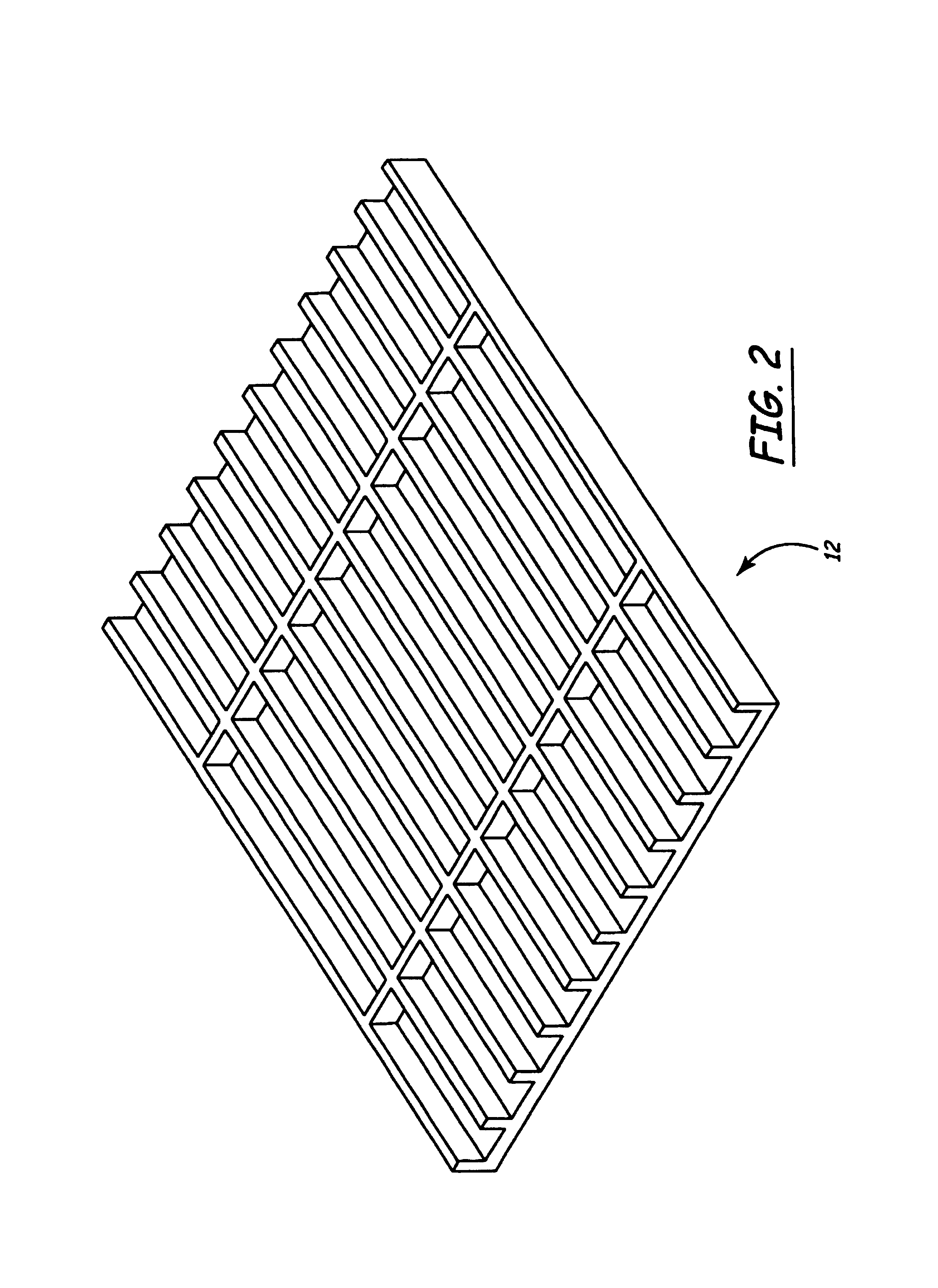
[0026]In one embodiment, the present invention comprises a method of forming and machining wing skins (and / or aircraft body portions, airfoil skins,
doors,
fuselage panels, or the like) suitable for use in the
aircraft industry, wherein the wing skins are machined to a final shape. In some embodiments, the product of the process, i.e., the wing skins, may have or contain integral stiffeners and ribs on the inside. In some embodiments, a suitable material for use in the process is a 7000 series aircraft aluminum alloys with a heat treatment of T7451. In some embodiments, the selected material is
cold formed, meaning no heat is applied to the material during the process; in some embodiments, the material is formed and processed in a state wherein it was previously
heat treated. Further, in the process of the present invention, the selected material need not be subjected to subsequent heat treatments or annealing operations, and the amount of over forming and bending back is may be selected and controlled.



 Login to View More