
Method and system for detection of cardiac arrhythmia
a cardiac arrhythmia and detection method technology, applied in the field of cardiac arrhythmia detection methods and systems, can solve the problems of difficult automatic determination of p waves, difficult application in concrete situations, and the inability to detect atrial fibrillation based on this data
- Summary
- Abstract
- Description
- Claims
- Application Information
AI Technical Summary
Benefits of technology
Problems solved by technology
Method used
Image

Examples
Embodiment Construction
[0041]Although the preferred embodiment of the present invention will be described in relation to atrial fibrillation, the same concept can be applied to detection of other cardiac arrhythmias including in particular but not exclusively atrial flutter, multifocal atrial tachycardia, ventricular tachycardia, premature ventricular contractions, etc. This concept can also be applied to detection of other body phenomenon involving electrical activity.
[0042]Data was obtained from the MIT-BIH atrial fibrillation / flutter database. The data contains 300 atrial fibrillation episodes, sampled at 250 Hz for 10 hours from Holter tapes of 25 subjects. Arrhythmia detection was carried out by trained observers and was confirmed by an independent evaluation.
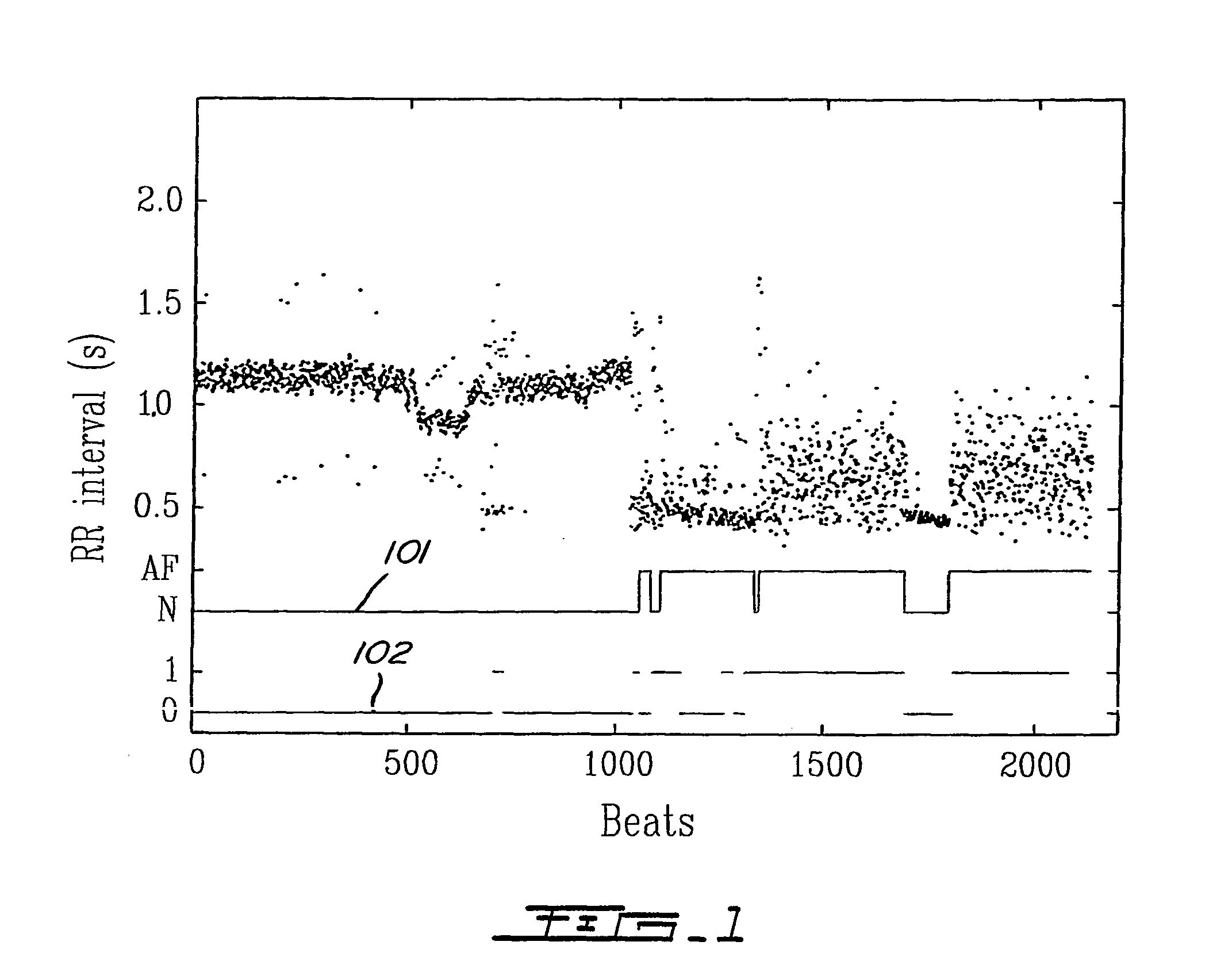
[0043]FIG. 1 is a typical time series of RR intervals from a patient with atrial fibrillation. Immediately under the recording is a solid marker line 101. When atrial fibrillation occurs this marker line 101 is set to AF; otherwise it is set to ...
PUM
 Login to View More
 Abstract
Description
Claims
Application Information
 Login to View More