Unlock instant, AI-driven research and patent intelligence for your innovation.

Pulse compression processor

a pulse compression and processor technology, applied in the field of pulse compression processors, can solve the problems of increasing the transmitted power in order to keep the radar sensitivity high, difficult to converge with the optimum solution so as to achieve the effect of reducing the sensitivity of the puls

Active Publication Date: 2006-12-19
KK TOSHIBA
View PDF17 Cites 11 Cited by
  • Summary
  • Abstract
  • Description
  • Claims
  • Application Information

AI Technical Summary

Benefits of technology

The invention provides high-performance pulse compression processors that can achieve sidelobe-free and high resolution with minimal signal-to-noise loss. The processor uses a coefficient calculator to calculate filtering coefficients for converting sampled output signal values outside the main-lobe of the pulse signal into zeros and minimizing S / N loss in the peak value of the main-lobe. A pulse compression filter then compresses the modulated pulse signal based on these filtering coefficients.

Problems solved by technology

Of course, although S / N loss that deteriorates radar sensitivity is clearly preferable to small, the increase of the transmitted power in order to keep radar sensitivity is generally very expensive.
Thus, when designing radar systems, we are forced on the trade-off between them.
However, since these methods aim at only sidelobe suppression, they do not assure the minimization of S / N loss because they consider the S / N loss calculated after the filter design finished.
However, it is hard to converge them with optimum solutions because computational efforts increase with the increase of the length of input code sequences, which are complex numbers, in the method of steepest descent.

Method used

the structure of the environmentally friendly knitted fabric provided by the present invention; figure 2 Flow chart of the yarn wrapping machine for environmentally friendly knitted fabrics and storage devices; image 3 Is the parameter map of the yarn covering machine
View more

Image

Smart Image Click on the blue labels to locate them in the text.
Viewing Examples
Smart Image
  • Pulse compression processor
  • Pulse compression processor
  • Pulse compression processor

Examples

Experimental program
Comparison scheme
Effect test

first embodiment

[0037]Let us provide detailed explanations of a pulse compression processor according to the present invention with reference to FIG. 3.

[0038]As shown in FIG. 3, the pulse compression processor 20 comprises a filtering coefficient calculator 30 and a pulse compression filter 40. Further, the filtering coefficient calculator 30 includes a minimum S / N loss calculator 31 and a zero sidelobe calculator 32.

[0039]The filtering coefficient calculator 30 calculates a first coefficient vector {right arrow over (H)}dz provided to the pulse compression filter 40. Namely, the minimum S / N loss calculator 31 calculates second coefficient data that theoretically minimizes S / N loss, and the zero sidelobe calculator 32 calculates first coefficient data as the first coefficient vector {right arrow over (H)}dz for reducing sidelobe level to zero, called sidelobe free, based on the second coefficient data as a second coefficient vector {right arrow over (H)}zM calculated by the minimum S / N loss calcula...

second embodiment

[0093]the present invention permits the pulse compression processing to be executed in the frequency space.

[0094]Let us explain the schematic construction of the pulse compression processor according to the second embodiment of the present invention with reference to FIGS. 5A and 5B.

[0095]FIG. 5A is a functional block diagram showing the first example of a pulse compression processor according to the second embodiment of the present invention. Hereinafter, the same component parts as those of the first embodiment bear the same reference numbers for describing differences from the first embodiment.

[0096]The pulse compression processor 20a of the first example of the second embodiment comprises a filtering coefficient calculator 30a, a pulse compression filter 40a.

[0097]The filtering coefficient calculator 30a comprises a minimum S / N loss calculator 31, a zero sidelobe calculator 32, and a first Fourier transformation operator 33. This filtering coefficient calculator 30a calculates ...

the structure of the environmentally friendly knitted fabric provided by the present invention; figure 2 Flow chart of the yarn wrapping machine for environmentally friendly knitted fabrics and storage devices; image 3 Is the parameter map of the yarn covering machine
Login to View More

PUM

No PUM Login to View More

Abstract

A pulse compression processor 20 compressing a modulated pulse signal correlately received by a receiver, includes a coefficient calculator 30 calculating a set of filtering coefficients for converting sampled output signal values outside a vicinity of main-lobe of a compressed pulse signal into zero as well as for minimizing S / N loss in a peak value of the main-lobe, and a pulse compression filter 40 compressing the modulated pulse signal based on the set of the filtering coefficients calculated by the coefficient calculator.

Description

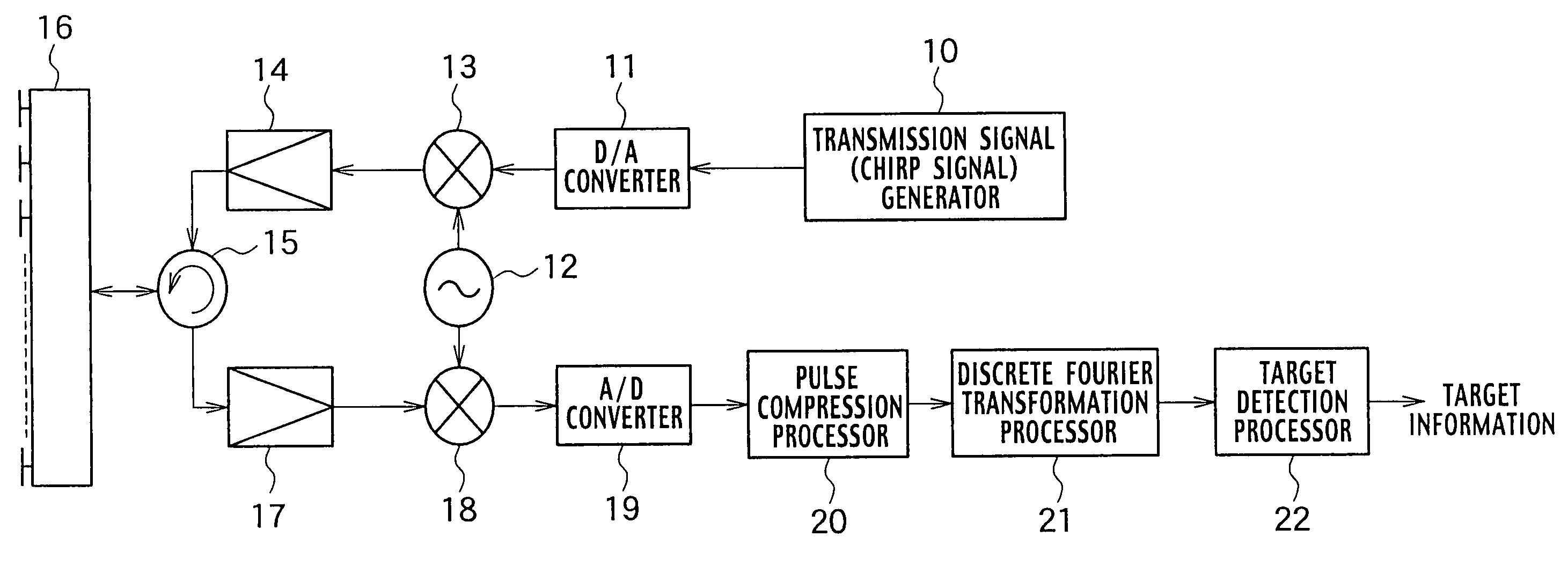
BACKGROUND OF THE INVENTION[0001]1. Field of the Invention[0002]This invention relates to pulse compression processors used for receivers of radars, and more specifically, to techniques for realizing pulse compression of the received signals with sidelobe-free as well as minimum S / N loss.[0003]2. Description of the Related Art[0004]A radar signal processor adopting a pulse compression method used for radars is shown in Japanese Patent Application Laid-Open H04-357485. This radar signal processor which transmits chirp signals (linear FM modulated signals) as transmission signals to relatively moving targets detects the targets from the Doppler frequency components extracted from the signals reflected by the targets.[0005]This pulse compression method is used for converting chirp signals received by a receiver into short pulse signals by pulse compression filters matching these chirp signals. Therefore, since the method has some advantages such as longer distance detection, higher ran...

Claims

the structure of the environmentally friendly knitted fabric provided by the present invention; figure 2 Flow chart of the yarn wrapping machine for environmentally friendly knitted fabrics and storage devices; image 3 Is the parameter map of the yarn covering machine
Login to View More

Application Information

Patent Timeline
no application Login to View More
Patent Type & Authority Patents(United States)
IPC IPC(8): G01S7/32G01S7/28G01S13/00G01S13/28
CPCG01S13/282
Inventor SHINONAGA, MITSUYOSHINISHIMOTO, SHINKICHI
Owner KK TOSHIBA