Unlock instant, AI-driven research and patent intelligence for your innovation.

Knowledge-based hierarchical method for detecting regions of interest

Inactive Publication Date: 2007-06-12
GENERAL DYNAMICS MISSION SYST INC
View PDF7 Cites 7 Cited by
  • Summary
  • Abstract
  • Description
  • Claims
  • Application Information

AI Technical Summary

Benefits of technology

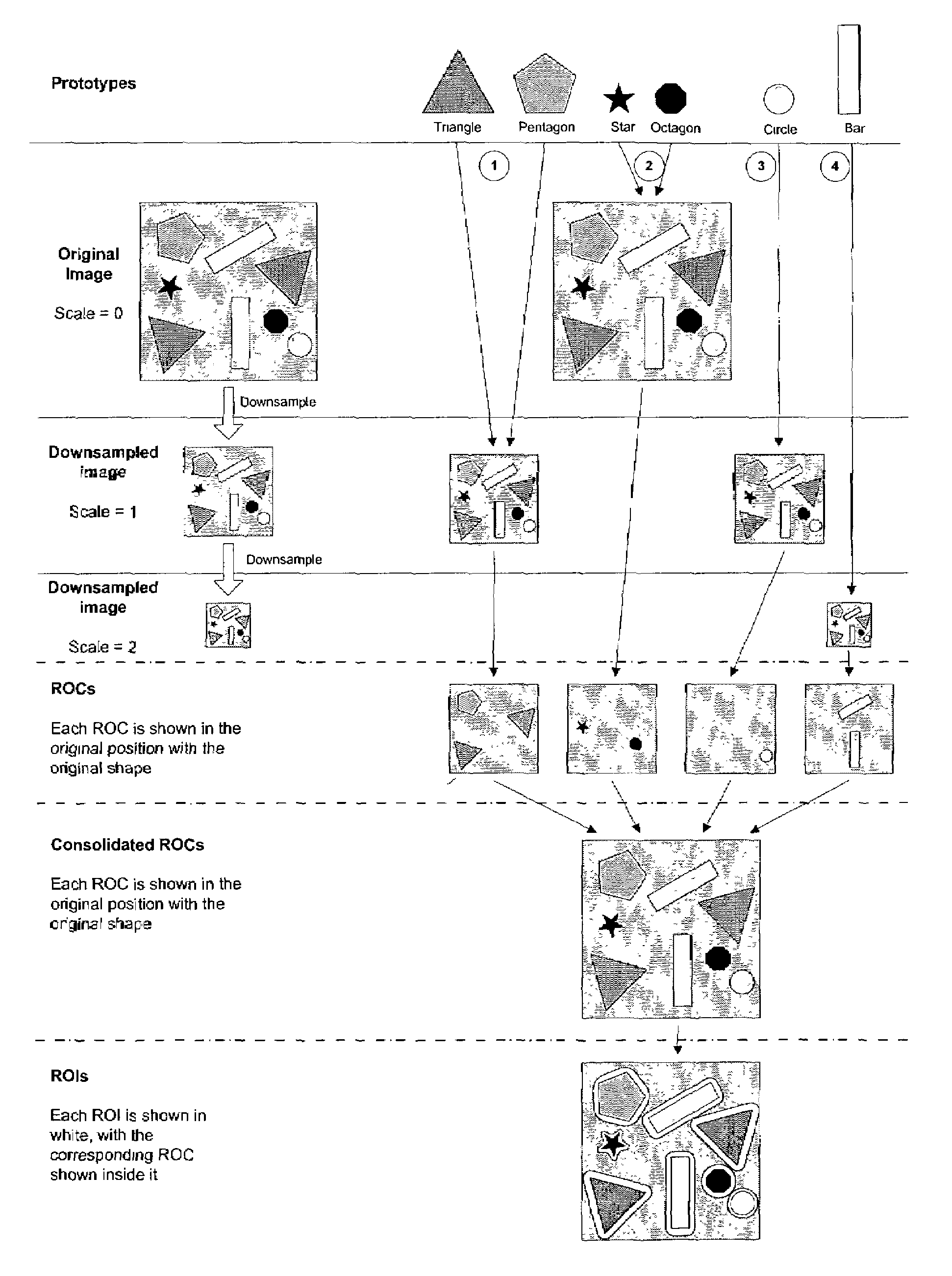
[0010]The present invention is a knowledge-based multi-resolution method for detecting ROIs in images. The present invention makes use of prior knowledge about targets using prototype information which can contain size and shape information about an object as well as object size information calculated from the imaging sensor parameters. Using prior knowledge, the present invention can detect ROIs and then apply segmentation to those ROIs. The present invention reduces the computational complexity of detecting ROIs and can provide quality ROI detection performance with poor-quality imagery. Moreover, the excellent detection performance can greatly improve the performance of subsequent processing techniques such as compression, segmentation, and recognition.
[0012]The present invention has several advantages over conventional methods. The use of prior knowledge in the present invention can be used for grouping prototypes, choosing features and the use of more efficient and simpler algorithms. The present invention also utilizes multi-resolution that allows for detecting groups of prototypes on the minimal resolution in which the prototypes are barely detectable which reduces the volume of data to be processed. The use of multi-resolution with different groups of prototypes reduces the risk of errors made in any one resolution from proliferating to other resolutions. The present invention solves many of the problems of conventional methods because of its use of prior knowledge and multi-resolutions. Furthermore, the present invention is not bound to detecting ROIs by symmetrical shapes like rectangles. The present invention may detect ROIs with irregular shapes (i.e. any shape and any positioning) that conform to the shape of the target.

Problems solved by technology

Because these issues may impact the efficiency and effectiveness of a DIRS, the segmentation phase can affect the functionality of the entire process.
Several problems hinder the segmentation process.
First, because of the characteristics of the image, such as luminance, noise level, ROI position uncertainty, etc., it is difficult to determine the critical parameters for segmentation at different positions.
Secondly, different objects in the image have different and distinctive features.
Even when the pixels of the objects are accurately grouped and separated, other problems remain.
However, the computational complexity associated with these algorithms may prohibit them from use in real-time applications.
Thus, these solutions may result in inaccurate, incomplete, or too general results in detecting ROIs.
In addition, they are often computationally complex and usually do not work well with low quality images.

Method used

the structure of the environmentally friendly knitted fabric provided by the present invention; figure 2 Flow chart of the yarn wrapping machine for environmentally friendly knitted fabrics and storage devices; image 3 Is the parameter map of the yarn covering machine
View more

Image

Smart Image Click on the blue labels to locate them in the text.
Viewing Examples
Smart Image
  • Knowledge-based hierarchical method for detecting regions of interest
  • Knowledge-based hierarchical method for detecting regions of interest
  • Knowledge-based hierarchical method for detecting regions of interest

Examples

Experimental program
Comparison scheme
Effect test

Embodiment Construction

[0019]The present invention is a knowledge-based hierarchical method for detecting potential ROIs in an image. The present invention may comprise four primary steps: i) processing prior knowledge to divide the prototypes into groups, and to decide how to detect each group of prototypes; ii) detecting ROCs for each group of prototypes in a properly assigned resolution; iii) competing ROCs for different prototype groups to make the consolidated ROCs; and iv) extending the area of the consolidated ROCs to get the regions of interest (ROIs). The first step is preferably run only once for multiple images, if the prototypes are the same for these images. The second step may run several times for each image. Each time focuses on one group of prototypes and on a particular resolution. The third and fourth steps typically run once for each image.

[0020]In the preferred embodiment, prior knowledge consists of general information about the targets (i.e. as prototypes) and information about the ...

the structure of the environmentally friendly knitted fabric provided by the present invention; figure 2 Flow chart of the yarn wrapping machine for environmentally friendly knitted fabrics and storage devices; image 3 Is the parameter map of the yarn covering machine
Login to View More

PUM

No PUM Login to View More

Abstract

A knowledge-based hierarchical method for detecting regions of interests (ROIs) uses prior knowledge of the targets and the image resolution in detecting ROIs. The result produces ROIs that contain only one target that is completely enclosed within the ROI. The detected ROI can conform to the shape of the target even if the target is of irregular shape. Furthermore, the method works well with images that contain connected targets or targets broken into pieces. The method is not sensitive to contrast levels and is robust to noise. Thus, this method effectively detects ROIs in common real world imagery that has a low resolution without costly processing while providing fast and robust results.

Description

BACKGROUND OF THE INVENTION[0001]1. Field of the Invention[0002]The present invention relates to the field of image processing and, more particularly, to detecting regions of interests (ROIs) in images.[0003]2. Description of the Related Art[0004]Detecting ROIs in images is a common step in many image processing systems. Conventional digital image recognition systems (DIRSs) detect ROIs by typically using some knowledge of a prototype. Generally, an image is composed of many objects that can be defined by pixels. A group of pixels is called a region. A target is an object of interest. A prototype contains information about a type of target. A DIRS may detect a region in an image that matches the prototype.[0005]Images may contain a lot of information. DIRSs may have different phases to more efficiently process information from an image, such as: a segmentation phase, a feature extraction phase and a classification phase. The function of the segmentation and feature extraction phases...

Claims

the structure of the environmentally friendly knitted fabric provided by the present invention; figure 2 Flow chart of the yarn wrapping machine for environmentally friendly knitted fabrics and storage devices; image 3 Is the parameter map of the yarn covering machine
Login to View More

Application Information

Patent Timeline
no application Login to View More
IPC IPC(8): G06K9/48G06V10/25
CPCG06K9/3233G06V10/25
Inventor ABOUSLEMAN, GLEN P.LIN, HUIBAOSI, JENNIE
Owner GENERAL DYNAMICS MISSION SYST INC