Activator of peroxisome proliferator-activated re-ceptor delta
Inactive Publication Date: 2007-09-04
NIPPON CHEMIPHAR CO LTD
View PDF11 Cites 18 Cited by
Summary
Abstract
Description
Claims
Application Information
AI Technical Summary
This helps you quickly interpret patents by identifying the three key elements:
Problems solved by technology
Method used
Benefits of technology
Benefits of technology
The compound demonstrates excellent PPARδ activating effects, showing potential in treating hyperglycemia, hyperlipidemia, obesity, and various cancers, with improved therapeutic outcomes compared to existing ligands.
Problems solved by technology
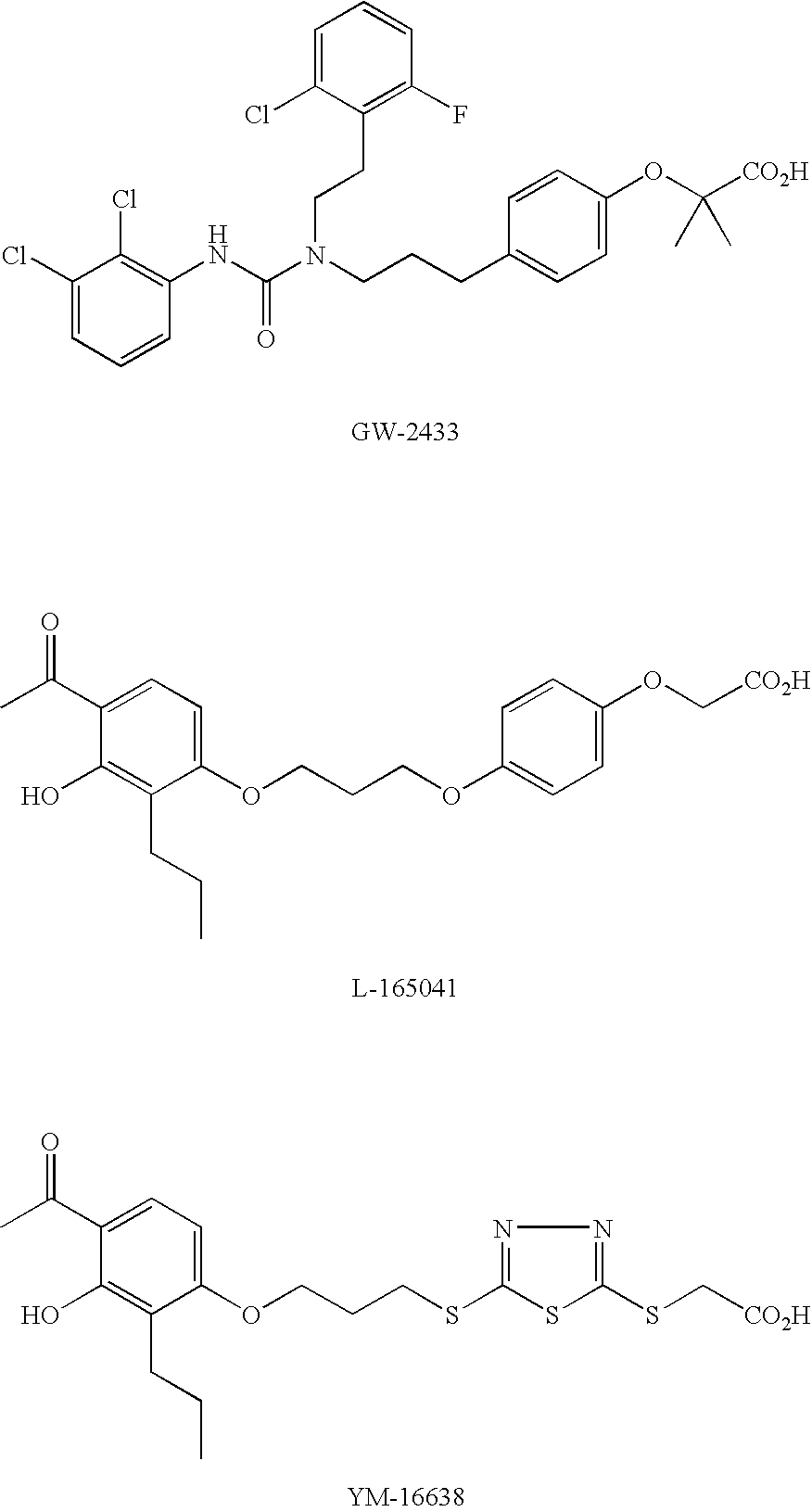
Further, while the J. Immunol. Methods teaches the use of the compound B as blood pressuredepressant, there is no concrete description to teach that the compound is effective as PPARδ ligand.
Method used
the structure of the environmentally friendly knitted fabric provided by the present invention; figure 2 Flow chart of the yarn wrapping machine for environmentally friendly knitted fabrics and storage devices; image 3 Is the parameter map of the yarn covering machine
View more
Image
Smart Image Click on the blue labels to locate them in the text.
Viewing Examples
Smart Image
Click on the blue label to locate the original text in one second.
Reading with bidirectional positioning of images and text.
[0128]To an ice-cold THF (5 mL) was added 60% sodiumhydride (97 mg, 2.42 mmol). Subsequently, a solution of ethyl 2-[(3-methyl-4-benzyloxy)benzoyl]acetate (757 mg, 2.42 mmol) in THF (4 mL) was dropwise added for 30 minutes. The mixture was allowed to room temperature, and then stirred for 30 minutes. To the mixture was added 4-iodomethyl-5-isopropyl-2-(2,4-dichlorophenyl)oxazole (960 mg, 2.42 mmol). The resulting mixture was refluxed for 20 hours under nitrogenatmosphere, and allowed to room temperature. THF was removed under reduced pressure. To the residue was added acetic acid (6.4 mL)-conc. hydrochloric acid (1.6 mL), and the mixture was refluxed for 10 hours, and allowed to room temperature. The reaction mixture was poured into ice water. Ethyl acetate was added to the mixture. Th...
[0134]The synthetic intermediate of Example 1, namely 3-[2-(2,4-dichlorophenyl)-5-isopropyl-4-oxazolyl]-1-(3-methyl-4-hydroxyphenyl)propan-1-one (105 mg, 0.25 mmol) and potassiumcarbonate (103 mg, 0.75 mmol) were suspended in acetone (3 mL). Ethyl bromoacetate (0.08 mL, 0.75 mmol) was added to the suspension while cooling with ice. The suspension was allowed to room temperature, and refluxed while heating for 6 hours. Insolubles were filtered, and washed with acetone. Subsequently, the solvent was distilled off. The residue was purified by column chromatography on silica gel with hexane / ethyl acetate (7 / 1-4 / 1) to give the subject compound (117 mg) as colorless oil (yield 92%)
[0136]To an ice-cold THF (5 mL) was added 60% sodiumhydride (27 mg, 0.67 mmol). Subsequently, a solution of ethyl 2-[(3-methyl-4-benzyloxy)benzoyl]acetate (190 mg, 0.61 mmol) in THF (3 mL) was dropwise added for 30 minutes. The mixture was allowed to room temperature, and then stirred for 30 minutes. To the mixture was added 5-iodomethyl-4-isopropyl-2-(4-trifluoromethyl)phenylthiazole (250 mg, 0.61 mmol). The resulting mixture was refluxed for 20 hours under nitrogenatmosphere, and allowed to room temperature. THF was removed under reduced pressure. To the residue was added acetic acid (3.2 mL)-conc. hydrochloric acid (0.8 mL), and the mixture was refluxed for 10 hours under heating, and allowed to room temperature. The reaction mixture was poured into ice water. The mixture was extracte...
the structure of the environmentally friendly knitted fabric provided by the present invention; figure 2 Flow chart of the yarn wrapping machine for environmentally friendly knitted fabrics and storage devices; image 3 Is the parameter map of the yarn covering machine
Login to View More
PUM
Login to View More
Abstract
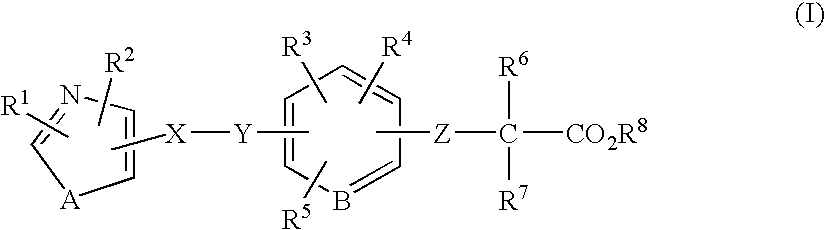
A compound represented by the following general formula (I):(wherein R1 represents phenyl, etc. which can have substituents selected from the group consisting of C1-8 alkyl, C1-8 alkyl having halogen, halogen, hydroxyl, etc.; R2 represents C1-8 alkyl, etc.; A represents oxygen, sulfur, etc.; X represents C1-8 alkylene chain, etc.; Y represents C(═O), CH═CH, etc.; R3, R4, and R5 each represents hydrogen, C1-8 alkyl, etc.; B represents CH or nitrogen; Z represents oxygen or sulfur; R6 and R7 each represents hydrogen, C1-8 alkyl, etc.; and R8 represents hydrogen or C1-8 alkyl; provided that at least one of R3, R4, and R5 is not hydrogen) or a salt of the compound; and a PPAR-δ activator which contains the compound or salt as the active ingredient.
Description
TECHNICAL FIELD[0001]The present invention relates to an activator of peroxisome proliferator activated receptor δ.PRIOR ART[0002]The peroxisome is a small organ present in cells of animals and plants, and its matrix contains various enzymes such as catalases. Various compounds such as fibrates, herbicides, and phthalic acid plasticizers are known as peroxisome proliferators which induce proliferation of peroxisomes.[0003]Isseman, et al. have identified a nuclear receptor which is activated by peroxisome proliferator and called it peroxisome proliferator activated receptor (PPAR).—Nature, 347, p 645-650, 1990.[0004]Three subtypes such as PPARα, PPARγ and PPARδ have been identified.—Proc. Natl. Acad. Sci. USA, 91, p 7335-7359, 1994.[0005]The above-mentioned fibrates used as the serum triglyceride (TG) lowering drug can modulates PPARδ activity. Further, thiazolidine compounds (Troglitazone, Rosiglitazone, Pioglitazone) useful in the treatment of diabetes are also known as ligands of ...
Claims
the structure of the environmentally friendly knitted fabric provided by the present invention; figure 2 Flow chart of the yarn wrapping machine for environmentally friendly knitted fabrics and storage devices; image 3 Is the parameter map of the yarn covering machine
Login to View More
Application Information
Patent Timeline
Application Date:The date an application was filed.
Publication Date:The date a patent or application was officially published.
First Publication Date:The earliest publication date of a patent with the same application number.
Issue Date:Publication date of the patent grant document.
PCT Entry Date:The Entry date of PCT National Phase.
Estimated Expiry Date:The statutory expiry date of a patent right according to the Patent Law, and it is the longest term of protection that the patent right can achieve without the termination of the patent right due to other reasons(Term extension factor has been taken into account ).
Invalid Date:Actual expiry date is based on effective date or publication date of legal transaction data of invalid patent.


 Login to View More
  Login to View More