Systems and methods for regularly approximating context-free grammars through transformation

US7289948B1Active Publication Date: 2007-10-30NUANCE COMM INC
12 Cites 64 Cited by

Patent Information

Authority / Receiving Office
US · United States
Current Assignee / Owner
Publication Date
2007-10-30

Smart Images

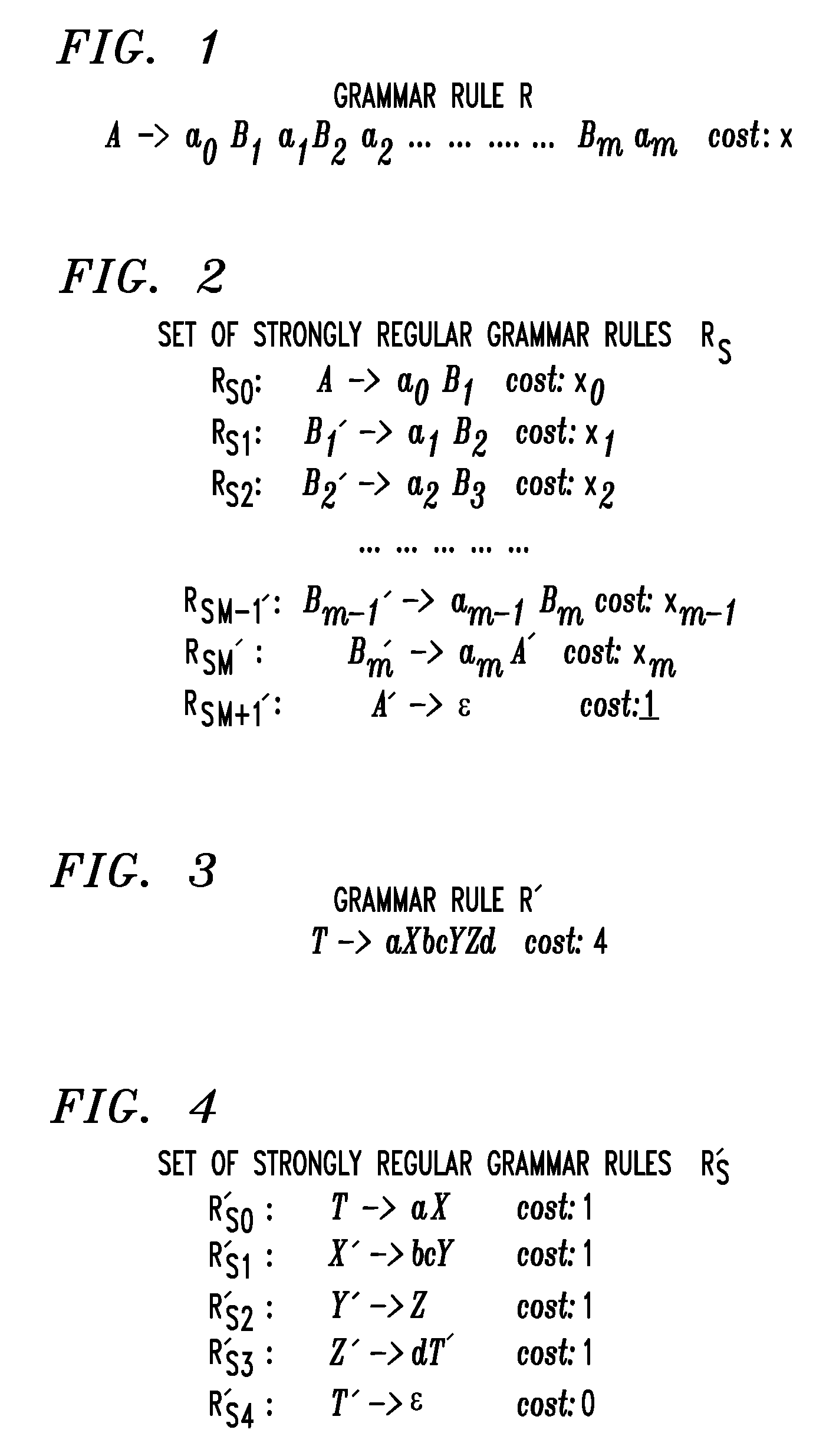
  • Figure 1
    Figure 1
  • Figure 2
    Figure 2
  • Figure 3
    Figure 3
Patent Text Reader

Abstract

Context-free grammars generally comprise a large number of rules, where each rule defines how a sting of symbols is generated from a different series of symbols. While techniques for creating finite-state automata from the rules of context-free grammars exist, these techniques require an input grammar to be strongly regular. Systems and methods that convert the rules of a context-free grammar into a strongly regular grammar include transforming each input rule into a set of output rules that approximate the input rule. The output rules are all right- or left-linear and are strongly regular. In various exemplary embodiments, the output rules are output in a specific format that specifies, for each rule, the left-hand non-terminal symbol, a single right-hand non-terminal symbol, and zero, one or more terminal symbols. If the input context-free grammar rule is weighted, the weight of that rule is distributed and assigned to the output rules.
Need to check novelty before this filing date? Find Prior Art

Description

[0001] This non-provisional application claims the benefit of U.S. Provisional Application No. 60 / 344,792, filed Jan. 7, 2002, which is incorporated herein by reference in its entirety.BACKGROUND OF THE INVENTION

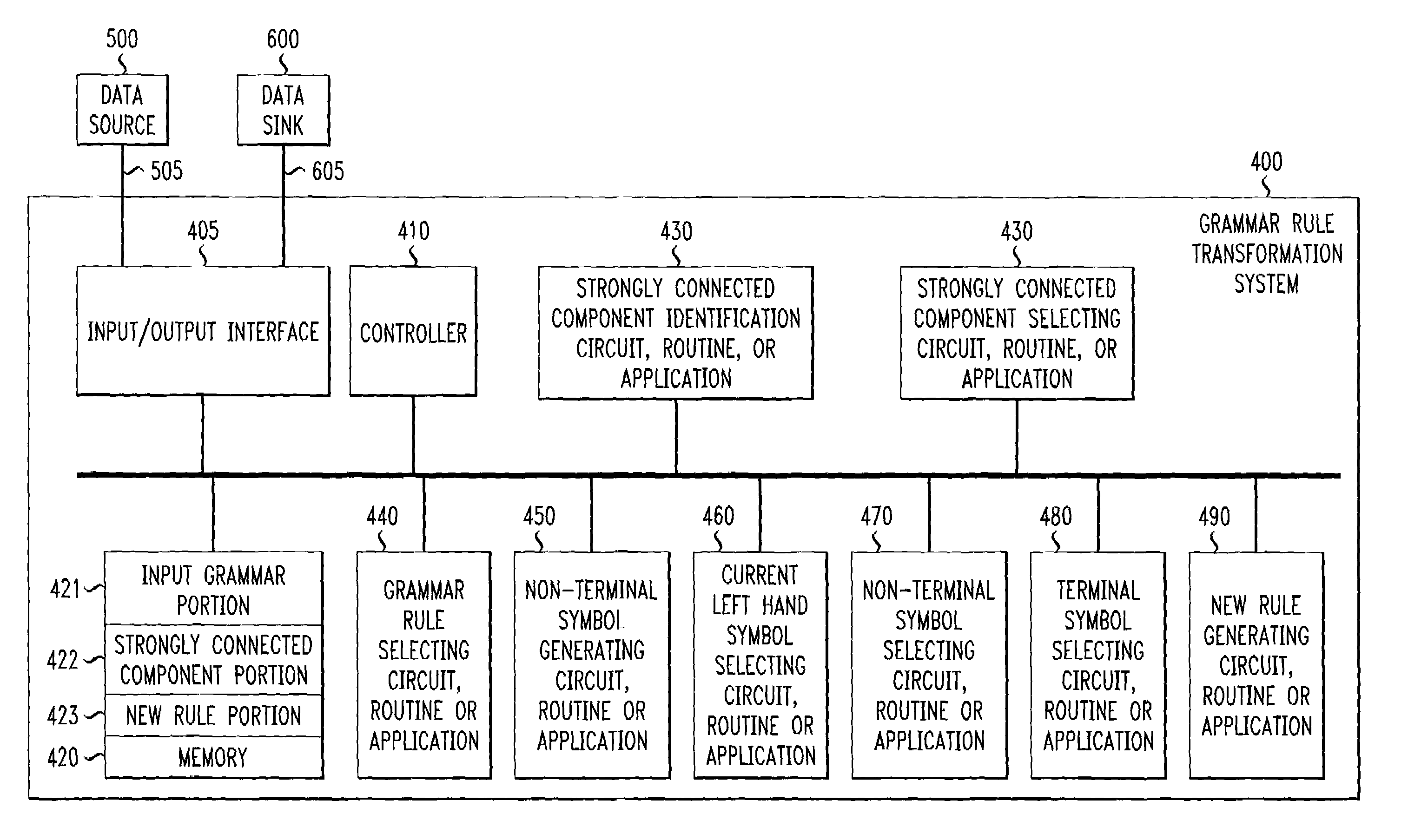
[0002] 1. Field of Invention

[0003] This invention is directed to systems and methods for transforming any context-free grammar into a strongly regular grammar.

[0004] 2. Description of Related Art

[0005] Context-free grammars are used in a variety of technical fields, such as linguistics, speech recognition, speech synthesis (text-to-speech), to represent the conversion of one set of symbols into another set of symbols. For example, context-free grammars can be used to convert acoustic signals into recognized speech.

[0006] Grammars generally comprise a large number of rules, where each rule defines how a given string of symbols can be produced from a different series of symbols. In many computer implementations, such grammars are represented or implemented using finite-state automat...

Examples

Embodiment Construction

[0022]A grammar is a set of rules that specify the set of acceptable sequences of symbols of a language. Additionally, grammars, such as context-free grammars, may assign parsing information to each acceptable sequence of symbols based on the non-terminal symbols of the grammar. A weighted grammar is one that additionally assigns some weight to each acceptable sequence of symbols. A weighted grammar is one which has costs or weights assigned to each rule. This allows the system implementing the grammar to have multiple rules with different outputs for the same input. Thus, in weighted grammars, each sequence of symbols is assigned a different probability. Subsequent rules can modify these probabilities.

[0023]The symbols in the grammar, for the purpose of this invention, are assigned specific definitions. Symbols that appear only on the right-hand side of a rule are the “terminal” symbols. The other symbols in the grammar that appear on the left-hand side of a rule, and possibly on t...