The enormous force of
gravitation should not allow such a protuberance on a round
planet.
However, none of such phenomena has been proven experimentally.
We all know of thermal
convection occurs in a pot of water, but insofar as I am aware, no one has successfully reproduced a
convection current forming a linear spreading center like the mid-oceanic
ridge in liquids.
But it is impossible to transform a curved surface into a plane surface without
distortion.
However, to some experts, Mercator is an abhorrent projection.
The shape of Antarctica is swollen so grotesquely that nobody can imagine the original shape of that continent.
Another important misconception deriving from the Mercator is that it fails to show the shortest, most
direct route between two points on the earth's surface.
The National Geographic Society adopted the Van der Grinten projection in 1922 as the Society's standard reference
world map and Arthur Robinson's projection in 1988, but these are not optimal solutions to the Mercator problem.
The problem of the shortest air
route is not solved either.
But they distort the shapes of the continents severely.
But unfortunately, this original map had severe discontinuity problems.
However, this in turn means that no layperson can change the configuration at will.
In fact, I could not produce a map of the continental hemisphere from it.
In general, there are no books that provide any instruction how one can make a
world map on their own.
Fuller claimed that his projection is able to show the shortest air routes between landmasses, but its ability is a limited one because the angles between outer facets make them discontinuous.
For instance, one can hardly figure out the shortest air
route between South America and Africa.
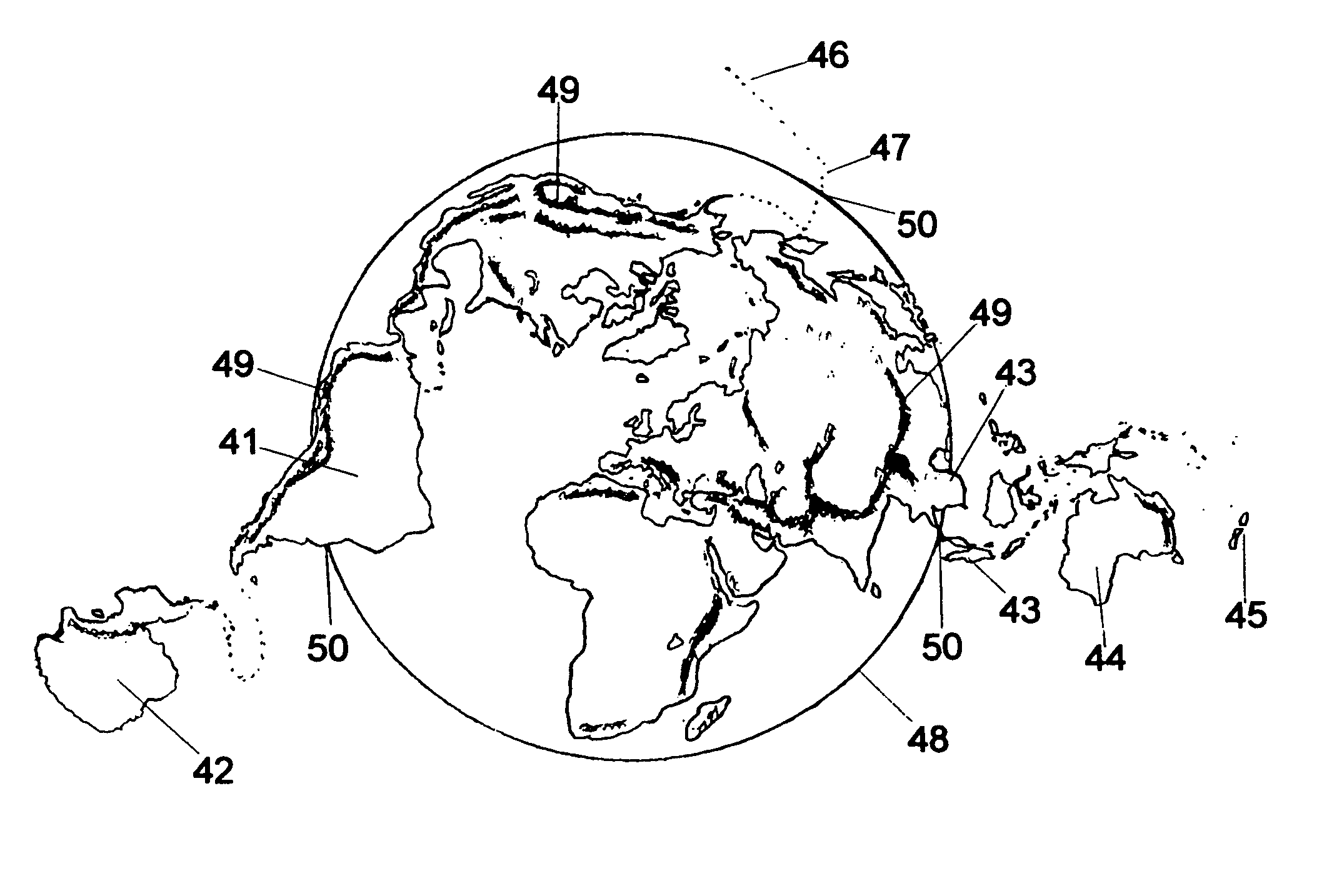
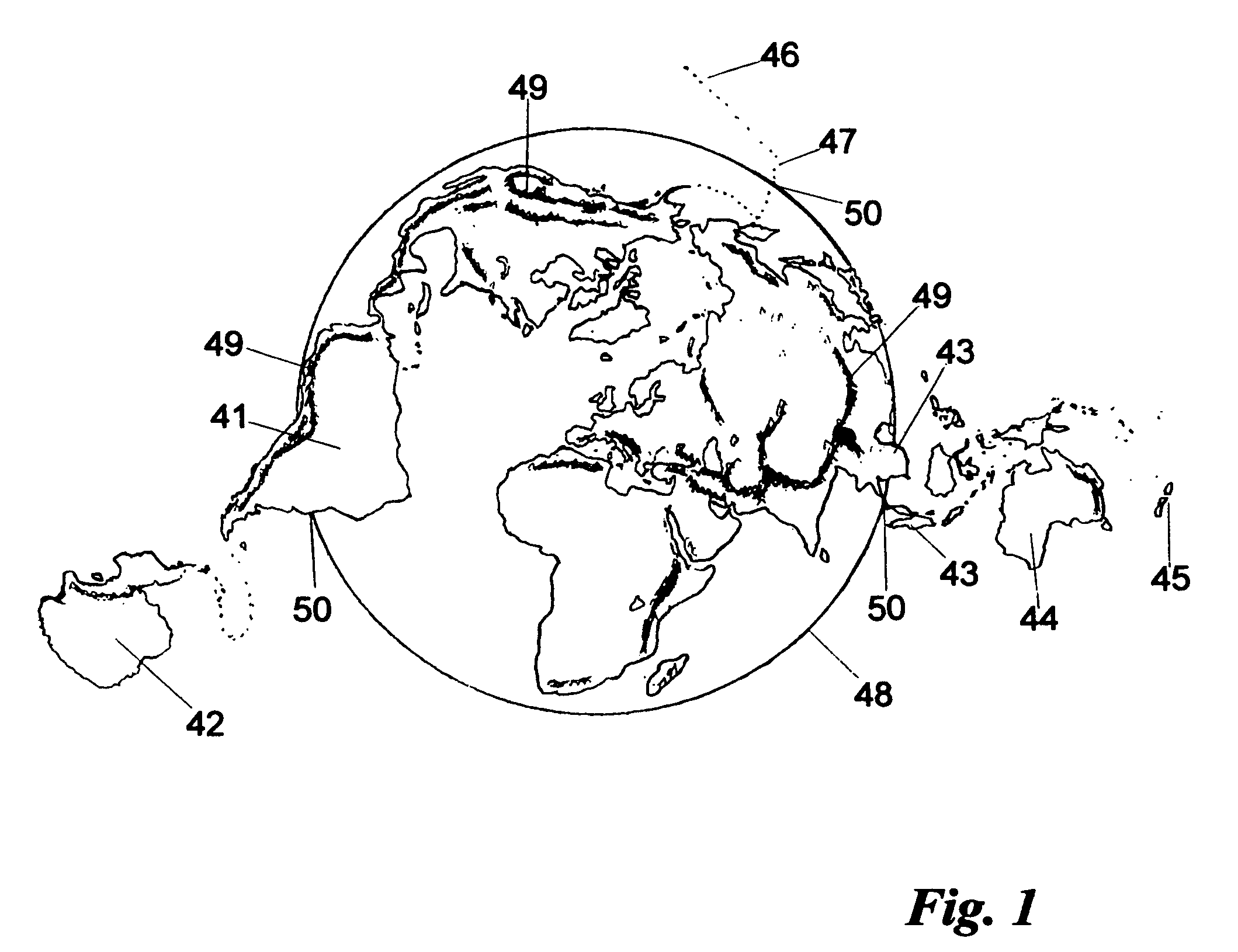
Although there are many continental (land) hemisphere maps on the Azimuthal (equal-area,
Equidistant or perspective) projection in books and web sites, I could not find any world maps based on the continental hemisphere.
Even though Frye's extension of an oblique Azimuthal
Equidistant hemisphere shows interrupted landmasses in the continental hemisphere extended to complete their contours, it is not intended to produce a
world map.
This creates major problems in fully representing the continents since scale variations and distortions increase markedly as coverage extends into the second hemisphere.
In conclusion, there are many prior-art maps in
geophysics and
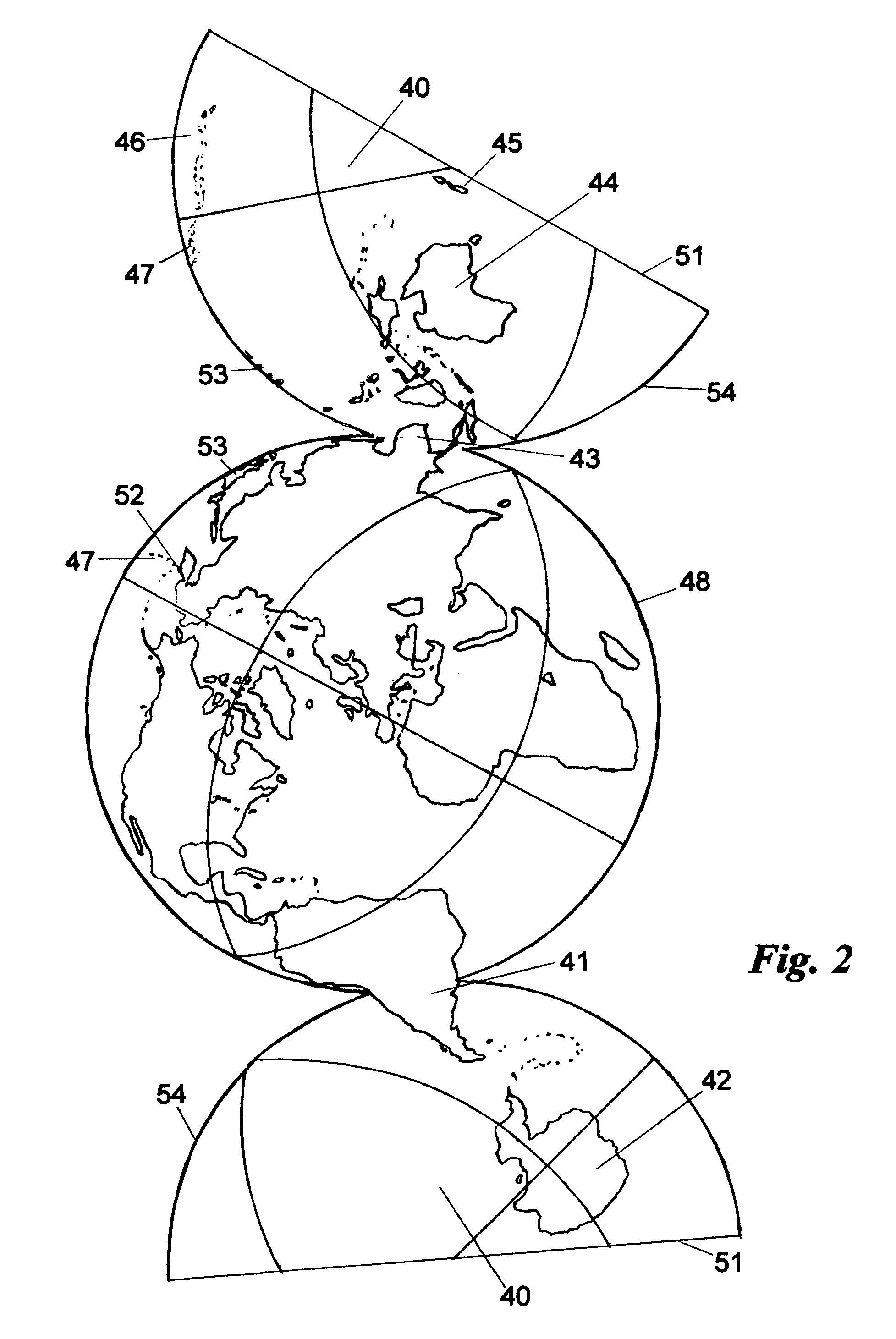
cartography but they are not satisfactory because;1. There is no theory describing how and why the continents take their shapes, considering the force of the earth's gravity.2. A world map reflecting the real shapes of the continents is indispensable when discussing their origin but there is no such map.3. Many popular world maps, especially the
Mercator projection, have misled people's conceptions about the relative sizes and shapes of the continents.4. A world
map projection is too complicated and difficult for laypersons to make on their own.5. The shortest air routes between most of the landmasses are not apparent in many popular world maps.6. There is no full-scale world map using the continental and the oceanic hemispheres.


 Login to View More
  Login to View More