
Nanocomposite scintillator, detector, and method
a detector and nanocomposite technology, applied in the field of nanocomposite detectors and detectors, can solve the problems of limiting the amount of usable single crystals, difficult and expensive preparation of high-quality single crystals, and limiting the efforts to develop other types of crystals with an lso host latti
- Summary
- Abstract
- Description
- Claims
- Application Information
AI Technical Summary
Benefits of technology
Problems solved by technology
Method used
Image

Examples
Embodiment Construction
[0026]The invention is concerned with nanocomposite scintillators and with a detector that employs nanocomposite scintillators and that can detect photons (x-rays and gamma rays, for example) and / or particles (protons and neutrons, for example). Scintillators are phosphors that convert ionizing radiation to a light output in the UV-visible and / or infrared. The nanocomposite scintillator is prepared using nanopowders of fast, bright, dense scintillators. The brightness provides an invention detector with optimum light detection, and the high density provides the detector with stopping power for the x-rays, gamma-rays, neutrons, protons, or the like. Also, the cost of preparing nanocomposite scintillator of the invention is inexpensive compared to the cost of preparing single crystals.
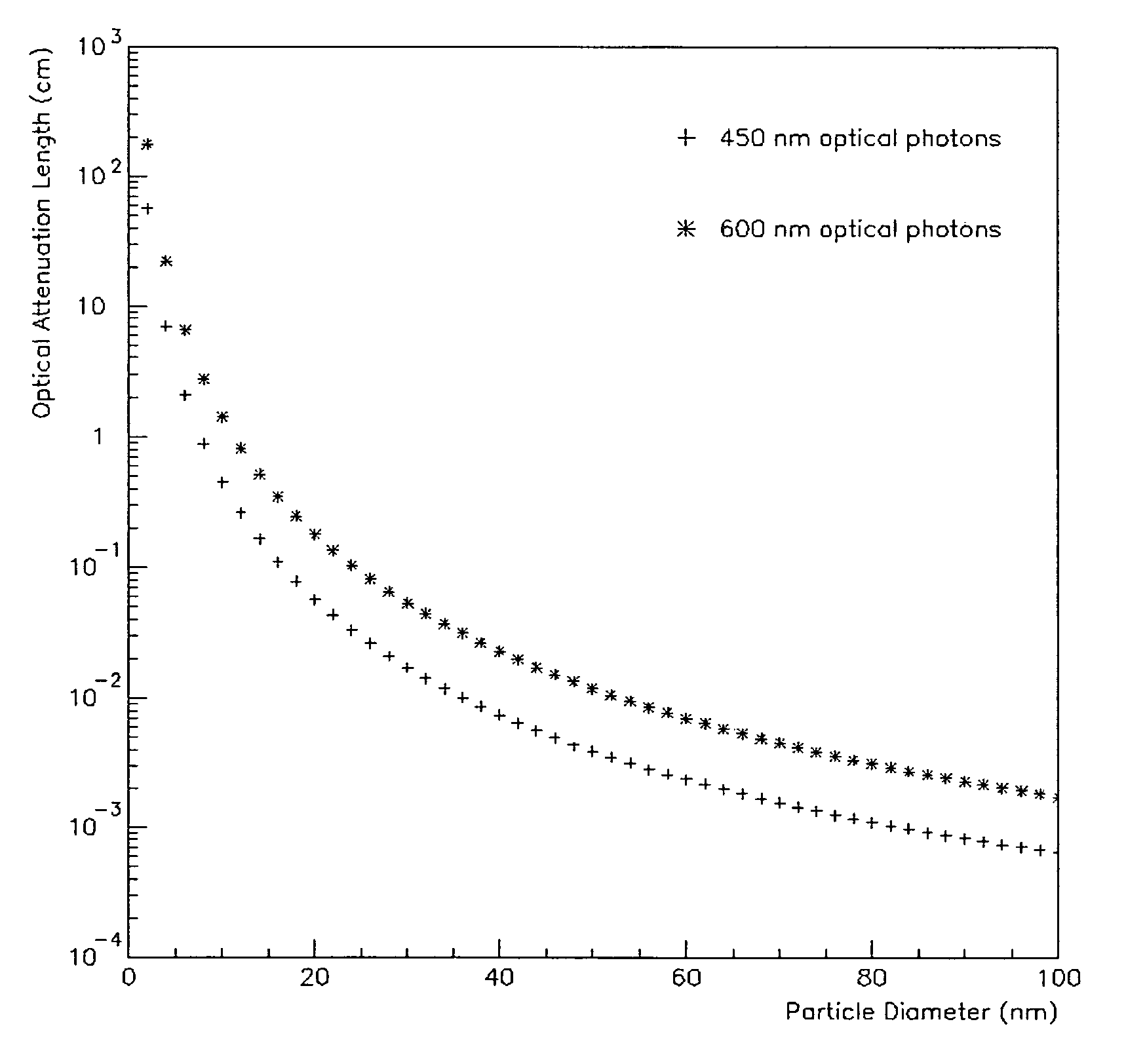
[0027]Embodiment nanocomposites may be prepared by mixing nanopowder phosphor with a polymer or glass binder. Nanopowder is defined herein as powder with particle sizes of 100 nanometers or less. The bin...
PUM
| Property | Measurement | Unit |
|---|---|---|
| size | aaaaa | aaaaa |
| particle sizes | aaaaa | aaaaa |
| volume percent | aaaaa | aaaaa |
Abstract
Description
Claims
Application Information
 Login to View More