Unlock instant, AI-driven research and patent intelligence for your innovation.

Method for controlling a flow of information between secondary agents and a mobile device in a wireless communications system

a wireless communication system and secondary agent technology, applied in the field of wireless communication, can solve the problems of excessive complexity of cellular architectures, excessive processing capacity, and high construction and maintenance costs

Inactive Publication Date: 2010-03-09
ALCATEL-LUCENT USA INC +1
View PDF16 Cites 39 Cited by
  • Summary
  • Abstract
  • Description
  • Claims
  • Application Information

AI Technical Summary

Benefits of technology

This approach reduces complexity, enhances scalability, and improves resource allocation efficiency, enabling better support for data-centric services while maintaining quality of service for real-time traffic like VoIP, thereby reducing operational and capital expenditures.

Problems solved by technology

These proposed 4G systems suffer from a variety of shortcomings, including the fact that the current cellular architectures will be required to be heavily modified to provide desired interconnectivity and services.
These modifications will result in cellular architectures that are exceedingly complex, and thus, expensive to construct and maintain.
In short, past processing capabilities were sufficiently expensive that for the cellular system to be viable, the processing had to be split across a variety of network elements.
Some prior attempts have tried to tie in cellular aspects to the general idea of broadband access but they did not address the backward compatibility of the air interfaces, while the others are mainly directed to the Media Access Control (MAC) layer and the physical layer and do not address the generic aspects of cellular systems in regard to radio resource management or mobility across a controlled cellular network.
First, scalability of the system is significantly limited.
BTSs, however, may not be simply added to the system without eventually creating a need for additional elements in the system.
Accordingly, this approach has a relatively high cost with regard to the amount of equipment needed to build the solution as capacity limits are reached.
Moreover, this problem will also be exacerbated by the tendency toward small cells as advocated by prior systems.
Also, a new BTS will start off supporting a lighter load than the existing BTSs, thereby leading to inefficient use of the resources in the wireless network.
Second, flexibility of the system is significantly limited.
The second problem with traditional cellular networks is that the existing solutions are not designed to allow the use of equipment using different radio interfaces.
That is, although provision is made to hand-over from other radio interfaces, direct access to future types of interfaces is not provided.
Third, the system becomes exceedingly complex.
Both of the above problem areas combine to make the present solutions complex or at least overly complicated in the sense of future development of a network.
This complexity may then necessitate high capital expenditures to create the new infrastructure.
A second form of complexity arises out of the management of the numerous interfaces that these systems present.
This type of complexity is reflected in higher operational expenditures.
However, such efficiency can be difficult to achieve because data applications are fundamentally different from traditional voice applications, both in terms of the traffic characteristics and the QoS requirements.

Method used

the structure of the environmentally friendly knitted fabric provided by the present invention; figure 2 Flow chart of the yarn wrapping machine for environmentally friendly knitted fabrics and storage devices; image 3 Is the parameter map of the yarn covering machine
View more

Image

Smart Image Click on the blue labels to locate them in the text.
Viewing Examples
Smart Image
  • Method for controlling a flow of information between secondary agents and a mobile device in a wireless communications system
  • Method for controlling a flow of information between secondary agents and a mobile device in a wireless communications system
  • Method for controlling a flow of information between secondary agents and a mobile device in a wireless communications system

Examples

Experimental program
Comparison scheme
Effect test

Embodiment Construction

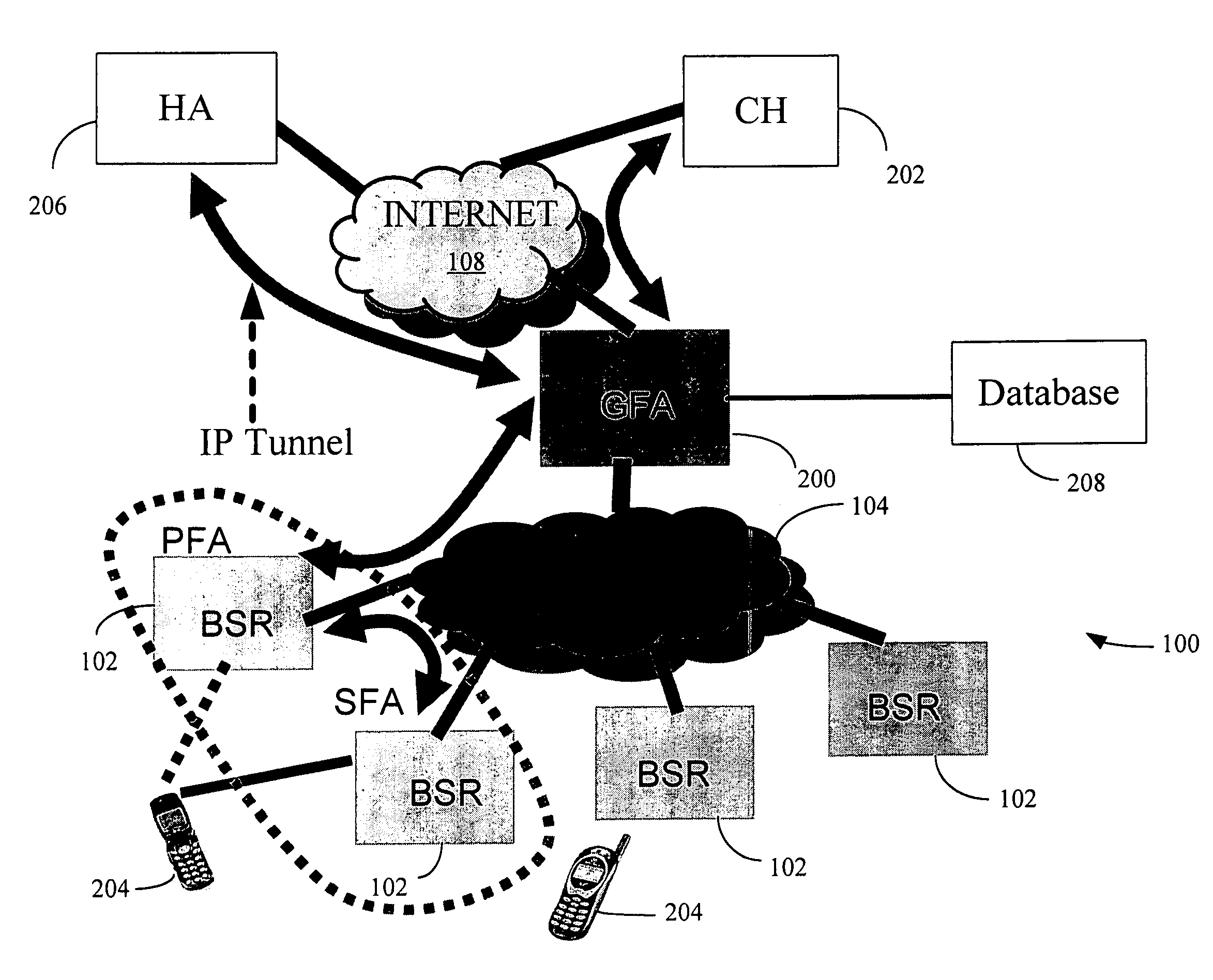
[0030]Illustrative embodiments of the invention are described below. In the interest of clarity, not all features of an actual implementation are described in this specification. It will of course be appreciated that in the development of any such actual embodiment, numerous implementation-specific decisions may be made to achieve the developers' specific goals, such as compliance with system-related and business-related constraints, which may vary from one implementation to another. Moreover, it will be appreciated that such a development effort might be complex and time-consuming, but may nevertheless be a routine undertaking for those of ordinary skill in the art having the benefit of this disclosure.

[0031]There are several aspects of the instant invention, each of which tends to arise from the notion of a Base Station Router (BSR). The BSR moves away from a traditional centralized and hierarchical cellular architecture to a migratable distributed cellular architecture, as is dis...

the structure of the environmentally friendly knitted fabric provided by the present invention; figure 2 Flow chart of the yarn wrapping machine for environmentally friendly knitted fabrics and storage devices; image 3 Is the parameter map of the yarn covering machine
Login to View More

PUM

No PUM Login to View More

Abstract

In one aspect of the present invention, a method for controlling a communications session with a mobile device is provided. The method comprises selecting a plurality of base stations, where at least a portion of the base stations are adapted to operate as a secondary agent, and wherein the secondary agent is capable of communicating with a mobile device. Substantially similar data is then delivered to a plurality of the secondary agents, and a first one of the secondary agents is selected as a first serving secondary agent to communicate with the mobile device. The first serving secondary agent transfers the data to the mobile device during the communications session.

Description

BACKGROUND OF THE INVENTION[0001]1. Field of the Invention[0002]This invention relates generally to telecommunications, and more particularly, to wireless communications.[0003]2. Description of the Related Art[0004]The wireless industry and the Internet are converging. In wireless cellular technology, this convergence is embodied in Time Division Multiple Access (TDMA) based technology, particular beginning with second-generation systems, such as the European Telecommunications Standards Institute (ETSI) General Packet Radio Service (GPRS). Alternatively, in Code Division Multiple Access (CDMA) based systems, this convergence is achieved via new standards, such as 3rd Generation Partnership Project's (3GPP's) Universal Mobile Telecommunications System (UMTS) standard or via the evolution of existing Second Generation (2G) CDMA standards, such as IS95 in the form of CDMA 2000. These systems are intended to convey data as well as legacy voice traffic. Looking to the future, new commun...

Claims

the structure of the environmentally friendly knitted fabric provided by the present invention; figure 2 Flow chart of the yarn wrapping machine for environmentally friendly knitted fabrics and storage devices; image 3 Is the parameter map of the yarn covering machine
Login to View More

Application Information

Patent Timeline
no application Login to View More
Patent Type & Authority Patents(United States)
IPC IPC(8): H04B7/00
CPCH04B7/022
Inventor DAS, SUMANKLEIN, THIERRY E.LEUNG, KIN K.MUKHERJEE, SAYANDEVRITTENHOUSE, GEORGE E.SAMUEL, LOUIS GWYNVISWANATHAN, HARISHZHENG, HAITAO
Owner ALCATEL-LUCENT USA INC