Method for the acquisition of data relating to multi-dimensional NMR spectra by means of frequency-dependent convolution
a multi-dimensional nmr and spectra technology, applied in the field of frequency-dependent convolution acquisition of data relating to multi-dimensional nmr spectra, can solve the problems of relatively large sample amounts or high substance concentrations, difficult interpretation of multi-dimensional nmr spectra, and large sample amounts, so as to improve the evaluability of the resulting multi-dimensional nmr spectra, reduce the overall measuring time of an nmr experiment, and improve the resolution of the nmr spectrum
- Summary
- Abstract
- Description
- Claims
- Application Information
AI Technical Summary
Benefits of technology
Problems solved by technology
Method used
Image

Examples
Embodiment Construction
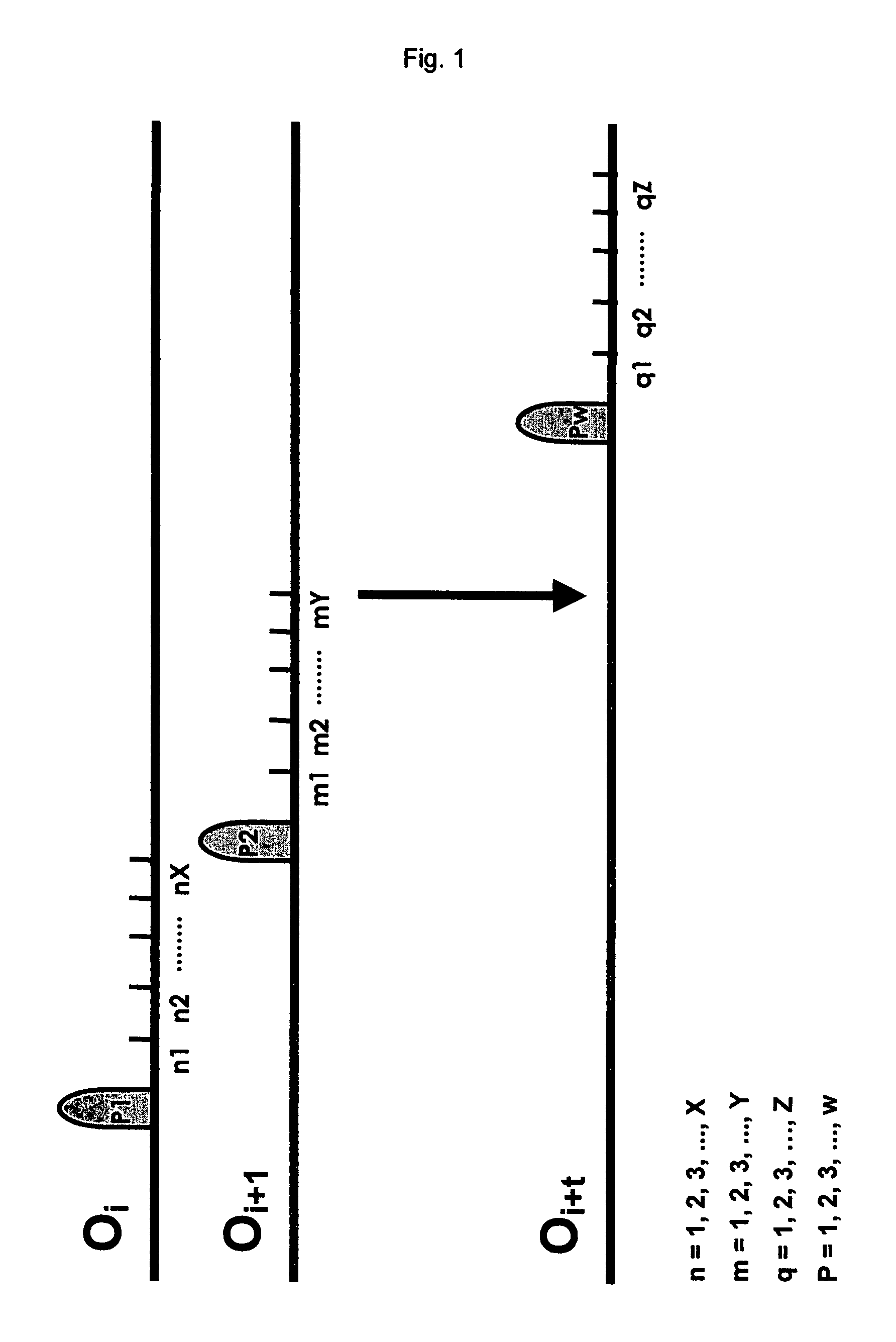
[0041]FIG. 1 schematically shows an embodiment of the SHARC sequence with a series of selective pulses P1, P2, . . . to Pw which are separated by a determined number of incrementable waiting times (delays)={n1, n2, . . . nX}, {m1, m2, . . . , mY}, . . . , {q1, q2, . . . , qZ}. The number {X, Y and Z} of the incrementable waiting times (delays) and the number of selective pulses W to be applied (and thereby the frequency ranges Oi, Oi+1 etc.) may be arbitrarily selected. The range of numbers that can be stated for W depends on the real length of a selective pulse chosen by the user. The real length of a selective pulse, in turn, depends on the desired excitation bandwidth. The shorter the length of a selective pulse, the larger the number of selective pulses that can be introduced into the sequence. The T1 / T2 relaxation mechanism is thereby the limiting factor. A preferred range W is 1 to 20.
[0042]The T1 / T2 relaxation delays (waiting time between individual scans, also called repetit...
PUM
 Login to View More
 Abstract
Description
Claims
Application Information
 Login to View More