Unlock instant, AI-driven research and patent intelligence for your innovation.

Technique for license management and online software license enforcement

a license management and license enforcement technology, applied in the field of license management system and a technique for enforcing the use of software products, can solve the problems of reducing the achievable revenue, affecting the legal status of software suppliers, and reducing the possibility of malicious subjects being prosecuted, so as to simplify the process of cracking softwar

Inactive Publication Date: 2011-02-15
STARBOARD VALUE INTERMEDIATE FUND LP AS COLLATERAL AGENT
View PDF18 Cites 20 Cited by
  • Summary
  • Abstract
  • Description
  • Claims
  • Application Information

AI Technical Summary

Benefits of technology

[0026]The proposed method of a provision of licenses and an individualization of the licensed software products on delivery and a further monitoring of the execution of the software products subject to a license provided, all in one system allows for one an effective control of distribution lines and beyond this ties the use of a software product to the conditions agreed to in an underlying license contract. Furthermore, it provides a high level of protection against attackers with the specific intent to circumvent the license terms by inhibiting impersonation and replay attacks and any tampering with the program code. Because licenses are provided on an individual basis, the system is able to support a variety of different licensing and distribution schemes.
[0029]Modifying files of a software product preferably comprises embedding information in at least one of said files, since the embedded information is easy to locate and identify by the party that performed the embedding. The modifying is advantageously at least partly based on information extracted from at least a part of data of one or more objects files generated during the creation process of the software product, thereby allowing easy modification of files without any knowledge of the source code. In addition to that, the modifying is preferably at least partly based on information extracted from at least a part of the debug information, for debug information is comparatively uncomplicated to process and the capability of development tools to consolidate information from earlier stages of the creation process is taken advantage of. The information must not be distributed in order not to facilitate the task of an attacker, as is the case with any other data used from the final stage of the creation process. The modifying is further advantageously at least partly based on information extracted from at least, a part of the relocation information, since relocation information is in many cases by default automatically generated by the development tools. Modifying one or more executable files of the software product advantageously eliminates the need for files from a previous stage of the compilation process and creates the potential for high performance. The modifying comprising a modification of the arrangement of the subroutines and / or variables within the software product provides an advantageous means for obfuscating the inner workings of the software program. Inserting data and / or code between any two subroutines and / or any two variables within the software product raises the level of security against pirating adversaries in an advantageous implementation. Inserting data and / or code into the code of one or more subroutines within the software product advantageously makes it difficult for an attacker to separate the inserted information from the original code. Advantageously, data and / or code is inserted into the software product for testing the integrity of at least a part of the software product, to make tampering more difficult. In another advantageous implementation, the modifying comprises embedding at least a part of a piece of verification software, to relieve the developer of the software product from the burden of manually and cleverly adding verification code.
[0034]A request ticket is preferably supplied with a query to obtain a permission to run. Also preferably, a runtime ticket received from the execution control software program constitutes that permission to run. Advantageously, a log-off ticket is received from the execution control software program, and further advantageously the log-off ticket is returned to the execution control software program at the process of terminating the execution of the individual download copy. At least a part of a piece of verification code is advantageously embedded in one or more subroutines to verify the validity of at least one type of ticket for hampering any tricking of the ticket mechanism. Each time a subroutine of the individual download copy is invoked, a piece of code embedded therein advantageously increments a counter particular to the invoked subroutine, whereby further advantageously, the reading of each of the counters is submitted to the execution control software program at the process of terminating the execution of the individual download copy, so that the individual usage of each individual download copy can be examined. At least part of a piece of meta-verification code is preferably embedded in subroutines to verify the integrity of a least a part of the individual download copy. A provision of means for an execution of code supplied by the execution control software program advantageously enables the download copy to perform special tasks requested by the execution control software program, whereby further advantageously, a provision of means for returning a result of the execution of this code to the execution control software program enables the execution control software program to evaluate the result of the code execution.
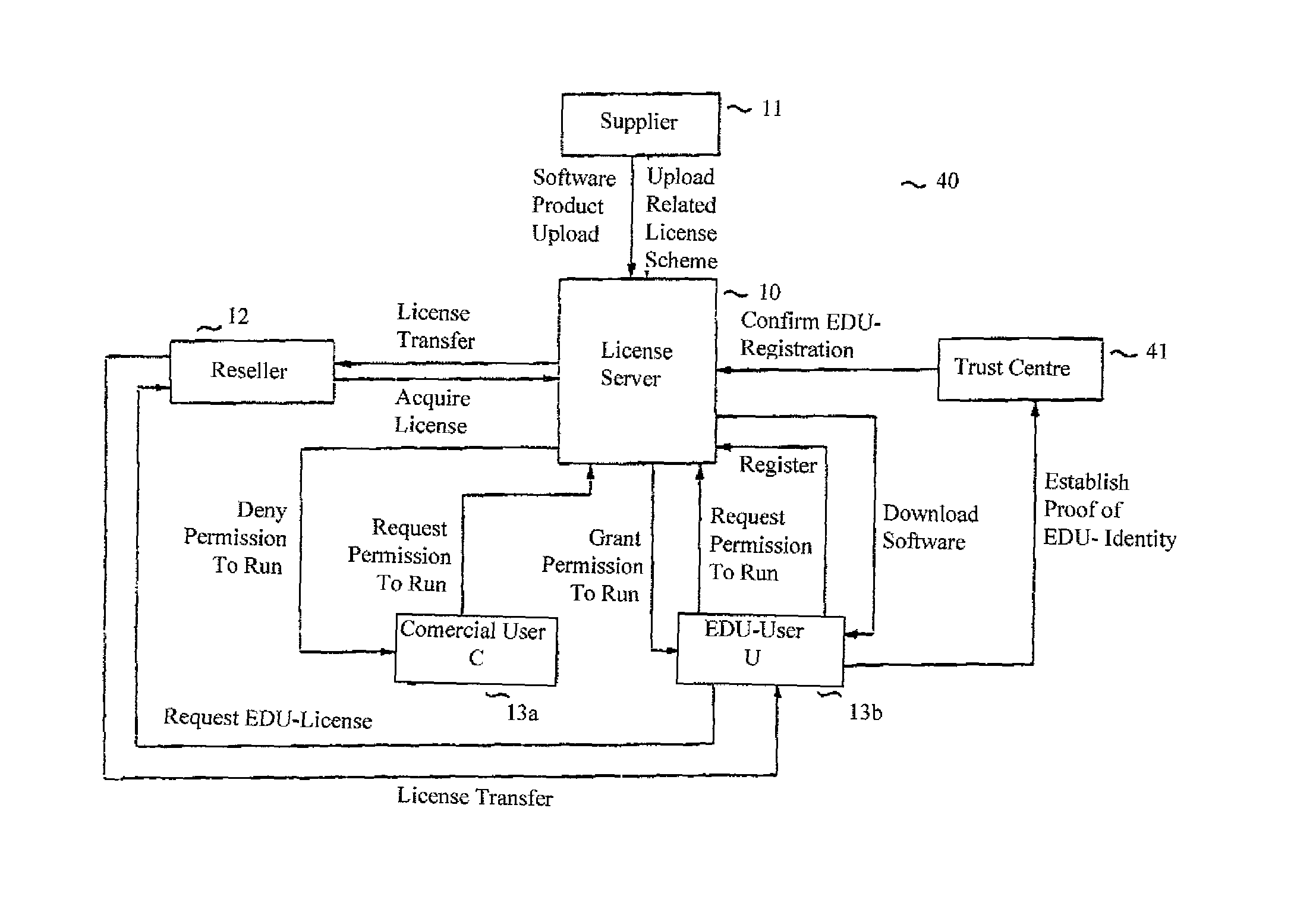
[0036]The software license management and online software license enforcement system according to the present invention can further be implemented in a business model for providing license services to the software industry, e.g. software suppliers and software merchants. According to this business model, the services offered to a software supplier include an upload of the respective software products in addition to an upload of corresponding licenses onto the license server, and the automatic enforcement of the license regulations by the license server. Alternatively, the licenses may be generated on the server. A software supplier may hereby structure the license provision to his own convenience and by this define a distribution scheme according to his own choice. Distributors and dealers are provided by this model with a lean administration system, reducing software distribution to a virtual trading of licenses and rendering a real shipment of software on data carrier superfluous. To an end-user of a piece of software the business model provides the service of an automatic license enforcements which guarantees him juridical security by excluding any misuse of an acquired piece of software. Furthermore, license terms can easily and at any time be adapted to altered requirements on a user's side. To protect the identity of an end-user and for separating his real identity from the utilization log of the software he employs, an independent trust center is provided in this business model, which handles the validation of the roles each subject acquires in the system.

Problems solved by technology

One of the most significant problems in software distribution is the protection of the rights of software producers and other subjects involved in software distribution.
This price range very often forms an incentive for fraud.
Another annoyance for software suppliers is software pirating and the distribution of bootlegs, which considerably reduces the achievable revenue.
Software pirates prefer to act in countries where it is very difficult for a software supplier to get legal support in prosecuting malicious subjects.
Therefore, a software supplier will in many cases be unable to enforce his license terms.
A known approach for solving this problem is the integration of mechanisms in a software product, which makes it difficult for malicious subjects to create a bootleg of that software product.
A common way of realizing a protection mechanism against software, pirating is to apply a mark to the software distribution medium like e.g. floppy discs or CD-ROMs such, that it will be very difficult for a malicious subject to reproduce the mark on an illicit copy.
Both types of attacks, copying marks or generating key files on one side and “cracking” on the other side are in wide-spread use and cannot be fully defended against.
A software producer can only try to discourage any attempt of “cracking” his software by making the process of reverse engineering and other forms of attack as difficult as possible by obfuscating the inner workings of his software.
But still, an attack of an adversary cannot be fully defended against.
In case, a license cannot be issued to a copy of an application program, this copy cannot be executed.
Although those systems check certain parameters like e.g. “Is there a license?”, “Are all licenses used up?” or “Is there an attempt to use the program beyond the expiration date of the license?”, a correct usage of the software program according to a contractual provision—part from the requirement that a license must exist at the site of the end-user cannot be guaranteed.
Further, no provisions are suggested for warding off common impersonation attacks, where a malicious user sets up a fake license management unit unconditionally granting the execution of the application program, or replay attacks, where messages sent by the license management unit are recorded and later replayed for allowing an application program to execute without actually having to contact the license management unit.
However, since most programmers are not security experts and hence not aware of how an attacker works, they do so in a way that greatly simplifies “cracking” their software.

Method used

the structure of the environmentally friendly knitted fabric provided by the present invention; figure 2 Flow chart of the yarn wrapping machine for environmentally friendly knitted fabrics and storage devices; image 3 Is the parameter map of the yarn covering machine
View more

Image

Smart Image Click on the blue labels to locate them in the text.
Viewing Examples
Smart Image
  • Technique for license management and online software license enforcement
  • Technique for license management and online software license enforcement
  • Technique for license management and online software license enforcement

Examples

Experimental program
Comparison scheme
Effect test

Embodiment Construction

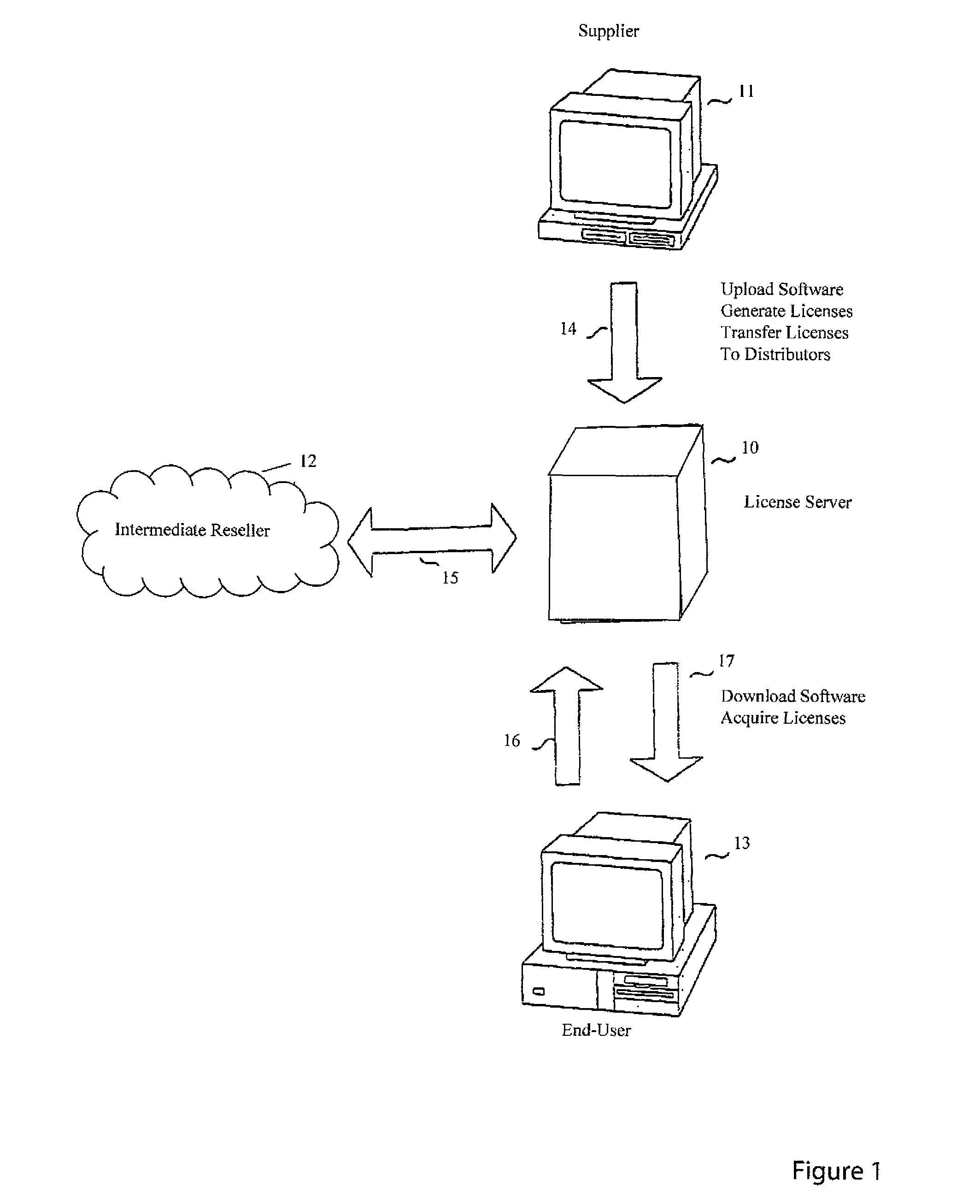
[0050]FIG. 1 illustrates the functions and services supplied by a license, server 10 according to the present invention to the subjects taking part in the distribution or use of a software product. The service offered to software suppliers 11 includes an upload or generation of licenses, a transfer of licenses to resellers 12 or end-users 13, and an upload of the software product to be traded with the method according to the present invention. A reseller 12 does not have to sell the software in its material form but acquires and transfers licenses to other resellers 12 or end-users 13, while the end-user 13 downloads the software himself as soon as he has acquired a license. It is to be noted that the scheme of FIG. 1 does not represent a detailed description of the processes involved, but defines the main groups of subjects, and the basic functionality provided by the license server for these groups of subjects.

[0051]Prior to being granted access to the services of the license serv...

the structure of the environmentally friendly knitted fabric provided by the present invention; figure 2 Flow chart of the yarn wrapping machine for environmentally friendly knitted fabrics and storage devices; image 3 Is the parameter map of the yarn covering machine
Login to View More

PUM

No PUM Login to View More

Abstract

A software protection is presented comprising software license management and online software license enforcement, wherein individual licenses are provided for regulating the use of a software product, and the software product is individualized while being downloaded from a license server, and the execution of each individualized software product is monitored in agreement with the individual license terms corresponding to the individual software download.

Description

RELATED APPLICATION[0001]This application is a divisional of U.S. Ser. No. 09 / 921,785, filed Aug. 3, 2001, which claims the benefit of priority from European (EPO) Application Serial No. 01107039.8, filed Mar. 21, 2001, the entire contents of which are incorporated herein by reference.BACKGROUND OF THE INVENTION[0002]The present invention relates to techniques for preventing fraudulent use of software products. In particular, the present invention provides a license management system and a technique for enforcing the use of a software product according to the corresponding license terms.[0003]One of the most significant problems in software distribution is the protection of the rights of software producers and other subjects involved in software distribution. The subject holding the rights on a software product is very often distinct from the actual producer of it. Therefore, the subject owning the rights on a software product will be referred to as software supplier in the context ...

Claims

the structure of the environmentally friendly knitted fabric provided by the present invention; figure 2 Flow chart of the yarn wrapping machine for environmentally friendly knitted fabrics and storage devices; image 3 Is the parameter map of the yarn covering machine
Login to View More

Application Information

Patent Timeline
no application Login to View More
Patent Type & Authority Patents(United States)
IPC IPC(8): G06Q20/00G06F21/12
CPCG06F21/125
Inventor LOPATIC, THOMAS
Owner STARBOARD VALUE INTERMEDIATE FUND LP AS COLLATERAL AGENT
Features
  • R&D
  • Intellectual Property
  • Life Sciences
  • Materials
  • Tech Scout
Why Patsnap Eureka
  • Unparalleled Data Quality
  • Higher Quality Content
  • 60% Fewer Hallucinations
Social media
Patsnap Eureka Blog
Learn More