Unlock instant, AI-driven research and patent intelligence for your innovation.

Hierarchical alignment of character sequences representing text of same source

Inactive Publication Date: 2012-05-01
GOOGLE LLC
View PDF14 Cites 9 Cited by
  • Summary
  • Abstract
  • Description
  • Claims
  • Application Information

AI Technical Summary

Benefits of technology

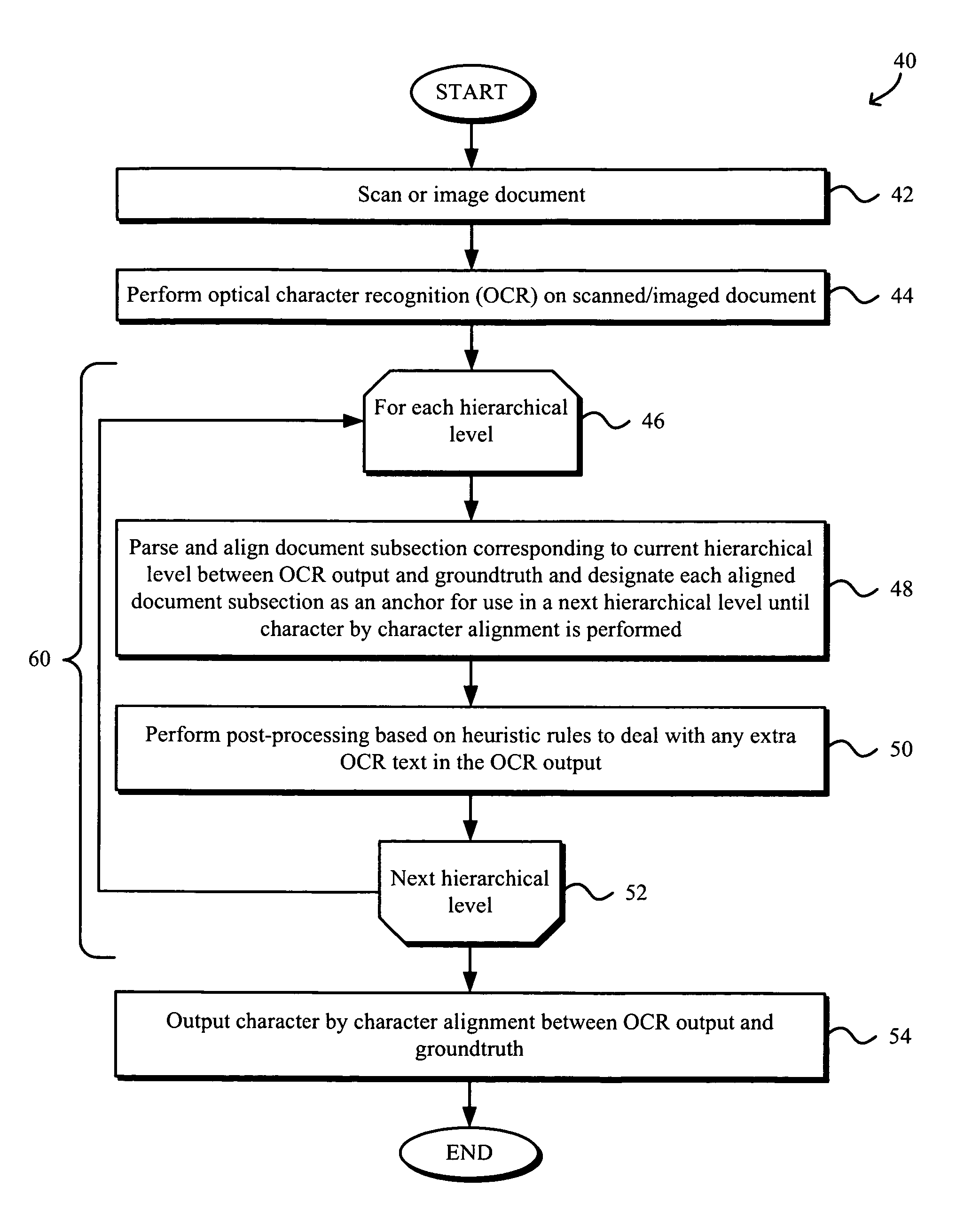
[0008]Hierarchical alignment as described herein may advantageously and successfully generate an alignment even where the two character sequences are long and / or when the one or both of the characters sequences include many errors. As an example, the two character sequences may be an OCR output from a scanned document such as a book and an electronic text version (groundtruth) corresponding to the book. A typical book may have, e.g., more than 1 million characters, and / or there may be many errors in one or both of the character sequences. Hierarchical alignment can achieve alignment even when large portions of text are missing from one or both of the characters sequences. Such a scenario may occur, for example, where the two character sequences, although representing text from the same source, may be generated from or based on different editions of the same source such that one edition of the source may have a preface, introduction, and / or chapter missing as compared to the other edition of the same source. Such a scenario may also occur, for example, where one of the character sequences is generated by scanning the source and one or several consecutive pages are missing and / or duplicated due to errors in the scanning process. As noted, hierarchical alignment can also achieve alignment even when one or both of the characters sequences include many errors, such as a result of OCR errors.
[0012]In another embodiment, the character subsequences corresponding to the first hierarchical level may be unique words where the parsing may include locating words that occur only once in the first character sequence (e.g., groundtruth) as unique words and locating words in the second character sequence (e.g., OCR output) that correspond to the unique words. Note that words (if any) in the second character sequence corresponding to each unique word may not exist, may be unique, or may not be unique. In the first hierarchical level, the unique words in the first character sequence are aligned with words in the second character sequence corresponding to the unique words. Using unique words for the first hierarchical level in the hierarchical alignment, the hierarchical alignment may successfully generate an alignment even when there are no aligned, e.g., exactly matching, sentences in as many as, e.g., 80 pages.

Problems solved by technology

A typical book may have, e.g., more than 1 million characters, and / or there may be many errors in one or both of the character sequences.
Such a scenario may also occur, for example, where one of the character sequences is generated by scanning the source and one or several consecutive pages are missing and / or duplicated due to errors in the scanning process.

Method used

the structure of the environmentally friendly knitted fabric provided by the present invention; figure 2 Flow chart of the yarn wrapping machine for environmentally friendly knitted fabrics and storage devices; image 3 Is the parameter map of the yarn covering machine
View more

Image

Smart Image Click on the blue labels to locate them in the text.
Viewing Examples
Smart Image
  • Hierarchical alignment of character sequences representing text of same source
  • Hierarchical alignment of character sequences representing text of same source
  • Hierarchical alignment of character sequences representing text of same source

Examples

Experimental program
Comparison scheme
Effect test

Embodiment Construction

[0021]Systems and methods for character-by-character alignment of two character sequences (such as OCR output from a scanned document and an electronic version of the same document) using a Hidden Markov Model (HMM) in a hierarchical fashion are disclosed. The alignment may be used to, for example, facilitate evaluation of OCR engines and / or facilitate evaluation of the effects of preprocessing algorithms performed on the scanned document on the accuracy of the OCR output. The following description is presented to enable any person skilled in the art to make and use the invention. Descriptions of specific embodiments and applications are provided only as examples and various modifications will be readily apparent to those skilled in the art. The general principles defined herein may be applied to other embodiments and applications without departing from the spirit and scope of the invention. Thus, the present invention is to be accorded the widest scope encompassing numerous alterna...

the structure of the environmentally friendly knitted fabric provided by the present invention; figure 2 Flow chart of the yarn wrapping machine for environmentally friendly knitted fabrics and storage devices; image 3 Is the parameter map of the yarn covering machine
Login to View More

PUM

No PUM Login to View More

Abstract

Systems and methods for character-by-character alignment of two character sequences (such as OCR output from a scanned document and an electronic version of the same document) using a Hidden Markov Model (HMM) in a hierarchical fashion are disclosed. The method may include aligning two character sequences utilizing multiple hierarchical levels. For each hierarchical level above a final hierarchical level, the aligning may include parsing character subsequences from the two character sequences, performing an alignment of the character subsequences, and designating aligned character subsequences as the anchors, the parsing and performing the alignment being between the anchors generated from an immediately previous hierarchical level if the current hierarchical level is below the first hierarchical level. For the final hierarchical level, the aligning includes performing a character-by-character alignment of characters between anchors generated from the immediately previous hierarchical level. At each hierarchical level, an HMM may be constructed and Viterbi algorithm may be employed to solve for the alignment.

Description

BACKGROUND OF THE INVENTION[0001]1. Field of the Invention[0002]The present invention relates generally to alignment of two text sequences, e.g., of a optical character recognition (OCR) output with an electronic version of the same document. More specifically, systems and methods for character-by-character alignment of two character sequences (such as OCR output from a scanned document and an electronic version of the same document) using a Hidden Markov Model (HMM) in a hierarchical fashion are disclosed.[0003]2. Description of Related Art[0004]Scanning books, magazines, and other printed material into digital form has become more common with the advent of improved imaging, storage and distribution techniques. Many institutions, such as the libraries, universities, bookstores, and private enterprises have vast collections of documents. By converting these documents into electronic form, such institutions can reduce the cost of storage, facilitate remote access, enable simultaneous...

Claims

the structure of the environmentally friendly knitted fabric provided by the present invention; figure 2 Flow chart of the yarn wrapping machine for environmentally friendly knitted fabrics and storage devices; image 3 Is the parameter map of the yarn covering machine
Login to View More

Application Information

Patent Timeline
no application Login to View More
IPC IPC(8): G06K9/00
CPCG06F17/2211G06F40/194
Inventor FENG, SHAOLEIMANMATHA, RAGHAVAN
Owner GOOGLE LLC