
Rotor for motor
a technology for rotating wheels and motors, applied in the direction of manufacturing stator/rotor bodies, magnetic circuit rotating parts, magnetic circuit shape/form/construction, etc., can solve the problems of disengagement or undesired rotation of magnets, affecting the stability of magnets, and affecting the engagement stability. , to achieve the effect of improving the stability of engaging
- Summary
- Abstract
- Description
- Claims
- Application Information
AI Technical Summary
Benefits of technology
Problems solved by technology
Method used
Image

Examples
first embodiment
[0036]With reference to FIGS. 6 and 7, a rotor 1 for a motor of a first embodiment according to the present invention includes a shaft 11, a coupling member 12, and a plastic magnet 13. The shaft 11 and the coupling member 12 are tightly engaged with each other. The plastic magnet 13 integrally envelops the shaft 11 and the coupling member 12. The coupling member 12 prevents the plastic magnet 13 from disengaging from the shaft 11.
[0037]The shaft 11 can be a rod made of stainless steel. The shaft 11 includes an outer periphery having an engaging portion 111. The engaging portion 111 has an outer diameter D1 perpendicular to an axial direction of the shaft 11.
[0038]The coupling member 12 can be a metal ring that is less hard than the shaft 11. As an example, the coupling member 12 can be an annular member made of copper such that the shaft 11 is less likely to be damaged by the coupling member 12 when the coupling member 12 is engaged with the shaft 11 by tight coupling. Furthermore,...
second embodiment
[0042]By the above technical feature, the coupling member 22 of the rotor 2 of the second embodiment has non-circular cross sections due to provision of the positioning portion 222. Thus, the plastic magnet 23 engages with the positioning portion 222 when the plastic magnet 23 integrally envelops the coupling member 22 and the intermediate portion of the shaft 21. Thus, the coupling member 22 not only prevents the plastic magnet 23 from moving axially or disengaging from the shaft 21, but also prevents the plastic magnet 23 from rotating relatively to the shaft 21, providing further enhanced positioning effect in the axial direction.
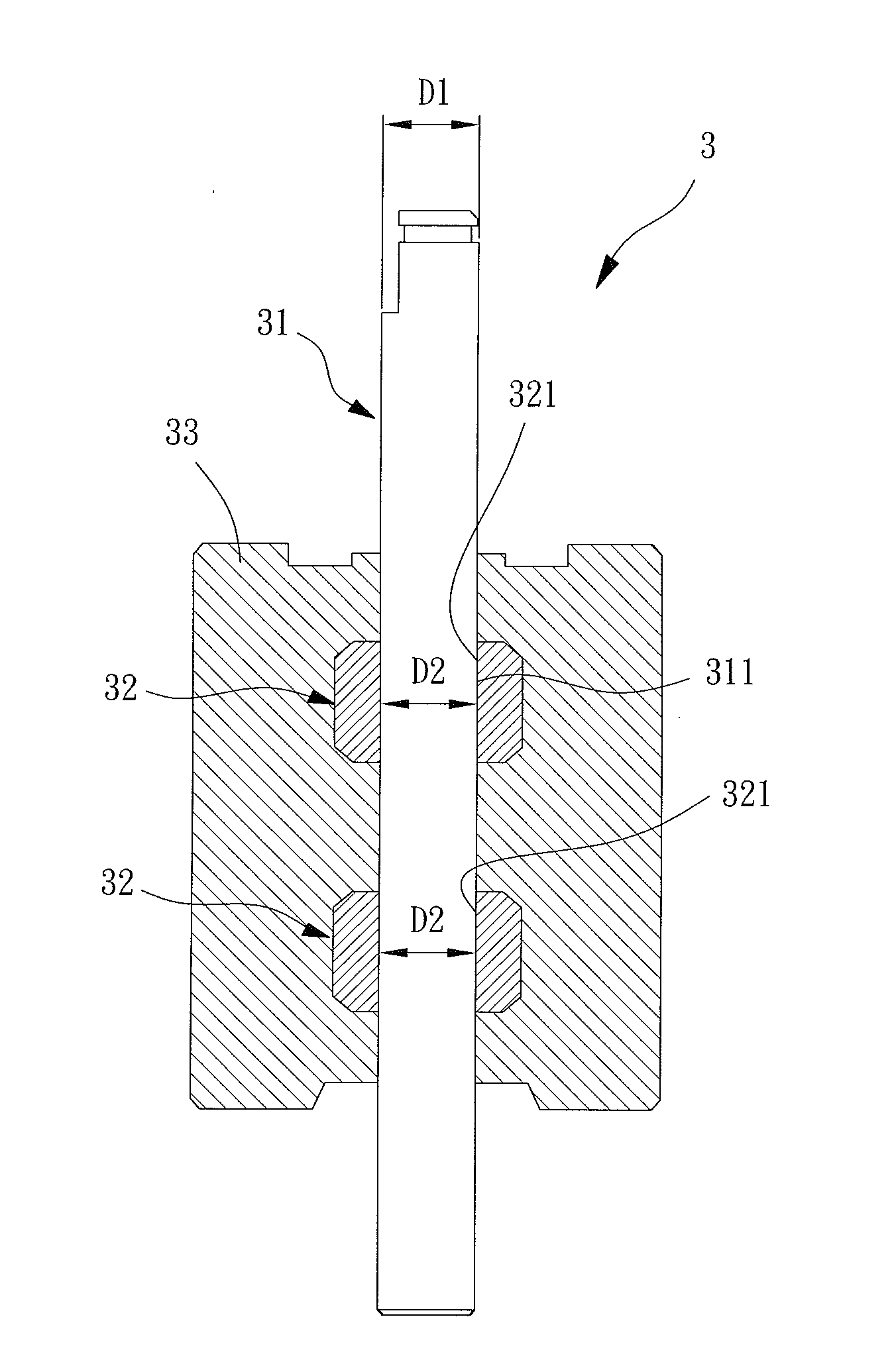
[0043]With reference to FIGS. 12 and 13, similar to the rotor 1 of the first embodiment, a rotor 3 for a motor of a third embodiment according to the present invention includes a shaft 31 with an engaging portion 311, a coupling member 32 with an engaging hole 321, and a plastic magnet 33. The difference between the rotor 3 of the third embodiment and th...
PUM
 Login to View More
 Abstract
Description
Claims
Application Information
 Login to View More