

Filter-based identification of malicious websites
a filter and website technology, applied in the field of computer security, can solve the problems of requiring significant computational resources and the inability to identify a comprehensive set of known malicious websites, and achieve the effect of reducing the number of malicious websites
- Summary
- Abstract
- Description
- Claims
- Application Information
AI Technical Summary
Benefits of technology
Problems solved by technology
Method used
Image

Examples
Embodiment Construction
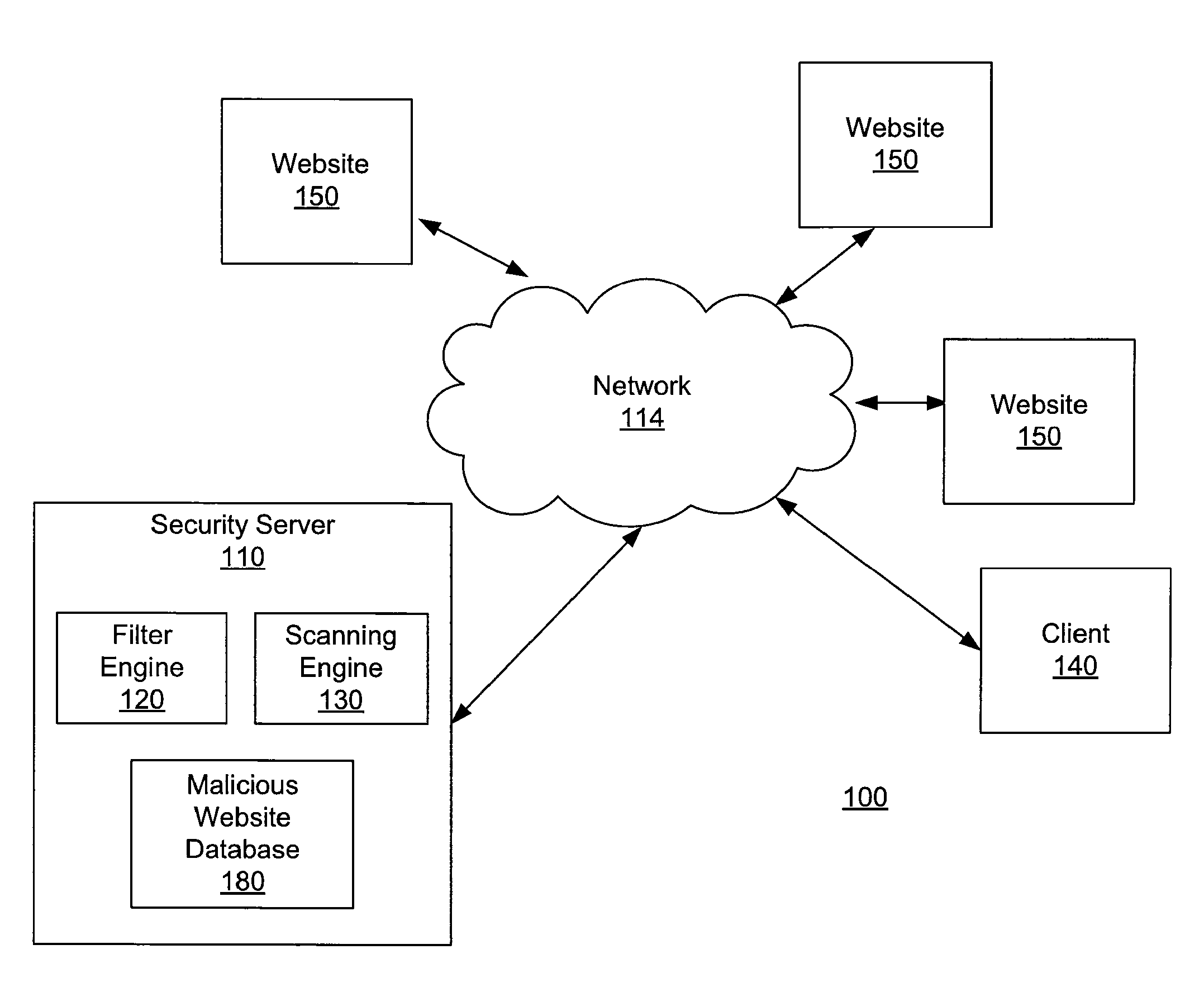
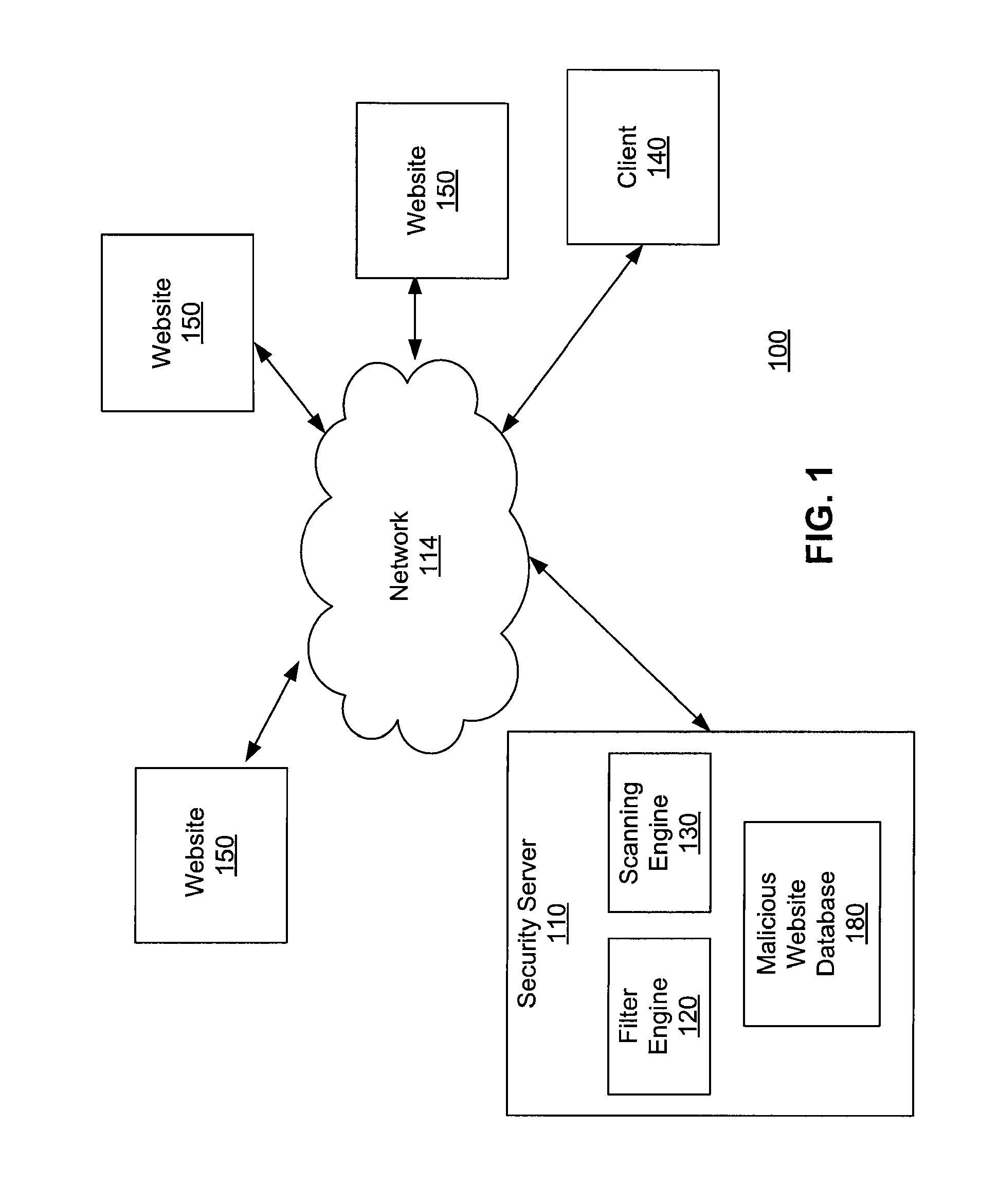
[0020]FIG. 1 is a high-level block diagram of a computing environment 100 according to one embodiment. FIG. 1 illustrates a security server 110, a client 140 and plurality of websites 150 connected by a network 114. Only three websites 150 and one client 140 are shown in FIG. 1 in order to simplify and clarify the description. Embodiments of the computing environment 100 can have thousands or millions of websites 150 and clients 140 connected to the network 114.
[0021]The security server 110 interacts with the websites 150 via the network 114. The security server 110 includes a filter engine 120 which accesses the websites 150 through the network 114 in order to identify candidate suspicious websites based on a set of defined heuristics. The filter engine 120 further identifies information associated with the candidate suspicious websites including hypertext transfer protocol (HTTP) traffic information.
[0022]The filter engine 120 applies a filter classifier to lightweight features ex...
PUM
 Login to View More
 Abstract
Description
Claims
Application Information
 Login to View More